
 NZ
 UK
 US
 AU
 IND

 CA

 Share
 X (Formerly Twitter)
 Whatsapp
 Facebook
 LinkedIn
 Telegram
 Email This Article
 Copy Link
 Summarize with AI
 Chat GPT
 Perplexity

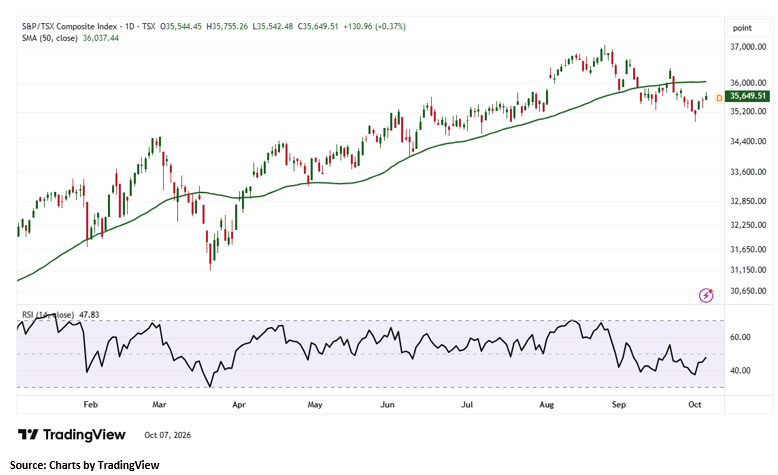
The S&P/TSX Composite index is expected to open on a positive note, supported by strength across the utilities and technology sectors. However, the index remains firmly below its 50-day Simple Moving Average (SMA), which continues to act as a key dynamic resistance level and signals persistent technical weakness. Immediate support is positioned near 35,400, a crucial level for maintaining the current technical structure. Sustained trading above this support could help stabilize market sentiment and preserve the broader technical outlook. A successful rebound from 35,400 could attract renewed buying interest and support a recovery toward the recent high near 35,900. Conversely, a decisive break below this level could weaken the technical setup and increase near-term downside risk.
Global Macro Backdrop
Global markets remain focused on the direction of Monetary Policy following the Federal Reserve’s latest rate decision. Investors are assessing whether the recent policy shift can evolve into a broader easing cycle, while Inflation and labour-market conditions remain important constraints on the pace of future rate adjustments.
The U.S. Treasury market remains central to the cross-asset outlook. Movements in longer-term yields can influence Equity valuations, particularly for technology and other growth-oriented companies, while also affecting gold, real estate and utilities.
The U.S. dollar remains another important market variable. A stronger greenback can put pressure on dollar-denominated commodities, whereas a softer dollar can provide a more supportive environment for gold and industrial metals. Changes in the USD/CAD relationship are also important for Canadian exporters and resource companies.
Global growth expectations remain mixed. Investors continue to monitor U.S. economic resilience, European activity and China's industrial demand. China's growth trajectory remains particularly important for copper, nickel and other base metals, while the U.S. economy remains a key source of external Demand for Canadian goods and commodities.
In Canada, the Bank of Canada continues to balance inflation risks against economic-growth conditions. Expectations for future BoC policy remain sensitive to domestic data, while movements in U.S. rates can influence Canadian financial conditions and the Canadian dollar.
Canadian Market Focus
The TSX remains heavily influenced by commodities and financials, leaving the benchmark particularly sensitive to changes in global growth and interest-rate expectations.
Energy stocks remain closely tied to crude-oil prices and global demand expectations. Materials companies continue to track gold, silver and industrial metals, with precious-metals equities especially sensitive to real yields and the U.S. dollar.
Canadian financials remain an important indicator of domestic economic sentiment. Investors continue to monitor Loan growth, Credit quality, household finances and corporate borrowing conditions as the interest-rate cycle evolves.
The Canadian dollar remains another important transmission mechanism. A weaker CAD can boost the Canadian-dollar value of U.S.-dollar revenues for Commodity exporters, while a stronger currency can reduce the translation benefit.
Commodity view — what will move the TSX
- Crude: Crude oil climbed toward $90 per barrel on Wednesday, recovering from five-week lows as persistent risks to Middle East energy flows overshadowed signs of rising Supply from the region.
- Gold: Gold fell below $4,150 an ounce on Wednesday, giving back gains from the previous session as oil prices rebounded on persistent risks to Middle East supply, keeping inflationary risks and rate hike concerns in focus.
- Silver: Silver dropped below $61 an ounce on Wednesday, reversing gains from the previous session as oil prices rebounded on persistent risks to Middle East supply, keeping inflationary risks and rate hike concerns in focus.
- Copper: Copper futures rose toward $6.6 per pound, hovering near one-week highs amid a rally in risk assets, highlighted by gains in technology and artificial intelligence stocks.
Forex Watch
The Canadian dollar remains caught between commodity support and interest-rate differentials with the United States.
A stronger U.S. dollar and higher Treasury yields could weigh on CAD, while firm oil and metals prices could provide an offset. Expectations for Bank of Canada policy remain another important factor.
For TSX investors, currency movements will have different implications across sectors. Resource exporters with U.S.-dollar revenues may benefit from a weaker CAD, while companies with significant foreign-currency expenses may face a different Earnings impact.
Key Market Drivers Today
- Federal Reserve outlook: Markets continue to assess the implications of the Fed's latest policy decision and the potential path of future rate adjustments.
- Bank of Canada expectations: Domestic inflation, employment and growth data remain important for the Canadian rate outlook.
- Bond yields: U.S. and Canadian government yields remain critical for equity valuations and rate-sensitive sectors.
- Canadian dollar: CAD movements could influence resource exporters and companies with international operations.
- Global Risk sentiments: U.S., European and Asian equity markets could influence the opening tone in Toronto.
- Fourth Quarter-opening flows: The first Trading session of the fourth quarter could see portfolio repositioning and renewed sector allocation following the close of September.

Market Outlook
The TSX heads into Wednesday's session with the interaction between commodities, monetary policy and global growth continuing to shape the Investment landscape. Energy and materials remain the benchmark's most direct exposure to commodity markets, while financials remain closely tied to Canadian economic and interest-rate expectations.
The direction of bond yields and the U.S. dollar remains particularly important for technology, real estate, utilities and precious metals. Meanwhile, CAD movements could amplify or offset commodity-driven moves for Canadian resource companies.
As the fourth quarter progresses, investors are likely to focus increasingly on whether the evolving monetary-policy cycle can support economic activity without reigniting inflation pressures. For the TSX, Federal Reserve and Bank of Canada expectations, crude oil, gold, copper, bond yields, CAD and global risk appetite remain the key variables to watch as Wednesday's trading session gets underway.


 Nov 24, 2026





 Please wait processing your request...