
 NZ
 UK
 US
 AU
 IND

 CA

 Share
 X (Formerly Twitter)
 Whatsapp
 Facebook
 LinkedIn
 Telegram
 Email This Article
 Copy Link
 Summarize with AI
 Chat GPT
 Perplexity

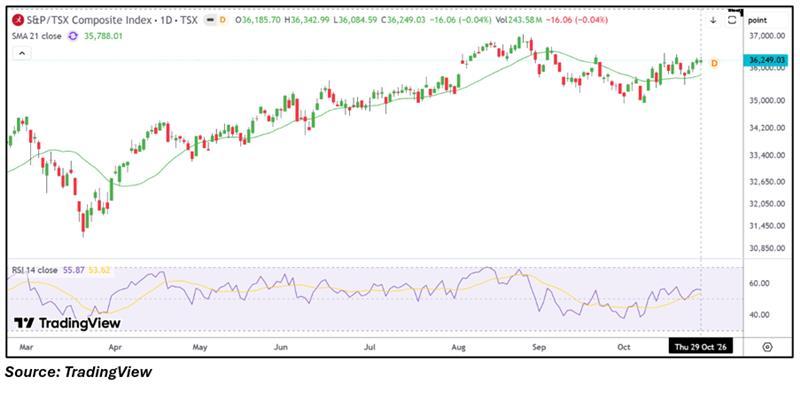
The US markets are trading in negative territory, while Crude Oil prices continue to surge amid escalating geopolitical tensions in the Middle East. Rising oil prices and concerns over potential Supply disruptions are weighing on broader market sentiment. Against this backdrop, the S&P/TSX Composite index is expected to open mildly lower. The index edged down 0.04% on Thursday to close at 36,249.03, while remaining above its 21-day SMA of 35,788.01. The 14-day RSI stands at 55.87, indicating positive momentum. Support is positioned near 36,000, followed by 35,800, while further recovery could extend towards 36,700.
 Global Macro Backdrop
U.S. Monetary Policy and inflation: The Federal Reserve's policy outlook remains a major influence on global financial conditions. Investors are focused on whether Inflation is moderating sufficiently to create room for lower interest rates without undermining economic growth. Persistent price pressures could keep Treasury yields elevated and weigh on Equity valuations. Conversely, easing inflation alongside resilient consumer and Business activity would provide a more supportive backdrop for risk assets.
The latest available inflation and labour-market data, together with Federal Reserve commentary, should be assessed against market expectations. The direction of real yields and the U.S. dollar will be particularly relevant for precious metals and growth-oriented equities.
Bank of Canada and domestic economic conditions: Canada's inflation trajectory, labour-market performance, consumer spending and business Investment remain central to expectations for monetary policy. A cooling economy could strengthen the case for lower borrowing costs, while persistent inflation could limit the Bank of Canada's flexibility.
For the TSX, the implications are broad. Interest-rate expectations influence bank funding conditions, mortgage-sensitive businesses, real estate valuations and the relative appeal of dividend-paying stocks.
China and global manufacturing: China's economic performance remains an important driver of industrial Commodity demand. Manufacturing, infrastructure investment and construction activity can influence copper, nickel and other base metals. Any signs of improving industrial Demand would be supportive for Canadian Mining companies, while weaker activity or continued property-sector concerns could weigh on resource sentiment.
Global bond yields and risk appetite: Bond yields remain a critical Factor in equity valuations. Rising yields can pressure technology stocks and other long-duration assets, while utilities and real estate may face higher financing costs. Falling yields can support these sectors, although a decline driven by Recession concerns may be negative for cyclical companies.
Month-end positioning: The final trading day of the month can bring portfolio rebalancing, profit-taking and adjustments to sector exposures. These flows can influence individual stocks and index performance independently of changes in underlying fundamentals.
Canadian Market Focus
The TSX Composite enters the final session of October with the interaction between commodity-sector performance and domestic interest-rate expectations remaining central to the outlook.
Energy and materials companies provide significant exposure to global commodity prices. However, investors should look beyond movements in crude and metals to assess production volumes, operating costs, capital expenditure, balance-sheet strength and management guidance. A favourable commodity environment is most valuable when companies can convert stronger prices into sustainable free cash flow.
Canadian banks remain sensitive to the health of households and businesses. Loan growth, credit-loss provisions, deposit costs and net interest margins will be important indicators. A resilient employment market and stable consumer spending would support Credit quality, whereas rising delinquencies or weakening business activity could create pressure on earnings.
The Canadian dollar is another important consideration. A weaker loonie can increase the Canadian-dollar value of overseas Earnings for companies with substantial foreign operations, including certain resource producers. However, it can also raise the cost of imported goods and inputs. Relative U.S. and Canadian interest-rate expectations, oil prices and global risk sentiment will remain important currency drivers.
Corporate earnings season continues to provide company-specific catalysts. Investors are likely to focus on Revenue growth, operating margins, free cash flow, capital allocation and management's outlook for the coming quarters. Companies with strong balance sheets and predictable cash generation may attract greater interest if market Volatility increases.
Commodity view — what will move the TSX
- Crude: Crude oil prices climbed above $103 per barrel on Friday, hitting six-week highs amid concerns that the US could resume military strikes against Iran following reports that a senior commander had briefed President Donald Trump on potential military options.
- Gold: Gold prices declined below $4,000 per ounce on Friday, extending losses from the previous session as persistent inflation and resilient economic growth in the US reinforced expectations of a potential Federal Reserve rate hike later this year.
- Silver: Silver prices declined below $51 an ounce on Friday, sinking to the lowest since November 2025 as persistent inflation and resilient economic growth in the US reinforced expectations of a potential Federal Reserve rate hike later this year.
- Copper: Copper futures fell toward $6.5 per pound on Friday, sliding for the second straight session as disappointing earnings updates triggered another selloff in tech and AI stocks.
Forex Watch
USD/CAD: The Canadian dollar remains sensitive to relative U.S. and Canadian economic performance, central-bank expectations, crude oil prices and broader risk sentiment. A stronger loonie can reduce the translated value of foreign earnings for some Canadian exporters, while a weaker currency may support those earnings but increase imported-input costs.
U.S. dollar: Broad dollar strength can create headwinds for dollar-denominated commodities, although supply-demand fundamentals and geopolitical developments can override currency effects. A softer dollar may provide support for gold and selected industrial metals.
Government bond yields: U.S. Treasury and Canadian government yields remain important for the TSX's interest-sensitive sectors. Lower yields may improve the relative appeal of dividend-paying stocks and ease refinancing pressure. Higher yields can weigh on valuations and increase borrowing costs for utilities and real estate companies.
Month-end currency positioning: Investors should also watch for potential month-end portfolio adjustments, which can influence currency movements and the Canadian dollar independently of economic fundamentals.
Key signal: The combination of USD/CAD, crude oil and government bond yields will help indicate whether the environment is becoming more favourable for resource producers, financials or rate-sensitive equities.
Key Market Drivers Today
- Federal Reserve outlook: Any verified economic releases or policy commentary that could change expectations for U.S. interest rates.
- Canadian economic conditions: Inflation, employment, consumer spending and business activity affecting Bank of Canada expectations.
- Government bond yields: Changes in U.S. and Canadian yields, particularly for financials, technology, utilities and real estate.
- Crude oil: Supply developments, inventory trends and revisions to global demand expectations.
- Gold and silver: Real yields, U.S. dollar movements and safe-haven demand.
- Copper and other base metals: Chinese economic conditions, Manufacturing activity and supply-demand balances.
- USD/CAD: Currency movements affecting commodity sentiment and international corporate earnings.
- Corporate earnings: Results, Margin trends, forward guidance, Capital Expenditure and shareholder-return announcements.
- Month-end portfolio adjustments: Rebalancing and profit-taking that could influence individual stocks and sector performance.
- Global risk sentiment: Developments affecting confidence in economic growth and demand for cyclical versus defensive investments.
Market Outlook
The TSX Composite's near-term outlook will depend on whether commodity-sector support and resilient corporate earnings can offset uncertainty surrounding global growth and interest rates.
A constructive scenario would feature stable or easing bond yields, resilient economic activity and supportive oil and metal prices. Such conditions could benefit energy and materials shares while helping financials and rate-sensitive sectors maintain investor interest. Broad participation across the index would provide a stronger indication of improving sentiment than gains concentrated in a handful of large resource companies.
A less favourable scenario would involve rising yields, a stronger U.S. dollar and weaker industrial demand. This combination could pressure growth-oriented stocks, utilities, real estate and base-metal producers. Deteriorating Canadian credit conditions would create an additional challenge for financials.
As October closes, investors should also consider the possibility of month-end portfolio rebalancing and profit-taking. Such flows may generate short-term volatility that does not necessarily reflect a change in corporate fundamentals.
Bottom line: The TSX's direction on October 30 will be shaped by the interaction between commodity prices, global interest-rate expectations, currency movements and corporate earnings. Crude oil, gold, copper, USD/CAD, government bond yields and company guidance are the principal indicators to monitor. A disciplined focus on free cash flow, balance-sheet strength and earnings quality remains appropriate as investors position for the final Trading session of the month and the transition into November.


 Nov 20, 2026





 Please wait processing your request...