
 NZ
 UK
 US
 AU
 IND

 CA

 Share
 X (Formerly Twitter)
 Whatsapp
 Facebook
 LinkedIn
 Telegram
 Email This Article
 Copy Link
 Summarize with AI
 Chat GPT
 Perplexity

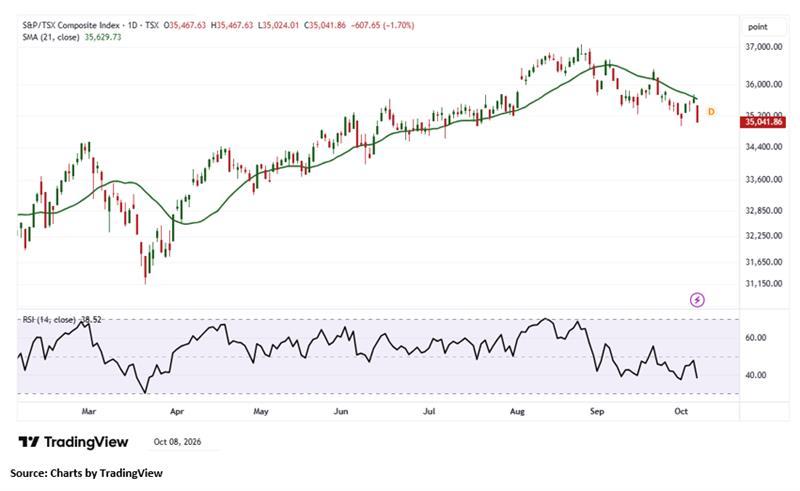
The S&P/TSX Composite index is expected to open on a negative note, weighed down by weakness across the basic materials and technology sectors. Moreover, the index remains below its 21-day Simple Moving Average (SMA), which continues to act as a key dynamic resistance level and signals persistent technical weakness. Immediate support is positioned near 34,700, a crucial level for maintaining the current technical structure. Sustained trading above this support could help stabilize market sentiment and preserve the broader technical outlook. A successful rebound from 34,700 could attract renewed buying interest and support a recovery toward the recent high near 35,300. Conversely, a decisive break below this level could weaken the technical setup and increase near-term downside risk.
Global Macro Backdrop
Global markets remain focused on the path of Monetary Policy as investors assess whether central banks have sufficient room to ease further without reigniting inflationary pressures. The Federal Reserve’s latest policy decision and subsequent commentary remain important for expectations around U.S. borrowing costs, Treasury yields and the broader direction of risk assets.
U.S. economic data continue to be closely watched for signs of resilience or cooling in consumer demand, employment and Business activity. A softer growth profile could reinforce expectations for a more accommodative Fed policy path, while persistent Inflation or stronger-than-expected activity could keep Treasury yields elevated.
In Europe, growth concerns remain an important consideration for global investors, particularly as markets assess the outlook for industrial activity and corporate demand. China also remains a major variable for Commodity markets, with expectations for Manufacturing activity, property-sector stabilization and policy support influencing Demand for metals and energy.
For Canada, the Bank of Canada remains a key market driver. Investors are assessing domestic inflation, employment and economic-growth trends to gauge the scope for further policy adjustment. Lower Canadian borrowing costs would generally provide support to interest-sensitive areas of the TSX, although the benefit could be offset if weaker economic conditions weigh on corporate earnings.
Canadian Market Focus
The Canadian Equity market continues to trade at the intersection of monetary policy and commodity performance. The resource-heavy composition of the TSX means that movements in crude oil, gold and base metals can have an outsized influence on index performance.
The Canadian dollar remains another important transmission channel. A softer CAD can support the Canadian Earnings of companies with substantial U.S.-dollar revenue, particularly large resource producers and exporters. At the same time, a stronger currency can reduce the Canadian-dollar value of foreign earnings and may weigh on some commodity-linked stocks.
Canadian financials remain sensitive to the interest-rate outlook, yield curves and Credit conditions. Investors will continue to monitor bank funding costs, Loan growth, credit quality and consumer resilience as the domestic economy adjusts to the prevailing rate environment.
Commodity view — what will move the TSX
- Crude: Crude oil topped $92.6 a barrel on Thursday, reaching their highest level in nearly a month as concerns over Supply disruptions intensified.
- Gold: Gold traded near $4,100 an ounce on Thursday, remaining close to its lowest level since early August as the latest FOMC minutes pointed to the possibility of another US rate hike this year, while elevated oil prices continued to fuel inflation concerns.
- Silver: Silver weakened below $60 an ounce on Thursday, remaining close to its lowest level since early August as the latest FOMC minutes pointed to the possibility of another US rate hike this year, while elevated oil prices continued to fuel inflation concerns.
- Copper: Copper futures climbed toward $6.7 per pound on Thursday, extending gains for the week as Chinese traders returned from a week-long holiday in a more optimistic mood. Strong earnings from South Korean chipmaker Samsung Electronics also boosted market sentiment, signaling solid spending on the global AI infrastructure buildout, which could support copper demand.
Forex Watch
The Canadian dollar remains closely linked to both monetary-policy expectations and commodity prices.
The U.S. dollar remains an important variable for the TSX. A stronger U.S. dollar can weigh on commodity prices and emerging-market sentiment, although it can simultaneously provide a translation benefit to Canadian companies generating significant U.S.-dollar revenue.
The CAD/USD relationship will therefore remain an important consideration for investors evaluating earnings expectations across Energy, Materials, Industrials and Technology.
Key Market Drivers Today
- Federal Reserve outlook: Markets continue to assess the implications of the Fed's latest policy decision and the potential path of future rate adjustments.
- Bank of Canada expectations: Domestic inflation, employment and growth data remain important for the Canadian rate outlook.
- Bond yields: U.S. and Canadian government yields remain critical for equity valuations and rate-sensitive sectors.
- Canadian dollar: CAD movements could influence resource exporters and companies with international operations.
- Global Risk sentiments: U.S., European and Asian equity markets could influence the opening tone in Toronto.
- Fourth Quarter-opening flows: The first Trading session of the fourth quarter could see portfolio repositioning and renewed sector allocation following the close of September.

Market Outlook
The TSX enters Thursday's session with a mixed but closely watched macro setup. Commodity strength remains an important source of support for Canada's resource-heavy benchmark, while the direction of interest rates and bond yields will determine the environment for financials, technology, utilities and real estate.
Energy and Materials are likely to remain among the most important sources of index-level direction, particularly if Crude Oil and precious metals maintain firm momentum. At the same time, investors will continue to monitor the Canadian dollar and the relative performance of Canadian versus U.S. equities.
Overall, the near-term tone for the TSX is likely to remain driven by the interaction between monetary-policy expectations, commodity prices, bond yields and global growth signals. With the market continuing to reassess the next phase of the Fed and Bank of Canada's policy paths, Volatility may remain elevated around major economic data and central-bank communications.
For Canadian investors, the combination of a commodity-sensitive index and an evolving rate environment makes Energy, Materials and Financials particularly important areas to watch, while lower yields could broaden support toward more defensive and rate-sensitive sectors.


 Nov 24, 2026





 Please wait processing your request...