
 NZ
 UK
 US
 AU
 IND

 CA

 Share
 X (Formerly Twitter)
 Whatsapp
 Facebook
 LinkedIn
 Telegram
 Email This Article
 Copy Link
 Summarize with AI
 Chat GPT
 Perplexity

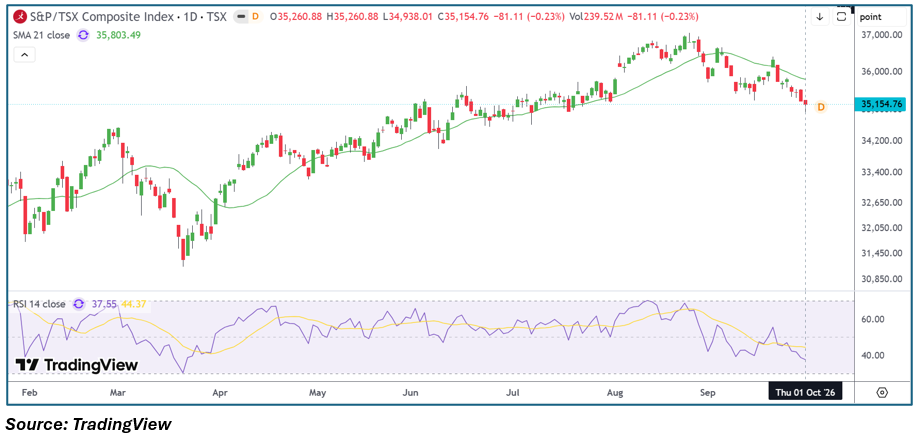
The S&P/TSX Composite index is expected to open firmer as global markets and commodities trade higher ahead of the NFP release, improving the market tone. The index settled at 35,154.76, declining 0.23%, while remaining below its 21-day Simple Moving Average of 35,803.49. Recent price action continues to reflect weakness after retreating from elevated levels, with candles showing continued softness. Market direction may be influenced by global Equity trends, Commodity prices, precious metals and broader risk sentiment during the session.
Global Macro Backdrop
Global markets remain in a period of adjustment following the Federal Reserve’s latest policy decision. Investors are assessing the pace and potential extent of future policy changes, with inflation, labour-market conditions and economic growth continuing to determine expectations for the next phase of the U.S. rate cycle.
U.S. Treasury yields remain a key market signal. Movements in longer-term yields can influence equity valuations and financing conditions, with technology and other growth-oriented stocks generally more sensitive to changes in discount rates. Yield movements are also important for gold and the broader commodity complex.
The U.S. dollar remains another major driver. A firm dollar can create headwinds for dollar-denominated commodities, while a softer greenback can provide a more supportive backdrop for precious metals and other raw materials. For Canadian investors, the USD/CAD relationship also has important implications for exporters and commodity producers.
Global growth remains an important theme as investors monitor economic activity across the United States, Europe and China. Chinese Demand is particularly relevant for copper, nickel and other industrial metals, while U.S. economic conditions remain important for Canadian exporters and overall global risk appetite.
In Canada, the Bank of Canada continues to balance Inflation and economic-growth considerations. Expectations for future BoC policy will remain sensitive to domestic data as well as changes in U.S. rates and Global Bond markets.
Canadian Market Focus
The TSX begins the second trading day of the fourth quarter with commodities and interest rates remaining the principal market drivers.
Energy stocks continue to have a significant influence on the index, making crude-oil prices and global demand expectations particularly important. Materials stocks will similarly remain sensitive to gold, silver, copper and other metals, with precious-metals companies responding closely to changes in real yields and the U.S. dollar.
Financials remain a central part of the Canadian market. Investors continue to assess the implications of interest rates for bank margins, Loan growth, Credit quality and household and corporate borrowing.
The Canadian dollar also remains an important consideration for Canadian equities. A weaker CAD can increase the Canadian-dollar value of U.S.-dollar revenues for exporters and resource companies, while a stronger currency can reduce that translation benefit.
Commodity view — what will move the TSX
- Crude: Crude oil traded around $93 per barrel on Friday after gaining for two consecutive sessions, as the US weighed sending another aircraft carrier to the Middle East, raising the prospect of an escalation in the war with Iran and further disruptions to regional energy supplies.
- Gold: Gold prices slipped to around $4,150 an ounce on Friday and were headed for a second consecutive weekly decline, pressured by higher oil prices amid concerns over a potential escalation in the US-Iran conflict.
- Silver: Silver fell to around $60.5 an ounce on Friday and was set to lose nearly 6% for the week, pressured by higher oil prices amid concerns over a potential escalation in the US-Iran conflict.
- Copper: Copper futures steadied around $6.52 per pound on Friday, but remained on track for a nearly 3% weekly decline as signs of weakening industrial activity in top consumer China weighed on the demand outlook.
Forex Watch
The Canadian dollar remains sensitive to both commodity prices and interest-rate differentials between Canada and the United States.
A stronger U.S. dollar and elevated Treasury yields could place pressure on CAD, while stronger crude and metals prices could provide support. Expectations surrounding future Bank of Canada policy remain another important influence.
For the TSX, currency effects will vary across sectors. Commodity exporters with U.S.-dollar-linked revenues may benefit from a weaker CAD, while companies with significant foreign-currency expenses can experience the opposite effect.
Key Market Drivers Today
- Federal Reserve outlook: Markets continue to assess the implications of the Fed's latest policy decision and the potential path of future rate adjustments.
- Bank of Canada expectations: Domestic inflation, employment and growth data remain important for the Canadian rate outlook.
- Bond yields: U.S. and Canadian government yields remain critical for equity valuations and rate-sensitive sectors.
- Crude oil: Oil prices remain a major determinant of the TSX's daily direction.
- Gold and silver: Precious metals remain sensitive to real yields, the U.S. dollar and global uncertainty.
- Copper: China's economic activity and global Manufacturing conditions remain key for industrial metals.
- Canadian dollar: CAD movements will influence the Earnings translation of commodity producers and internationally exposed companies.
- Global growth: U.S., European and Chinese economic signals will remain important for Canada's cyclical and resource sectors.
- Quarter-opening flows: The first Trading session of the fourth quarter could see portfolio repositioning and renewed sector allocation following the close of September.

Market Outlook
The TSX enters Friday’s session with commodities and Monetary Policy continuing to provide the strongest cross-market signals. Energy and materials remain particularly important to the benchmark, while financials will track expectations for interest rates and Canadian economic activity.
The direction of bond yields and the U.S. dollar remains crucial for rate-sensitive sectors and precious metals. At the same time, the Canadian dollar could amplify or offset commodity-driven moves for resource companies.
With the fourth quarter now underway, investors are likely to focus increasingly on the relationship between monetary policy, economic growth and corporate earnings. For the TSX, crude oil, gold, copper, bond yields, CAD and expectations for the Fed and Bank of Canada remain the key variables heading into Friday’s trading session.


 Nov 23, 2026





 Please wait processing your request...