
 NZ
 UK
 US
 AU
 IND

 CA

 Share
 X (Formerly Twitter)
 Whatsapp
 Facebook
 LinkedIn
 Telegram
 Email This Article
 Copy Link
 Summarize with AI
 Chat GPT
 Perplexity

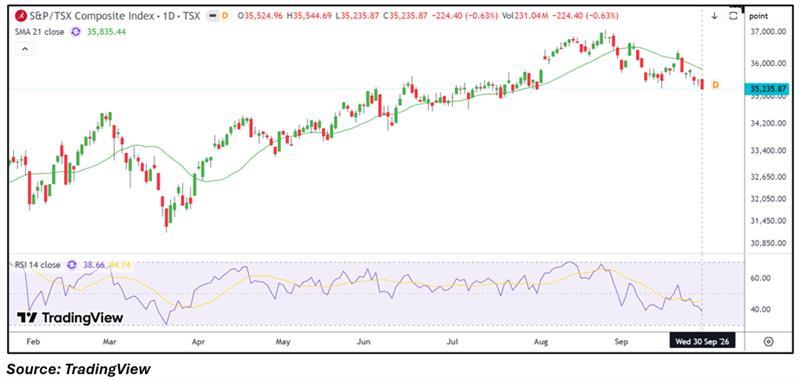
The S&P/TSX Composite index is expected to begin the session on a firmer note as global markets and commodities inch higher, improving the broader market tone. The index previously settled at 35,235.87, declining 0.63%, while remaining below its 21-day Simple Moving Average of 35,835.44. Recent price action continues to reflect weakness following the earlier stabilisation near elevated levels. The index remains below the key moving average, keeping the short-term technical structure subdued. Market direction may be influenced by global Equity trends, Commodity prices, precious metals and broader risk sentiment during the session.
Global Macro Backdrop
Global markets enter the fourth quarter with Monetary Policy still at the centre of the Investment landscape. Following the Federal Reserve’s latest rate decision, investors are evaluating the likely pace of future policy adjustments and how incoming inflation, employment and economic-growth data could influence the Fed's next moves.
The direction of U.S. Treasury yields remains particularly important. Lower yields could support rate-sensitive equities and precious metals, while renewed upward pressure on yields could tighten financial conditions and weigh on higher-duration assets.
The U.S. dollar is another major cross-market variable. Currency strength can create pressure on dollar-denominated commodities, while a softer greenback can provide a more supportive backdrop for gold and industrial metals. For Canada, movements in the U.S. dollar also have important implications for the Canadian currency and exporters.
The global growth outlook remains mixed, with investors monitoring economic activity in the United States, Europe and China. China's industrial and property activity remains particularly relevant for copper and other base metals, while U.S. Demand remains important for Canada's trade-sensitive economy.
In Canada, expectations for the Bank of Canada continue to depend on domestic inflation, employment and economic-growth conditions. The relationship between Canadian and U.S. interest-rate expectations will remain an important influence on CAD and Canadian financial assets.
Canadian Market Focus
The TSX begins October with investors looking beyond third-quarter performance and assessing the Earnings and economic backdrop for the final quarter of 2026.
Energy and materials remain central to the benchmark. Oil prices will continue to influence Canada's major energy producers, while gold and base metals remain important for Mining companies. Changes in global growth expectations could create significant differences between precious-metals and industrial-metals equities.
Financials remain another major source of market sensitivity. Canadian banks will be watched for signals surrounding Loan growth, Credit quality, margins and consumer and Business activity as investors assess the implications of the evolving interest-rate environment.
The Canadian dollar will also remain an important factor. A weaker CAD can increase the Canadian-dollar value of U.S.-dollar commodity revenues, while a stronger currency can reduce the translation benefit for exporters.
Commodity view — what will move the TSX
- Crude: Crude oil climbed back above $91 a barrel on Thursday as reports of tighter Chinese fuel supplies added to concerns over an already disrupted global market.
- Gold: Gold climbed toward $4,200 an ounce on Thursday, recovering losses from the previous session as softer-than-expected US PCE Inflation data reduced expectations for a Federal Reserve Interest Rate hike this month.
- Silver: Silver rose above $61 an ounce on Thursday, rebounding from two-month lows as softer-than-expected US PCE inflation data reduced expectations for a Federal Reserve interest rate hike this month.
- Copper: Copper futures fell below $6.50 per pound on Thursday, near a two-week low, as investors assessed mixed economic data from top consumer China this week, while a weeklong holiday in the country is expected to dampen trading activity.
Forex Watch
The Canadian dollar begins the fourth quarter with commodity prices and interest-rate expectations remaining its principal drivers.
A stronger U.S. dollar, particularly if accompanied by higher U.S. yields, could put pressure on CAD. Conversely, stronger crude and metals prices could provide support, particularly if expectations for Canadian monetary policy remain relatively firm.
Currency movements will have different consequences across the TSX. Resource exporters with substantial U.S.-dollar revenues may benefit from a weaker CAD, while companies with significant foreign-currency costs can experience a different earnings effect.
Key Market Drivers Today
- Federal Reserve outlook: Markets continue to assess the implications of the Fed's latest policy decision and the potential path of future rate adjustments.
- Bank of Canada expectations: Domestic inflation, employment and growth data remain important for the Canadian rate outlook.
- Bond yields: U.S. and Canadian government yields remain critical for equity valuations and rate-sensitive sectors.
- Crude oil: Oil prices remain a major determinant of the TSX's daily direction.
- Gold and silver: Precious metals remain sensitive to real yields, the U.S. dollar and global uncertainty.
- Copper: China's economic activity and global Manufacturing conditions remain key for industrial metals.
- Canadian dollar: CAD movements will influence the earnings translation of commodity producers and internationally exposed companies.
- Global growth: U.S., European and Chinese economic signals will remain important for Canada's cyclical and resource sectors.
- Quarter-opening flows: The first Trading session of the fourth quarter could see portfolio repositioning and renewed sector allocation following the close of September.
Market Outlook
The TSX enters October with the new quarter bringing a fresh focus on the sustainability of economic growth, the direction of monetary policy and the outlook for commodities.
Energy and materials remain positioned to respond closely to crude oil, gold and base-metal prices, while financials will continue to reflect expectations for Canadian economic activity and interest rates. Technology, utilities and real estate will remain more sensitive to changes in bond yields.
The Canadian dollar adds another important layer, particularly for resource companies whose revenues are linked to U.S.-dollar commodity prices. Meanwhile, developments in the United States and China will remain important external indicators for both Canadian equities and commodities.
As the fourth quarter gets underway, Fed and BoC policy expectations, bond yields, crude oil, gold, copper, CAD and global risk appetite will remain the principal variables shaping the TSX. Investors are likely to begin October with a renewed focus on how the evolving monetary-policy cycle and global growth outlook translate into corporate earnings and sector performance.


 Nov 24, 2026





 Please wait processing your request...