
 NZ
 UK
 US
 AU
 IND

 CA

 Share
 X (Formerly Twitter)
 Whatsapp
 Facebook
 LinkedIn
 Telegram
 Email This Article
 Copy Link
 Summarize with AI
 Chat GPT
 Perplexity

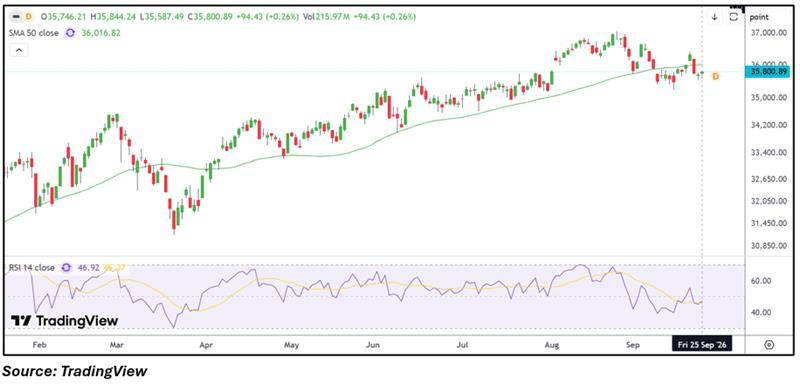
The S&P/TSX Composite index is expected to begin the session on a softer note, tracking weakness across international markets, while precious metals are also trading lower. The index previously settled at 35,706.46 and remains below its 50-day SMA of 36,009.12, with the 14-day RSI at 45.22, reflecting moderate momentum. Recent trading activity indicates some stabilisation following the earlier decline from higher levels. Market direction may remain influenced by global Equity performance, Commodity prices, precious metals and broader risk sentiment during the upcoming session.
Global Macro Backdrop
Global markets begin the week with Monetary Policy still a major driver of asset prices. Investors continue to assess the implications of the Federal Reserve’s latest rate decision and whether the current policy trajectory will translate into a broader easing cycle or remain dependent on incoming economic data.
U.S. Treasury yields and the direction of the U.S. dollar remain particularly important for Canadian equities. Lower yields and a softer dollar could provide support for commodities and interest-sensitive assets, while renewed upward pressure on yields could tighten financial conditions and weigh on risk appetite.
Economic-growth expectations are also in focus as investors balance signs of resilience in the U.S. economy against concerns about slower global activity. Developments in Europe and China remain relevant for Canadian materials and industrial companies, particularly through their influence on commodity demand.
For the Bank of Canada, the Federal Reserve's policy path remains an important external consideration, although domestic inflation, employment and economic-growth data will continue to determine the direction of Canadian monetary policy. Market expectations around future BoC moves are likely to remain sensitive to both domestic data and changes in Global Bond markets.
Canadian Market Focus
The TSX enters the new week with its usual sensitivity to commodities, financial conditions and the Canadian dollar.
Energy remains one of the most important contributors to the index, with oil prices and expectations for global fuel Demand likely to influence the performance of major Canadian producers. Gold and precious-metals equities should remain sensitive to real yields, currency movements and demand for defensive assets.
Canadian banks and other financial stocks will be closely watched as investors assess the implications of interest-rate expectations for lending activity, Credit conditions, margins and the domestic economy. A more stable rate environment could provide greater visibility for the sector, while concerns about economic growth and credit quality remain potential considerations.
The Canadian dollar also remains an important transmission channel for commodity-market moves. A stronger CAD can reduce the Canadian-dollar value of overseas commodity revenues, while a weaker currency can provide a tailwind to exporters and resource companies with significant U.S.-dollar Revenue exposure.
Commodity view — what will move the TSX
- Crude: Crude oil climbed more than 4% to above $96 a barrel on Monday, recovering from a 2.3% decline in the previous session as uncertainty surrounding US-Iran diplomacy kept Supply risks elevated.
- Gold: Gold fell below $4,200 an ounce on Monday, hitting its lowest levels in seven weeks as stalled US-Iran negotiations kept oil prices elevated and reinforced expectations for additional Federal Reserve tightening to curb inflation.
- Silver: Silver dropped toward $61 an ounce on Monday, hitting its lowest levels in seven weeks as stalled US-Iran negotiations kept oil prices elevated and reinforced expectations for additional Federal Reserve tightening to curb inflation.
- Copper: Copper futures fell below $6.60 per pound on Monday, extending their retreat from record highs as softening economic data from top consumer China weighed on the demand outlook.
Forex Watch
The Canadian dollar remains closely tied to the interaction between commodity prices, U.S. monetary policy and domestic economic expectations.
A stronger U.S. dollar could put downward pressure on CAD, particularly if U.S. yields remain elevated or markets push back expectations for aggressive monetary easing. Conversely, stronger commodity prices and expectations for a relatively stable Canadian rate environment could provide support to the loonie.
For the TSX, currency movements create different effects across sectors. Resource exporters with substantial U.S.-dollar revenues can benefit from a weaker CAD, while companies with significant U.S.-dollar costs or imported inputs may face a different impact.
Key Market Drivers Today
Federal Reserve policy: Markets continue to assess the implications of the Fed's latest rate decision and the potential path for future policy.
Bond yields: Movements in U.S. and Canadian government yields could influence financials, technology, utilities and real estate.
Crude oil: Oil prices remain a major driver of the TSX through the large weighting of Canadian energy companies.
Gold and precious metals: Gold prices remain sensitive to real yields, the U.S. dollar and global uncertainty.
Copper and base metals: Industrial metals remain an important gauge of expectations for Chinese and global economic activity.
Canadian dollar: CAD movements will influence the Earnings translation and competitiveness of Canadian exporters.
Bank of Canada expectations: Domestic Inflation and growth signals remain important for expectations around Canadian monetary policy.
Global risk sentiment: Developments across U.S., European and Asian markets could set the tone for the Canadian open.

Market Outlook
The TSX begins the week with several competing forces in play. Support from energy and precious-metals markets could help underpin the resource-heavy benchmark, while movements in bond yields and expectations for the Federal Reserve and Bank of Canada will remain important for financials and rate-sensitive sectors.
Investors will also be watching the Canadian dollar and global economic signals for confirmation of the direction of commodities and cyclical equities. With monetary policy still transitioning and commodity markets responding to both supply and demand expectations, sector performance may remain uneven.
Overall, the opening tone for the TSX is likely to be shaped by the interaction between U.S. rate expectations, Canadian monetary-policy prospects, commodity prices, bond yields and global risk appetite as investors position for the final stretch of September.


 Nov 23, 2026





 Please wait processing your request...