
 NZ
 UK
 US
 AU
 IND

 CA

 Share
 X (Formerly Twitter)
 Whatsapp
 Facebook
 LinkedIn
 Telegram
 Email This Article
 Copy Link
 Summarize with AI
 Chat GPT
 Perplexity

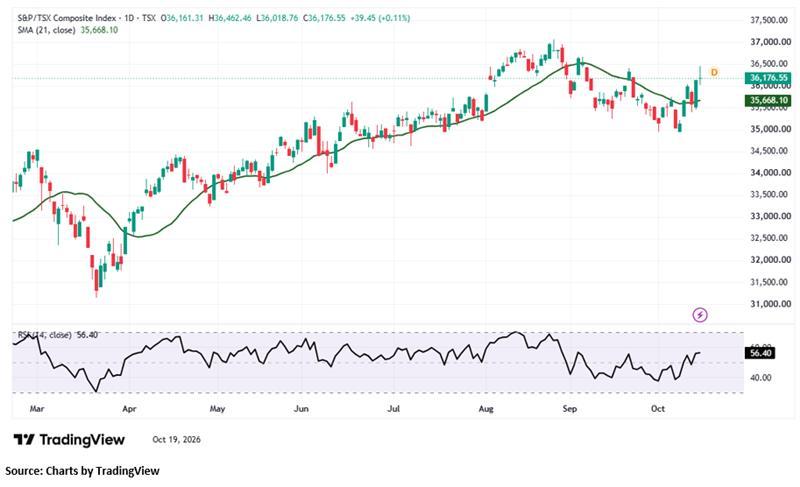
The S&P/TSX Composite index is expected to open on a negative note, weighed down by weakness across the technology and healthcare sectors. From a technical perspective, the index continues to trade below its 21-day Simple Moving Average (SMA), which acts as a key dynamic resistance level and indicates persistent selling pressure. Immediate support is positioned near 35,900, a crucial level for maintaining the near-term recovery. A sustained hold above this level could help stabilise market sentiment and encourage renewed buying interest, potentially supporting a rebound towards the recent high near 36,400. However, a decisive break below 35,900 could intensify selling pressure, undermine the technical structure, and expose the index to further downside risks.
Global Macro Backdrop
Global markets remain focused on the balance between Inflation risks, economic resilience and the potential direction of monetary policy. Investors are assessing the implications of the Federal Reserve’s latest rate decision, with the trajectory of future policy adjustments dependent on incoming inflation, employment and growth data.
U.S. Treasury yields remain a key driver for global equities. A decline in yields could support technology stocks, precious metals and other rate-sensitive assets, while renewed upward pressure could tighten financial conditions and weigh on valuations. The direction of the U.S. dollar is equally important, particularly for commodities priced in dollars.
Global growth expectations remain another major consideration. Economic activity in the United States, Europe and China will influence Demand for energy and industrial materials. China remains particularly important for copper and other base metals, while U.S. economic conditions are closely linked to the outlook for Canadian exports and corporate earnings.
For Canada, the Bank of Canada’s policy outlook continues to depend on domestic inflation, labour-market conditions and economic growth. Any divergence between Federal Reserve and Bank of Canada expectations could influence the Canadian dollar, bond yields and the relative performance of Canadian financial assets.
Canadian Market Focus
The TSX remains particularly sensitive to developments in energy, materials and financials, making Commodity prices and interest-rate expectations central to the market outlook.
Energy companies will be influenced by crude-oil prices, production expectations and the outlook for global demand. Gold producers and diversified miners will respond to movements in precious and industrial metals, alongside changes in the U.S. dollar and Canadian currency.
Financial stocks remain sensitive to the outlook for Canadian economic activity, Credit conditions, Loan growth and interest rates. Investors will continue to assess how borrowing costs and household financial conditions could affect bank profitability and credit quality.
The Canadian dollar is another important variable for the index. A weaker CAD can increase the Canadian-dollar value of U.S.-dollar revenues earned by resource exporters, although the benefit varies according to each company’s operating costs, hedging arrangements and foreign-currency expenses.
Commodity view — what will move the TSX
- Crude: Crude oil held near $101 a barrel on Monday, close to a four-week high after surging 10% last week, as renewed fighting across the Middle East heightened concerns over Supply disruptions.
- Gold: Gold climbed above $4,170 an ounce on Monday, extending its recent gains as dovish remarks from Federal Reserve Chair Kevin Warsh prompted traders to scale back expectations of an October rate hike.
- Silver: Silver climbed toward $54.5 an ounce on Monday, extending its recent gains as dovish remarks from Federal Reserve Chair Kevin Warsh prompted traders to scale back expectations of an October rate hike.
- Copper: Copper futures climbed toward $6.60 per pound on Monday, recovering from last week’s losses as stronger-than-expected economic data from China, the world’s largest consumer, improved the demand outlook.
Forex Watch
The Canadian dollar remains closely linked to commodity prices and the relative outlook for Canadian and U.S. interest rates.
A stronger U.S. dollar or higher U.S. Treasury yields could put pressure on CAD, while firm oil prices and stronger metals markets could provide support. Domestic inflation and employment data will remain important in shaping expectations for the Bank of Canada.
For TSX-listed companies, currency movements create both opportunities and risks. Resource exporters with substantial U.S.-dollar revenues may benefit from a weaker CAD, while businesses that rely on imported equipment or carry significant foreign-currency costs may face higher expenses.
Key Market Drivers Today
- Federal Reserve outlook: Investors continue to evaluate the implications of the Fed’s latest policy decision and the potential direction of future rate adjustments.
- Bank of Canada expectations: Canadian inflation, employment and economic-growth conditions remain central to domestic rate expectations.
- Government-bond yields: U.S. and Canadian yields influence Equity valuations, financing costs and demand for defensive assets.
- Crude oil: Supply expectations, inventories and global energy demand remain important for Canadian energy stocks.
- Gold and silver: Precious metals remain sensitive to real yields, the U.S. dollar and safe-haven demand.
- Copper and base metals: Chinese industrial activity and global Manufacturing conditions remain key for Canadian Mining companies.
- Canadian dollar: Currency movements affect exporters, resource producers and companies with international operations.
- Global market sentiment: Developments across U.S., European and Asian markets may influence the tone at the Toronto open.
- Economic data and earnings: New data and corporate updates can alter expectations for growth, margins and the direction of equities

Market Outlook
The TSX heads into Friday’s session with commodity-market direction and interest-rate expectations remaining central to the outlook. Energy and materials could provide support if oil and metals prices hold firm, while financials, technology, utilities and real estate will remain sensitive to changes in bond yields and monetary-policy expectations.
The Canadian dollar adds another layer to the market picture, particularly for resource companies that earn Revenue in U.S. dollars. Meanwhile, the outlook for Chinese industrial demand and U.S. economic activity remains important for assessing the durability of commodity prices and the prospects for Canadian exporters.
As investors move further into the fourth quarter, attention will remain on the interaction between monetary policy, global growth, commodity prices and corporate earnings. For the TSX, crude oil, gold, copper, bond yields, CAD movements and expectations for the Federal Reserve and Bank of Canada remain the principal variables to monitor as the Trading session approaches.


 Nov 23, 2026





 Please wait processing your request...