
 NZ
 UK
 US
 AU
 IND

 CA

 Share
 X (Formerly Twitter)
 Whatsapp
 Facebook
 LinkedIn
 Telegram
 Email This Article
 Copy Link
 Summarize with AI
 Chat GPT
 Perplexity

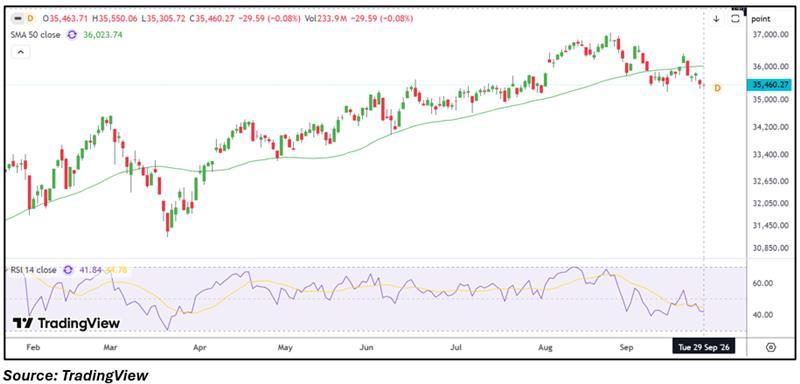
The S&P/TSX Composite index is expected to begin the session on a positive note, tracking firmer oil prices and mixed global market cues. The index previously settled at 35,489.86 after declining 0.87%, while remaining below its 50-day Simple Moving Average of 36,019.81. Recent price action indicates renewed pressure following an earlier period of stabilisation near higher levels. The index continues to trade below the key moving average, keeping the short-term technical structure subdued. Market direction may remain influenced by global Equity performance, Commodity prices, precious metals and broader risk sentiment. Continued weakness could maintain pressure, while stabilisation around recent levels may support consolidation during the session.
Global Macro Backdrop
Global markets remain focused on the Federal Reserve's policy path following its latest rate decision. Investors are assessing how the Fed will balance Inflation risks against economic-growth concerns and whether additional policy easing could emerge as incoming data provide further guidance.
U.S. Treasury yields remain a key transmission channel for global markets. Changes in longer-term yields can influence equity valuations, particularly for technology and other growth-oriented companies, while also affecting the attractiveness of fixed-income Assets relative to equities.
The U.S. dollar remains another important variable. A stronger dollar can create headwinds for commodities priced in dollars, while a softer greenback can provide support to gold and other raw materials. These cross-market movements are particularly relevant for the TSX because of its significant exposure to energy and mining.
Global growth expectations also remain in focus as investors monitor activity across the United States, Europe and China. China's industrial Demand is especially important for copper and other base metals, while developments in the U.S. economy remain important for both global risk appetite and Canadian exporters.
For Canada, the Bank of Canada's policy outlook continues to depend on domestic inflation, labour-market conditions and economic growth. The relationship between Canadian and U.S. interest-rate expectations remains an important influence on the Canadian dollar.
Canadian Market Focus
The Canadian economy showed no growth in July, Statistics Canada data showed, following three consecutive months of expansion. The result was in line with expectations and marked a weak start to the third quarter, while an advance estimate pointed to a 0.2% rebound in August.
The TSX approaches month-end with energy, materials and financials continuing to account for much of the benchmark's sensitivity to changes in the economic and commodity cycle.
Energy stocks remain closely tied to Crude Oil and global demand expectations. Materials companies, meanwhile, are responding to movements in gold, copper and other metals, with precious-metals producers particularly sensitive to interest-rate expectations and the U.S. dollar.
Canadian banks remain a major component of the index and will continue to be monitored for signals around Loan growth, Credit quality, net interest margins and the broader domestic economy. Expectations for future Canadian interest rates remain an important Factor for financial stocks.
The Canadian dollar is also important for the Earnings outlook of large Canadian exporters. A weaker CAD can increase the Canadian-dollar value of U.S.-dollar revenues, particularly for commodity producers, while a stronger currency can have the opposite translation effect.
Commodity view — what will move the TSX
- Crude: Crude oil climbed back above $90 a barrel on Wednesday and was heading for a monthly gain of more than 5% as uncertainty over US-Iran negotiations continued to support prices.
- Gold: Gold rose to around $4,200 an ounce on Wednesday, extending gains from the previous session, with falling oil prices offering some support despite continued pressure from elevated Treasury yields.
- Silver: Silver steadied above $61 an ounce on Wednesday, halting a recent decline with falling oil prices offering some support despite continued pressure from elevated Treasury yields.
- Copper: Copper futures fell to around $6.5 per pound, extending their retreat from record highs of $6.8 per pound early in the month, as softening economic data from top consumer China weighed on the demand outlook.
Forex Watch
The Canadian dollar remains sensitive to the competing influences of commodity prices, U.S. Monetary Policy and Canadian economic expectations.
A stronger U.S. dollar and elevated U.S. yields could put pressure on CAD, while stronger oil and metals prices could provide support. Expectations surrounding future Bank of Canada policy will remain another important variable.
For the TSX, the currency effect will differ across sectors. Resource exporters with U.S.-dollar-linked revenues can benefit from a weaker Canadian dollar, whereas companies with substantial foreign-currency expenses may see a different impact.
Key Market Drivers Today
- Fed policy: Markets continue to digest the latest Federal Reserve decision and assess the path for future interest rates.
- Bank of Canada outlook: Domestic inflation, employment and economic-growth conditions remain central to Canadian rate expectations.
- Bond yields: U.S. and Canadian yields remain important for equity valuations and rate-sensitive TSX sectors.
- Crude oil: Energy prices remain one of the largest day-to-day influences on the Canadian benchmark.
- Gold: Bullion remains sensitive to real yields, the U.S. dollar and monetary-policy expectations.
- Copper and base metals: China's demand outlook and global Manufacturing activity remain important for Canadian miners.
- Canadian dollar: CAD movements could affect commodity exporters and companies with international Revenue exposure.
- Global risk sentiment: The performance of U.S., European and Asian markets could influence the opening tone in Toronto.
- Quarter-end positioning: The final Trading session of September could bring portfolio Rebalancing and positioning ahead of the fourth quarter.
Market Outlook
The TSX enters the final session of September with commodities and monetary policy remaining the two dominant themes. Energy and materials could provide support if crude oil and precious metals remain firm, while financials and rate-sensitive sectors will continue to respond to changes in bond yields and expectations for the Bank of Canada and Federal Reserve.
The Canadian dollar adds another layer to the outlook, particularly for resource companies with significant U.S.-dollar revenues. At the same time, global growth signals — especially from the United States and China — will remain important for assessing the sustainability of commodity demand.
As investors close out the third quarter and prepare for the final quarter of 2026, Fed and BoC policy expectations, bond yields, crude oil, gold, copper, CAD and global risk appetite remain the key variables to watch. The month-end session could see heightened attention to positioning and sector rotation as markets look beyond September and toward the next phase of the economic and monetary-policy cycle.


 Nov 23, 2026





 Please wait processing your request...