
 NZ
 UK
 US
 AU
 IND

 CA

 Share
 X (Formerly Twitter)
 Whatsapp
 Facebook
 LinkedIn
 Telegram
 Email This Article
 Copy Link
 Summarize with AI
 Chat GPT
 Perplexity

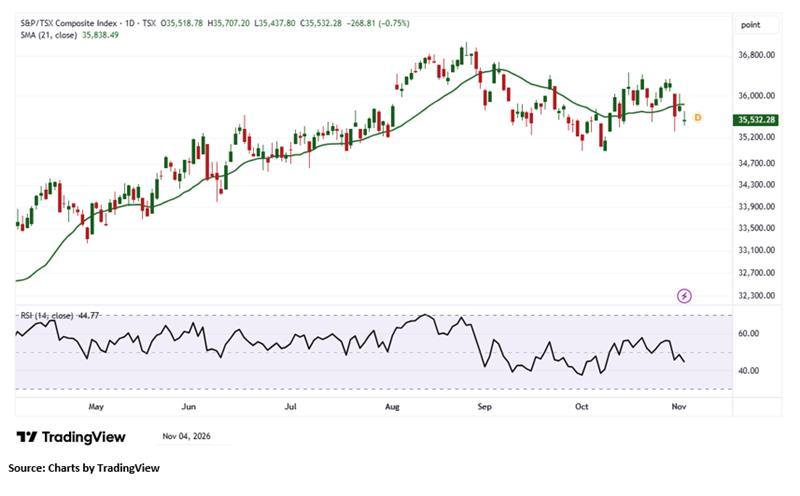
The S&P/TSX Composite index is expected to commence trading on a positive note, supported by strength across the healthcare and technology sectors. However, from a technical perspective, the index continues to trade below its 21-day Simple Moving Average (SMA), which remains a key dynamic resistance level and may limit the near-term recovery. Immediate support is positioned near 35,300, a crucial level for maintaining the current technical structure. Sustained trading above this level could improve market sentiment and attract fresh buying interest, potentially driving the index towards the recent high near 35,750. Conversely, a decisive break below 35,300 could undermine the recovery attempt, intensify selling pressure, and expose the index to further downside risks.
Global Macro Backdrop
The US economic outlook remains a major influence on Canadian market sentiment. Investors are monitoring Inflation trends, employment conditions, consumer spending and Business activity to assess the Federal Reserve's next policy steps.
The direction of US Treasury yields is especially important. A decline in yields could improve equity-market valuations and support growth-oriented companies, while renewed inflation concerns could keep borrowing costs elevated and place pressure on higher-valuation stocks.
US economic resilience also matters for Canadian exporters. Stronger American Demand can support Canadian energy shipments, industrial production, transportation activity and cross-border trade.
China — Industrial activity and Commodity demand
China remains a major influence on the global commodity cycle. Its Manufacturing performance, infrastructure spending, construction activity and industrial policy have direct implications for copper, iron ore, aluminium and energy demand.
Signs of improving industrial activity could support Canadian materials companies and diversified miners. Conversely, weak construction demand or continued uncertainty in the property sector could limit the recovery potential of industrial commodities.
Global bond yields and risk appetite
Bond yields remain an important barometer of monetary-policy expectations and investor confidence. Stable yields can provide a more supportive backdrop for equities, particularly utilities, real estate and other income-sensitive businesses.
Geopolitical uncertainty, trade developments and changes in global growth expectations remain potential sources of volatility. Investors should watch whether Market Participants favour cyclical exposure or move toward defensive assets.
Canadian Market Focus
The Canadian economic outlook continues to depend on domestic inflation, household spending, labour-market conditions and the health of the housing sector.
The Bank of Canada's policy direction will remain an important consideration for investors. A gradual easing in inflationary pressures could create room for a less restrictive monetary environment, although policymakers will need to balance this against economic resilience and the persistence of price pressures.
For the TSX, lower borrowing costs could be supportive for banks, utilities and real estate Investment trusts. However, weaker economic activity could offset some of those benefits through slower Loan growth, softer consumer demand and higher Credit provisions.
The Canadian dollar is another important transmission channel. Currency movements influence the competitiveness of exporters, the translated value of overseas Earnings and the cost of imported equipment and operating inputs.
Commodity view — what will move the TSX
- Crude: Crude oil prices edged lower to around $95.30 a barrel on Wednesday, hitting a three-week low and extending losses for a third consecutive session.
- Gold: Gold prices climbed more than 2% to reclaim above $4,000 an ounce level on Wednesday, supported by a weaker US dollar and falling Treasury yields after Democrats secured key victories in the US midterm elections.
- Silver: Silver prices climbed more than 4% toward the $52 an ounce level on Wednesday, supported by a weaker US dollar and falling Treasury yields after Democrats secured key victories in the US midterm elections.
- Copper: Copper futures dropped below $6.30 per pound on Wednesday, sinking to over three-month lows as renewed selling in technology stocks, driven by lingering concerns over artificial intelligence valuations, weighed on the metal.
Forex Watch
USD/CAD: The Canadian dollar remains sensitive to the relative monetary-policy outlook in Canada and the United States. Differences in bond yields, Crude Oil prices and global risk appetite can influence the currency pair.
A stronger US dollar could weigh on the loonie, while firmer energy prices and improved confidence in global growth could provide support.
US dollar: Broad US dollar movements remain important for commodity markets and international Capital flows. A softer dollar can support dollar-denominated metals, particularly gold, while a stronger dollar may create headwinds for commodities.
Canadian dollar implications: A weaker CAD can improve the translated value of foreign earnings for Canadian exporters and multinational businesses. However, it can also raise the cost of imported machinery, technology and other inputs.
Key Market Drivers Today
- Federal Reserve outlook: Changes in expectations for US Monetary Policy and their effect on Treasury yields and Equity valuations.
- Bank of Canada policy: Inflation, employment, consumer spending and housing-market developments.
- Crude oil: Global supply-demand expectations, production decisions and geopolitical risks.
- Gold and silver: Real interest rates, US dollar direction and safe-haven investment demand.
- Copper and industrial metals: Chinese manufacturing activity, infrastructure investment and global industrial demand.
- USD/CAD: Currency movements and their implications for Canadian exporters and commodity producers.
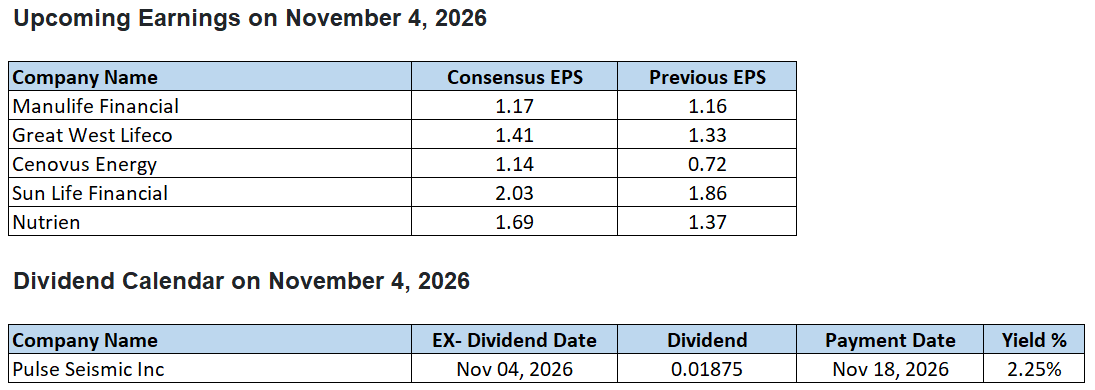
- Corporate earnings: Revenue growth, margins, capital expenditure, Debt levels and forward guidance.
- Global risk appetite: Bond-market volatility, trade developments and geopolitical uncertainty.
Market Outlook
The November 4 session is likely to be shaped by the interaction between global growth expectations, interest-rate sensitivity and commodity-market performance. Energy and materials remain important sources of direction for the TSX Composite, while financials, utilities and real estate will be particularly sensitive to the domestic economic outlook and bond yields.
A combination of stable borrowing costs, resilient US demand and supportive commodity prices would create a constructive backdrop for Canadian equities. Conversely, renewed inflation concerns, a stronger US dollar, weaker industrial-metal demand or rising bond yields could encourage a more cautious approach.
Investors should pay particular attention to the quality of corporate earnings, capital allocation, balance-sheet resilience and the sustainability of cash flows. Commodity exposure remains an important advantage for the Canadian market, but individual company performance will depend on operating efficiency and financial discipline.
Overall view: A cautiously balanced outlook is appropriate for the TSX Composite. Energy and materials may provide selective support if commodity conditions remain favourable, while the broader market will look to interest-rate expectations, global economic signals and corporate earnings for confirmation of a sustainable upward trend.


 Nov 24, 2026





 Please wait processing your request...