
 NZ
 UK
 US
 AU
 IND

 CA

 Share
 X (Formerly Twitter)
 Whatsapp
 Facebook
 LinkedIn
 Telegram
 Email This Article
 Copy Link
 Summarize with AI
 Chat GPT
 Perplexity

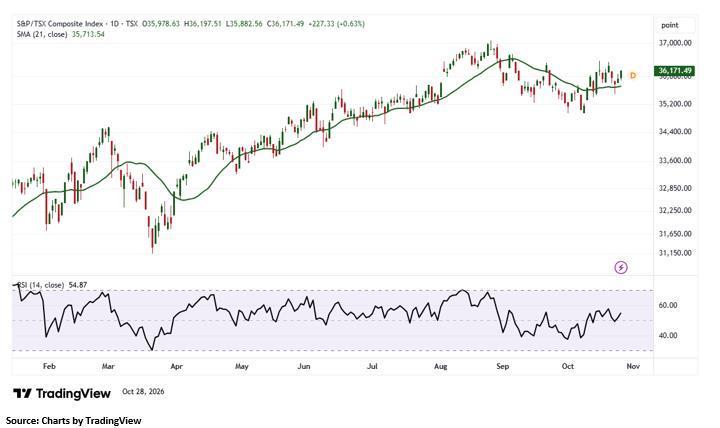
The S&P/TSX Composite index is expected to open on a positive note, supported by strength across the basic materials and technology sectors. From a technical perspective, the index continues to trade above its 21-day Simple Moving Average (SMA), which acts as a key dynamic support level and reinforces the improving technical structure. Immediate support is positioned near 35,900, a crucial level for sustaining the ongoing recovery. A sustained hold above this level could strengthen market sentiment and attract fresh buying interest, potentially driving the index towards the recent high near 36,450. Conversely, a decisive break below 35,900 could increase selling pressure and expose the index to further downside risks.
Global Macro Backdrop
Federal Reserve and U.S. inflation: The outlook for U.S. Monetary Policy remains a major influence on global financial conditions. Investors will assess the latest available inflation, employment and economic activity indicators for clues about the pace of future rate adjustments. Persistent Inflation could keep yields elevated and put pressure on Equity valuations, while moderating inflation alongside resilient Demand could support risk appetite. Any newly released U.S. data should be assessed against market expectations rather than in isolation.
Bank of Canada and the Canadian economy: Domestic inflation, employment, consumer spending and Business Investment remain central to the Bank of Canada outlook. The balance between slowing price pressures and the strength of economic demand will influence expectations for borrowing costs. These expectations matter particularly for Canadian banks, mortgage-sensitive businesses, utilities and real estate investment trusts.
China and industrial demand: China remains a key influence on global industrial commodities. Expectations for manufacturing, construction and infrastructure activity can affect copper, nickel and other base metals, with direct implications for Canadian miners. A more encouraging demand outlook could support industrial metals, whereas weaker activity or concerns about property-sector conditions could weigh on prices.
Global bond yields and financial conditions: Government bond yields remain a critical transmission channel between economic news and equity valuations. Higher yields can pressure growth-oriented stocks and income-sensitive sectors, while lower yields may provide relief. The reason for a Yield move is equally important: falling yields driven by easing inflation can be supportive, while a sharp decline reflecting Recession fears may signal a more challenging environment for cyclical companies.
Macro-news verification: I have not independently confirmed October 28’s overnight market movements, newly released economic figures or the latest central-bank headlines. The points above describe the main channels through which macroeconomic news can affect Canadian equities; they should not be interpreted as a verified list of today’s breaking developments.
Canadian Market Focus
The TSX Composite’s near-term direction will depend on the interaction between commodity-linked earnings, domestic economic conditions and changes in interest-rate expectations.
Energy and materials companies remain important sources of exposure to global Commodity prices. However, rising commodity prices do not necessarily translate into proportionate share-price gains. Investors also need to consider production costs, capital expenditure, operational performance, balance-sheet strength and management’s approach to Shareholder returns.
Canadian banks will remain sensitive to the health of households and businesses, credit-loss provisions, Loan growth and funding costs. A stable employment and spending environment could help support Credit quality, while signs of rising borrower stress or weaker business activity could increase concerns about future provisions.
The Canadian dollar will influence both corporate Earnings and market sentiment. A weaker loonie can increase the translated value of foreign earnings for companies with significant overseas operations, including some resource producers. However, it may also raise Import costs and complicate the inflation outlook. Relative U.S. and Canadian rate expectations, oil prices and global risk appetite remain important currency drivers.
Corporate earnings are another source of potential differentiation. Investors should focus on Revenue quality, Margin trends, free cash flow, capital discipline and forward guidance. Companies with resilient operating performance and manageable Debt may be better positioned if the macroeconomic backdrop becomes less favourable.
Commodity view — what will move the TSX
- Crude: Crude oil climbed above $101 a barrel on Wednesday, recovering from two sessions of losses as traders assessed the risk of renewed military escalation between the US and Iran.
- Gold: Gold fell below $4,050 an ounce on Wednesday after rising for two straight sessions, as investors cautiously awaited the US Federal Reserve’s upcoming policy decision and assessed geopolitical developments in the Middle East.
- Silver: Silver fell below $54 an ounce on Wednesday after rising for two straight sessions, as investors cautiously awaited the US Federal Reserve’s upcoming policy decision and assessed Israeli election results for potential implications on the Middle East conflict.
- Copper: Copper futures held above $6.6 per pound on Wednesday after rallying for three straight sessions, as Anthropic’s IPO filing and strong corporate earnings reignited investor enthusiasm for the artificial intelligence trade.
Forex Watch
USD/CAD: The Canadian dollar remains sensitive to relative U.S. and Canadian economic performance, central-bank expectations, crude prices and broader risk sentiment. A stronger loonie can reduce the Canadian-dollar value of foreign earnings for some exporters, while a weaker currency may support those earnings but increase the cost of imported inputs.
U.S. dollar: Broad dollar strength can weigh on dollar-denominated commodities, although supply-demand fundamentals and geopolitical developments can override this relationship. A softer dollar may support gold and selected industrial metals if other market conditions are favourable.
Government bond yields: U.S. Treasury and Canadian government yields remain important indicators for the TSX’s interest-sensitive sectors. Lower yields may improve the relative appeal of dividend-paying stocks and ease financing pressure, while rising yields can weigh on valuations and refinancing costs.
Key signal: Monitor USD/CAD alongside Crude Oil and government bond yields. Taken together, these indicators can help establish whether conditions are becoming more favourable for resource producers, domestic financials or rate-sensitive equities.
Key Market Drivers Today
- U.S. economic data and Fed expectations: Verified releases or policy commentary that could alter the anticipated path of interest rates.
- Canadian inflation and activity: Developments affecting Bank of Canada expectations, household finances and domestic demand.
- Bond yields: Changes in U.S. and Canadian yields, particularly for financials, technology, utilities and real estate.
- Crude oil: Supply developments, inventory trends and revisions to global demand expectations.
- Gold and silver: Changes in real yields, the U.S. dollar and safe-haven demand.
- Copper and other base metals: Chinese economic conditions, Manufacturing activity and supply-demand balances.
- USD/CAD: Currency movements affecting commodity sentiment and international corporate earnings.
- Corporate earnings: Results, forward guidance, margins, Capital Expenditure and shareholder-return announcements.
- Global risk sentiment: Developments influencing confidence in growth and demand for cyclical versus defensive investments.
Market Outlook
The TSX Composite’s near-term outlook will depend on whether commodity-sector support and resilient corporate earnings can offset uncertainty around global growth and interest rates.
A constructive scenario would combine stable or easing bond yields, resilient economic activity and supportive oil and metal prices. This could benefit resource producers while helping financials and rate-sensitive sectors maintain investor interest. Broader participation across the index would provide a stronger signal of improving market conditions than gains concentrated in a few large commodity-linked stocks.
A less favourable scenario would involve rising yields, a stronger U.S. dollar and weaker industrial demand. Such a combination could pressure growth-oriented stocks, utilities, real estate and base-metal producers. If domestic credit conditions also deteriorate, Canadian financials could face additional headwinds.
For Wednesday’s session, investors should monitor the interaction between commodity prices, currency movements and bond yields rather than relying on any single indicator. Earnings quality, capital discipline and balance-sheet strength remain important differentiators if Volatility increases.
Bottom line: The TSX’s near-term direction will be shaped by global interest-rate expectations, commodity prices and company-specific fundamentals. Crude oil, gold, copper, USD/CAD, government bond yields and earnings guidance are the main variables to monitor. Until the latest headlines and market data are confirmed, a measured, fundamentals-led approach is appropriate, with attention to free cash flow, balance-sheet resilience and sector-specific risks.


 Nov 23, 2026





 Please wait processing your request...