
 NZ
 UK
 US
 AU
 IND

 CA

 Share
 X (Formerly Twitter)
 Whatsapp
 Facebook
 LinkedIn
 Telegram
 Email This Article
 Copy Link
 Summarize with AI
 Chat GPT
 Perplexity

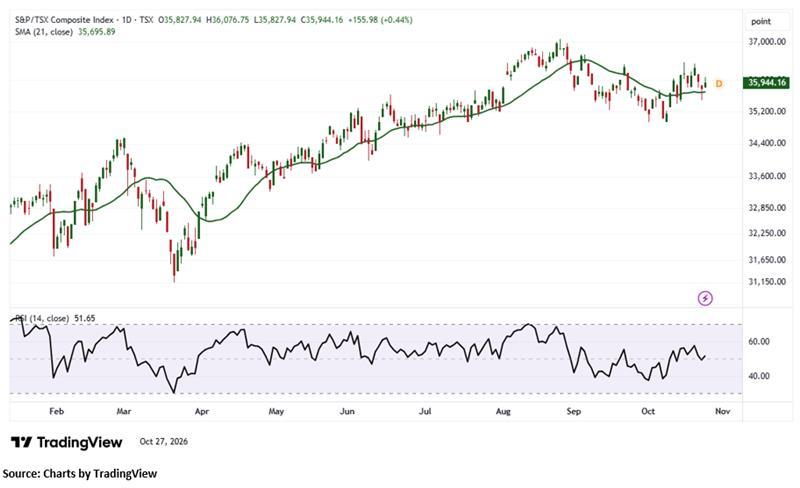
The S&P/TSX Composite index is expected to commence trading on a positive note, supported by strength across the basic materials and industrial sectors. From a technical perspective, the index continues to trade above its 21-day Simple Moving Average (SMA), which acts as a key dynamic support level and helps maintain the improving technical structure. Immediate support is positioned near 35,700, a critical level for sustaining the ongoing recovery. A sustained hold above this level could stabilise market sentiment and attract renewed buying interest, potentially supporting a rebound towards the recent high near 36,200. Conversely, a decisive break below 35,700 could intensify selling pressure and expose the index to further downside risks.
Global Macro Backdrop
Federal Reserve and U.S. economic momentum: The outlook for U.S. Monetary Policy remains an important influence on global equities. Investors will be watching inflation, employment and business-activity indicators for evidence that price pressures are easing and economic growth remains sustainable. Stronger-than-expected Inflation could keep borrowing costs elevated for longer, potentially pressuring Equity valuations. Conversely, moderating inflation alongside resilient Demand could support risk appetite.
Bank of Canada and domestic conditions: Canadian inflation, employment, consumer spending and Business Investment remain central to the domestic policy outlook. Markets will assess whether economic conditions leave room for further monetary easing or require interest rates to remain restrictive. Changes in rate expectations can influence bank margins, household borrowing costs, mortgage-sensitive businesses and the valuation of dividend-paying stocks.
China and global manufacturing: China remains a key variable for industrial commodities, particularly copper and other base metals. Expectations for construction, infrastructure investment and Manufacturing activity can influence Canadian miners and diversified resource producers. Improving demand expectations would be supportive, while concerns about a prolonged slowdown could weigh on industrial metals and related equities.
Global bond yields and risk sentiment: Government bond yields remain a critical link between macroeconomic developments and equity valuations. Rising yields can pressure long-duration Growth Stocks and rate-sensitive sectors, while falling yields may provide relief. Investors must distinguish between a benign decline associated with easing inflation and a sharper fall caused by deteriorating growth expectations.
Market context: The latest October 27 economic headlines, overnight index movements and central-bank developments have not been independently verified for this edition. These themes should be checked against current news and the economic calendar before being treated as confirmed session catalysts.
Canadian Market Focus
The TSX Composite’s near-term performance will likely depend on the balance between resource-sector Earnings potential and the sensitivity of domestic businesses to financing costs.
Energy and materials stocks remain important sources of index exposure to global Commodity markets. However, movements in underlying prices do not automatically translate into equivalent share-price gains: operating costs, production volumes, Capital Expenditure and company-specific guidance can all influence performance.
Canadian banks will remain in focus as investors assess Loan demand, Credit quality, deposit costs and net interest margins. A resilient labour market and stable household finances would be supportive, while signs of rising loan delinquencies or weaker business activity could increase concerns about credit losses.
The Canadian dollar will also affect the market outlook. A weaker loonie can lift the Canadian-dollar value of overseas earnings for some internationally exposed companies, including certain miners and energy producers. At the same time, it can increase Import costs and complicate the inflation outlook. The currency’s direction will depend on relative U.S. and Canadian rate expectations, oil prices and broader investor sentiment.
Corporate earnings provide an additional source of potential volatility. Investors should focus on Revenue quality, Margin trends, free cash flow, capital discipline and management guidance. Companies that demonstrate resilient earnings and strong balance sheets may be better positioned if market conditions become less supportive.
Commodity view — what will move the TSX
- Crude: Crude oil fell toward $100 a barrel on Tuesday, following a 1.5% loss on Monday, as renewed diplomatic efforts raised hopes of ending the US-Iran war and easing pressure on energy markets.
- Gold: Gold prices fell to around $4,000 per ounce on Tuesday, reversing gains from the previous session as the dollar strengthened ahead of key Central Bank policy decisions this week, weighing on the precious metal.
- Silver: Silver fell below $53 an ounce on Tuesday, hitting near one-year lows as the dollar strengthened ahead of key central bank policy decisions this week, weighing on the precious metal.
- Copper: Copper futures climbed toward $6.55 per pound on Tuesday, recovering from multi-week lows as Anthropic’s IPO filing reignited investor enthusiasm for the artificial intelligence trade.
Forex Watch
USD/CAD: The Canadian dollar remains sensitive to the relative outlook for the U.S. and Canadian economies, central-bank expectations, Crude Oil prices and global risk appetite. A stronger loonie may reduce the translated value of foreign earnings for some exporters, while a weaker currency can support those earnings but increase the cost of imported inputs.
U.S. dollar: Broad dollar strength can create a headwind for dollar-denominated commodities, although supply-demand fundamentals and geopolitical risks can override currency effects. A softer dollar may provide support for gold and selected industrial metals.
Bond yields: U.S. Treasury and Canadian government yields will remain important for interest-sensitive Canadian equities. A coordinated decline in yields and moderation in inflation expectations could improve conditions for utilities, real estate and growth-oriented stocks. A rise in yields could place renewed pressure on valuations and refinancing costs.
What to watch: The direction of USD/CAD alongside oil prices and bond yields. Together, these indicators can help explain whether the market is favouring resource producers, domestic financials or rate-sensitive sectors.
Key Market Drivers Today
- U.S. economic data and Fed expectations: Any verified releases or policy commentary that change the anticipated path of interest rates.
- Canadian economic conditions: Inflation, employment, household spending and other indicators affecting expectations for Bank of Canada policy.
- Government bond yields: Changes in U.S. and Canadian yields that influence financials, technology, utilities and real estate.
- Crude oil: Supply developments, inventory trends and changes in global demand expectations.
- Gold and silver: Movements in real yields, the U.S. dollar and safe-haven demand.
- Copper and other base metals: Chinese economic conditions, manufacturing activity and supply-demand balances.
- USD/CAD: Currency movements affecting commodity sentiment and internationally exposed corporate earnings.
- Corporate earnings: Results, margins, forward guidance, capital spending and shareholder-return announcements.
- Global risk appetite: Developments affecting confidence in economic growth and demand for cyclical versus defensive investments.
Market Outlook
The TSX Composite’s near-term direction will depend on whether commodity support and corporate earnings can offset uncertainty around global growth and interest rates.
A constructive scenario would feature stable or easing bond yields, resilient economic activity and supportive oil and metal prices. Such conditions could benefit resource producers while helping financials and rate-sensitive sectors maintain investor interest. Broad participation across sectors would strengthen the case for a sustainable advance.
A less favourable backdrop would involve rising yields, a stronger U.S. dollar and weakening industrial demand. This combination could pressure growth-oriented stocks, utilities, real estate and base-metal producers, leaving index performance more dependent on individual commodity winners. A deterioration in Canadian credit conditions would add another risk for financials.
For Tuesday’s session, investors should distinguish between broad-based strength and gains concentrated in a small number of large resource companies. Confirmation from financials and other major sectors, combined with resilient earnings guidance, would provide a stronger signal of improving market sentiment.
Bottom line: The TSX outlook remains tied to the interaction between global interest-rate expectations, commodity prices and company fundamentals. Crude oil, gold, copper, USD/CAD, government bond yields and earnings guidance are the principal variables to monitor. Until current market data and the latest macro headlines are confirmed, a measured approach focused on cash-flow quality, balance-sheet resilience and sector-specific risks is warranted.


 Nov 24, 2026





 Please wait processing your request...