
 NZ
 UK
 US
 AU
 IND

 CA

 Share
 X (Formerly Twitter)
 Whatsapp
 Facebook
 LinkedIn
 Telegram
 Email This Article
 Copy Link
 Summarize with AI
 Chat GPT
 Perplexity

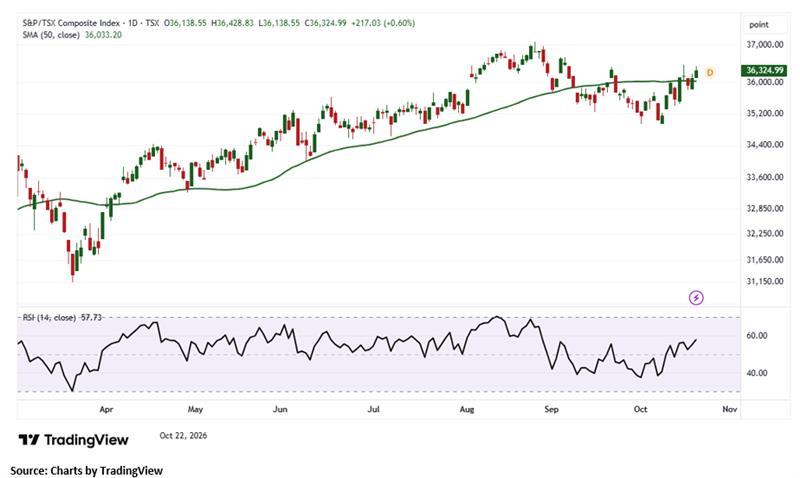
The S&P/TSX Composite index is expected to open on a positive note, supported by gains across the technology and financial sectors. Moreover, the index continues to trade above its 21-day Simple Moving Average (SMA), which acts as a key dynamic support level and reinforces the improving technical outlook. Immediate support is positioned near 36,100, a crucial level for sustaining the ongoing recovery. Holding above this level could improve market sentiment and attract fresh buying interest, potentially driving the index towards the recent high near 36,500. Conversely, a decisive break below 36,100 could intensify selling pressure, weaken the near-term recovery, and expose the index to further downside risks.
Global Macro Backdrop
Global markets remain focused on the interaction between inflation, economic growth and monetary policy. Following the Federal Reserve’s latest policy decision, investors continue to assess the likely path of future interest rates, with upcoming Inflation and employment data expected to play an important role in shaping expectations.
U.S. Treasury yields remain a key indicator for global risk assets. Lower yields could support growth-oriented equities and precious metals, while a renewed increase could place pressure on valuations and tighten financial conditions. The direction of the U.S. dollar will also matter for commodities, emerging-market Assets and the Canadian currency.
The global growth outlook remains an important consideration as investors monitor activity in the United States, Europe and China. U.S. Demand is particularly relevant for Canadian exporters, while China’s industrial activity and infrastructure Investment are important drivers of copper and other base metals.
For Canada, the Bank of Canada’s policy outlook continues to depend on inflation, labour-market conditions and domestic economic growth. Differences between Canadian and U.S. rate expectations could influence the loonie and Canadian bond yields, with implications for banks, real estate, utilities and other interest-sensitive sectors.
As the October Earnings season develops, investors will also be looking for evidence of how borrowing costs, labour expenses and consumer demand are affecting corporate margins and forward guidance.
Canadian Market Focus
The TSX remains highly sensitive to Commodity prices and financial conditions because of its substantial exposure to energy, materials and financials.
Energy stocks will continue to respond to crude-oil prices, Supply expectations and the outlook for global demand. Materials shares face different catalysts depending on their commodity exposure: gold producers are influenced by real yields and safe-haven demand, while copper and diversified miners are more closely tied to industrial activity and Chinese demand.
Financials remain central to the Canadian benchmark. Investors will assess the implications of interest rates for lending activity, net interest margins, Credit quality and household borrowing conditions. Corporate earnings and management commentary may provide additional insight into the health of Canadian consumers and businesses.
The Canadian dollar is another important Factor for resource companies and internationally exposed businesses. A weaker CAD can lift the Canadian-dollar value of U.S.-dollar revenues, although foreign-currency expenses, hedging and imported input costs can offset some of the benefit.
Commodity view — what will move the TSX
- Crude: Crude oil rose to near $100 a barrel on Thursday, the highest in five weeks, as concerns grew over a potential escalation of the Middle East conflict and renewed US strikes against Iran
- Gold: Gold prices dropped below $4,100 an ounce on Thursday, erasing gains from the previous session as renewed tensions in the Middle East pushed oil prices higher and fueled inflation concerns.
- Silver: Silver prices dropped toward $56 an ounce on Thursday, giving back recent gains as renewed tensions in the Middle East pushed oil prices higher and fueled inflation concerns.
- Copper: Copper futures fell toward $6.40 per pound on Thursday, reaching their lowest level in five weeks as a global selloff in artificial intelligence stocks dampened sentiment toward the metal.
Forex Watch
The Canadian dollar remains influenced by commodity prices, relative interest-rate expectations in Canada and the United States, and broader movements in the U.S. dollar.
Higher U.S. yields or stronger demand for dollar-denominated assets could place pressure on CAD. Stronger oil and metals prices could provide support, although domestic economic concerns and changing expectations for Bank of Canada policy may offset that influence.
For TSX-listed companies, the impact of currency movements varies. Resource exporters with substantial U.S.-dollar revenues may benefit from a weaker loonie, while companies reliant on imported equipment or foreign-currency inputs may face higher costs.
Investors will continue to monitor USD/CAD for signals about cross-border monetary-policy expectations and the potential effect on corporate earnings.
Key Market Drivers Today
- Federal Reserve outlook: The implications of the Fed's latest policy decision and expectations for future rate adjustments remain central to global financial conditions.
- Bank of Canada expectations: Domestic inflation, employment and growth conditions will influence the outlook for Canadian interest rates.
- Bond yields: U.S. and Canadian government yields remain important for Equity valuations, financing costs and rate-sensitive sectors.
- Crude oil: Supply developments, inventory trends and global demand expectations remain key for Canadian energy stocks.
- Gold and silver: Precious metals remain sensitive to real yields, the U.S. dollar and demand for defensive assets.
- Copper and base metals: Chinese industrial activity, Manufacturing conditions and supply trends remain important for Canadian miners.
- Canadian dollar: USD/CAD movements could affect exporters, resource producers and companies with international operations.
- Global market sentiment: Developments in U.S., European and Asian markets may influence the tone at the Toronto open.
- Earnings and economic data: Corporate updates and incoming economic indicators could change expectations for growth, profitability and sector leadership.

Market Outlook
The TSX approaches Thursday’s session with commodity prices and monetary-policy expectations remaining the principal cross-market influences. Energy and materials could support the benchmark if crude and metals prices remain firm, while financials will continue to reflect expectations for interest rates, credit conditions and Canadian economic activity.
Bond yields and the U.S. dollar remain important for technology, utilities, real estate and precious metals. Meanwhile, movements in the Canadian dollar could amplify or offset commodity-driven changes for exporters, depending on individual companies’ Revenue and cost structures.
Investors will also be watching whether global economic activity can sustain demand for industrial commodities as the fourth quarter advances. Developments in the United States and China remain particularly important for Canadian exporters and resource-intensive businesses.
Overall, Federal Reserve and Bank of Canada expectations, bond yields, crude oil, gold, copper, CAD movements and global risk appetite remain the key variables to watch. As earnings season progresses, the interaction between macroeconomic conditions, commodity prices and corporate guidance will be increasingly important in determining sector Leadership across the TSX.


 Nov 23, 2026





 Please wait processing your request...