
 NZ
 UK
 US
 AU
 IND

 CA

 Share
 X (Formerly Twitter)
 Whatsapp
 Facebook
 LinkedIn
 Telegram
 Email This Article
 Copy Link
 Summarize with AI
 Chat GPT
 Perplexity
Global Oil Market Outlook and Canadian Oil Stocks Analysis (2026)
The possibility of crude oil reaching $200 per barrel has once again become a major topic of debate among economists, energy analysts, and global investors.
Oil remains the most strategically important commodity in the global economy, powering transportation, manufacturing, agriculture, petrochemicals, and national energy security systems. Because of this central role, even moderate fluctuations in oil prices can trigger profound economic consequences across financial markets and geopolitical landscapes.
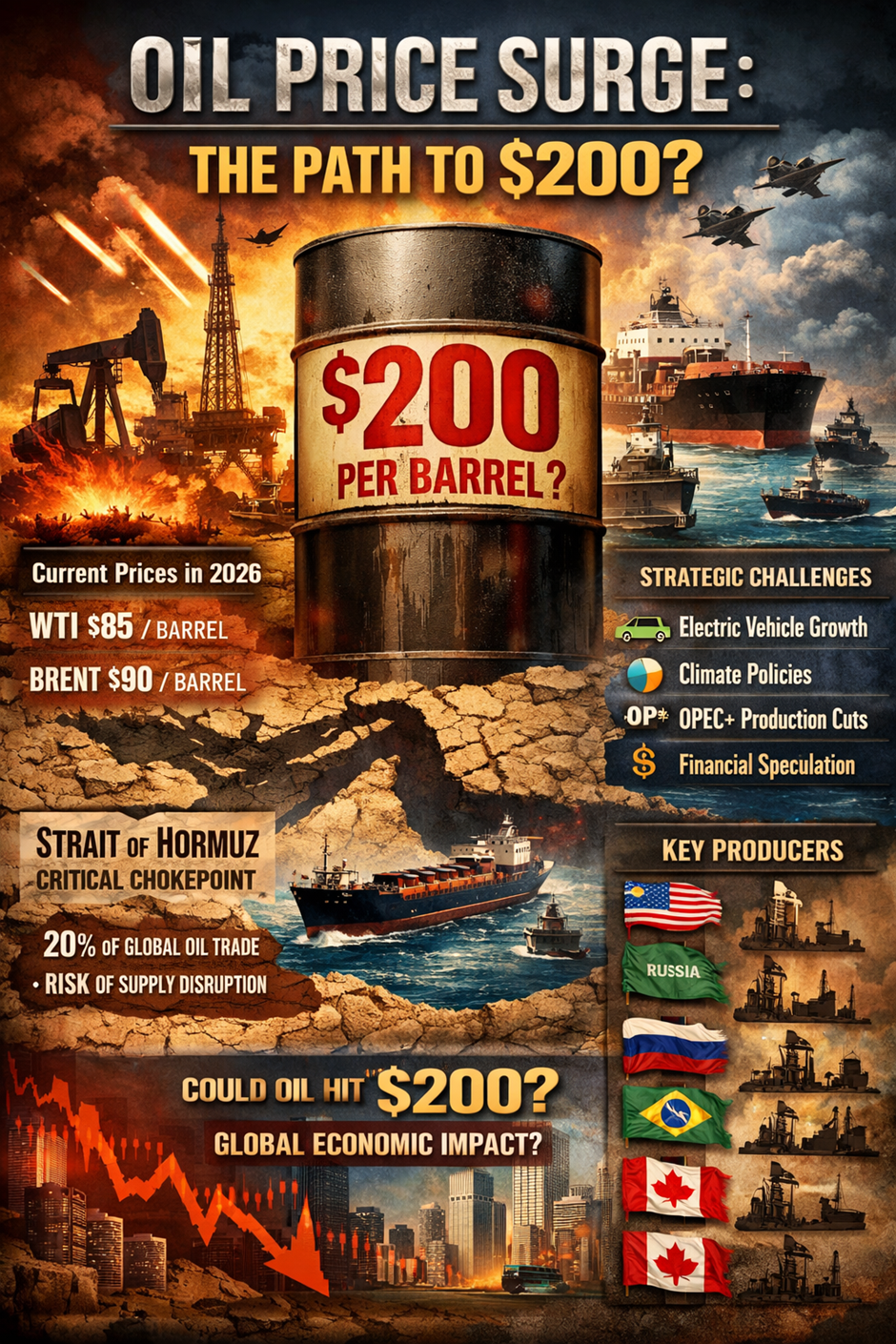
In early 2026, oil markets entered a period of extraordinary volatility. Prices surged sharply following escalating tensions in the Middle East and renewed concerns about potential disruptions to the Strait of Hormuz, the world’s most important oil shipping chokepoint.
At the same time, structural forces such as:
- the rapid expansion of electric vehicles
- climate policy and carbon pricing
- shifting global energy demand
- financial speculation in commodity markets
- and the long-term energy transition
are reshaping the future of oil markets.
This comprehensive analysis examines whether oil prices could realistically reach $200 per barrel, and what such a scenario would mean for the global economy and for investors — particularly those focused on Canadian oil stocks.
Source: Kalkine Group
The Global Oil Market in 2026
Current Oil Price Environment
As of early 2026, benchmark crude prices have experienced significant volatility.
Key reference benchmarks include:
WTI crude: approximately $80–$90 per barrel
Brent crude: approximately $85–$95 per barrel
These prices reflect a substantial geopolitical risk premium caused by tensions surrounding the Persian Gulf shipping corridor.
Before the current geopolitical tensions escalated, major institutional forecasts expected significantly lower oil prices.
Several forecasts entering 2026 projected:
EIA forecast
Brent average near $58 per barrel
JPMorgan estimate
Around $60 per barrel
Reuters analyst consensus
Approximately $64 per barrel
These projections assumed a relatively balanced market with moderate supply growth and slowing demand growth.
However, geopolitical events can rapidly override underlying fundamentals in commodity markets.
Supply Dynamics in the Global Oil Market
Global oil production in 2026 is expected to reach approximately 108 million barrels per day.
Major supply contributors include:
United States
around 13.6–13.8 million barrels per day
Saudi Arabia
the world’s largest swing producer
Russia
major exporter despite sanctions
Brazil
fast-growing offshore production
Guyana
one of the fastest-growing new oil producers
Canada
expanding oil sands production
One of the most important factors influencing supply remains the policy decisions of OPEC+, the alliance of major oil-exporting countries.
OPEC+ has maintained multi-million barrel production cuts in recent years in order to stabilize prices and prevent oversupply.
These coordinated supply restrictions have been a major factor supporting oil prices.
The Strait of Hormuz: A Critical Energy Chokepoint
Roughly 20 percent of global oil supply passes through the Strait of Hormuz.
The narrow shipping corridor connects the Persian Gulf with global markets.
Countries heavily dependent on this route include:
Saudi Arabia
Iraq
Kuwait
United Arab Emirates
Iran
Qatar
A sustained disruption in this corridor could remove 10–20 million barrels per day from global supply, creating one of the most severe energy crises in modern history.
Even temporary disruptions can generate significant price spikes because the global oil market operates with relatively small spare capacity.
Oil Price Supercycles and Historical Lessons
Oil markets have experienced several dramatic price shocks over the past fifty years.
Major historical crises include:
1973 oil embargo
Arab producers restricted exports to Western nations.
1979 Iranian Revolution
Political upheaval severely disrupted global supply.
2008 commodity supercycle
Oil prices surged to nearly $147 per barrel due to booming global demand.
2022 Ukraine energy crisis
Russian exports were disrupted following the invasion of Ukraine.
Each of these crises demonstrates the same key lesson:
Oil markets are extremely sensitive to geopolitical disruptions.
When supply shocks coincide with financial speculation, prices can move dramatically.
Demand Trends: Is Global Oil Demand Peaking?
Global oil demand in 2026 is expected to reach roughly 104–105 million barrels per day.
However, long-term demand growth is slowing.
Key drivers shaping demand include:
Emerging market growth
particularly China and India
Electric vehicle adoption
rapidly reducing gasoline demand
Energy efficiency improvements
Renewable energy expansion
Electrification of transport and heating
Electric vehicles alone displaced over 1 million barrels per day of oil demand annually in recent years.
Many analysts expect global oil demand growth to slow significantly by the end of the decade.
The Energy Transition and Long-Term Oil Demand
One of the most significant structural forces affecting oil markets is the global energy transition.
Governments and corporations are investing heavily in:
solar energy
wind power
battery technology
hydrogen fuels
electric mobility
These trends could gradually reduce the dominance of oil in the global energy system.
However, oil demand remains enormous and will likely remain essential for decades in sectors such as:
aviation
shipping
petrochemicals
heavy industry
Could Oil Reach $200 Per Barrel?
Although current market fundamentals do not support sustained $200 oil, extreme geopolitical scenarios could temporarily push prices to that level.
Several possible scenarios illustrate the range of outcomes.
Base Scenario
Oil stabilizes around $60–$80 per barrel once geopolitical tensions ease.
Moderate Crisis Scenario
Prices fluctuate between $90 and $120 per barrel.
Severe Disruption Scenario
Prices spike toward $130–$180 per barrel due to prolonged supply disruptions.
Extreme Tail Risk Scenario
Major Middle East conflict removes large portions of global supply, potentially pushing oil prices above $200 per barrel temporarily.
Most analysts consider this final scenario a low-probability but plausible tail risk.
Canadian Oil Stocks and the Global Energy Market
Canada possesses the third-largest proven oil reserves in the world, primarily located in Alberta’s oil sands.
Major Canadian producers include:
Canadian Natural Resources
Suncor Energy
Cenovus Energy
Imperial Oil
Together these companies produce millions of barrels per day, supplying both North American and global markets.
Canadian oil companies benefit from:
long-life reserves
stable political environment
advanced extraction technology
growing export capacity via pipelines
Why Investors Are Watching Canadian Oil Companies
Canadian oil producers are attractive to investors because they combine:
low breakeven production costs
large reserves
strong free cash flow
consistent dividends
Companies such as Suncor Energy and Canadian Natural Resources have also adopted disciplined capital allocation strategies that prioritize shareholder returns.
If oil prices remain elevated, these companies could generate exceptional cash flow.
Investment Outlook for Oil Markets
The outlook for oil markets in the coming decade will depend on the interaction between several powerful forces.
Key drivers include:
geopolitical stability in the Middle East
OPEC+ supply management
global economic growth
energy transition policies
electric vehicle adoption
technological innovation in oil extraction
While the base case suggests moderate oil prices, extreme geopolitical events could still trigger temporary spikes.
Final Assessment
Oil reaching $200 per barrel is unlikely under normal market conditions.
However, history shows that geopolitical crises can dramatically reshape commodity markets.
A major supply disruption — particularly involving the Persian Gulf — could produce temporary price spikes approaching or even exceeding that level.
For investors, the key takeaway is that oil markets remain deeply intertwined with geopolitics, technological change, and economic policy.
Canadian oil producers, with their vast reserves and improving cost structures, remain among the most strategically positioned energy companies in the world.


 Nov 27, 2026





 Please wait processing your request...