
 NZ
 UK
 US
 AU
 IND

 CA

 Share
 X (Formerly Twitter)
 Whatsapp
 Facebook
 LinkedIn
 Telegram
 Email This Article
 Copy Link
 Summarize with AI
 Chat GPT
 Perplexity

Quick Facts at a Glance
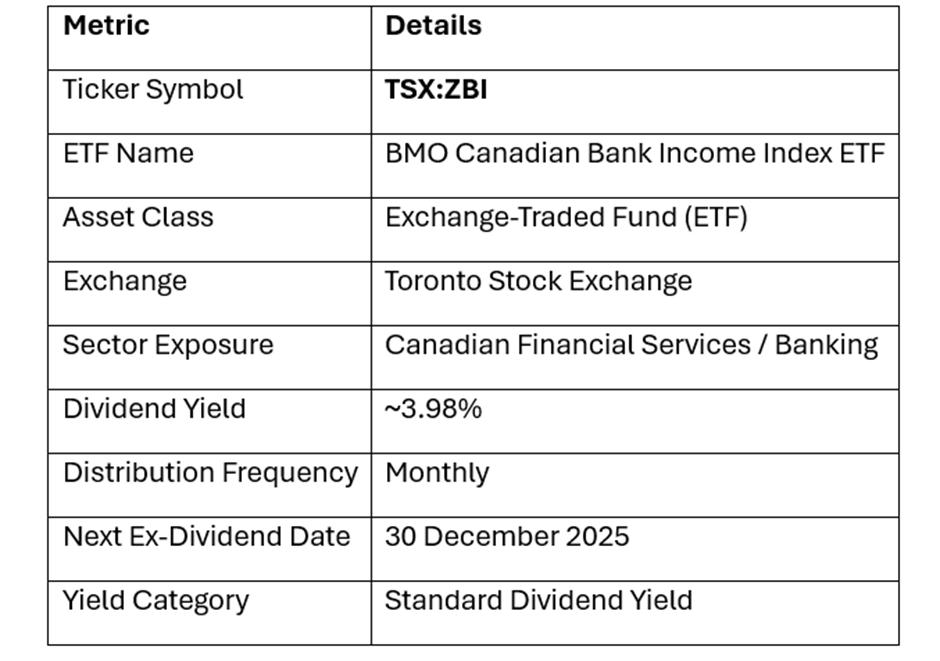
Source: Market Data
What Is TSX:ZBI and Why Are Investors Watching It in 2026?
The BMO Canadian Bank Income Index ETF (TSX:ZBI) has become a prominent income-focused ETF for investors seeking exposure to Canada’s dominant banking sector while collecting regular dividend distributions.
Canada’s banking industry is globally recognized for its stability, strong capital ratios, and consistent dividend policies. Instead of selecting individual bank stocks, TSX:ZBI allows investors to gain diversified exposure to multiple Canadian financial institutions within a single ETF structure.
With a dividend yield of roughly 3.98%, the ETF falls within the moderate income category, offering a blend of:
- consistent cash flow
• exposure to Canada’s largest banks
• long-term capital appreciation potential
For investors building dividend income portfolios or retirement portfolios, the ETF serves as a convenient gateway into one of the most profitable sectors of the Canadian economy.
How Does the BMO Canadian Bank Income Index ETF Work?
As an exchange-traded fund, TSX:ZBI pools investor capital and allocates it across a portfolio of major Canadian banking institutions.
The ETF tracks a bank-focused income strategy designed to generate yield through:
- bank dividend payments
• covered call income strategies
• income-oriented portfolio allocation
This structure allows the ETF to deliver consistent distributions while maintaining sector exposure to Canadian financial institutions.
The portfolio generally includes exposure to Canada's largest banking giants such as:
- Royal Bank of Canada
• Toronto-Dominion Bank
• Bank of Nova Scotia
• Bank of Montreal
• Canadian Imperial Bank of Commerce
• National Bank of Canada
These institutions historically rank among the most reliable dividend payers globally, which forms the backbone of ZBI’s income strategy.
TSX:ZBI Dividend Yield Analysis
Dividend yield remains the primary metric income investors evaluate when analyzing ETFs like TSX:ZBI.
Current estimated yield:
≈ 3.977%
This yield is considered stable rather than high-yield, reflecting the strong dividend culture of Canadian banks.
The yield profile is influenced by several factors:
- Bank Dividend Stability
Canadian banks maintain conservative payout ratios and tend to increase dividends gradually over time.
- Covered Call Income
Many income ETFs enhance yield through covered call strategies, which generate additional option income.
- Interest Rate Environment
Bank profitability tends to improve when interest margins expand, supporting dividend sustainability.
Distribution Structure and Payment Schedule
One of the most appealing characteristics of TSX:ZBI is its monthly distribution schedule.
Monthly payments offer advantages such as:
- predictable income stream
• easier budgeting for retirees
• faster compounding through reinvestment
The upcoming ex-dividend date is December 30, 2025, meaning investors must own units before that date to qualify for the next distribution.
Portfolio Composition and Sector Exposure
The ETF focuses almost exclusively on the Canadian banking industry, which represents the largest segment of Canada’s financial services sector.
Key characteristics of the portfolio include:
High quality banking exposure
Canada’s banks rank among the world’s safest and most profitable.
Dividend-focused strategy
The ETF prioritizes securities with strong dividend policies.
Large-cap financial concentration
Most holdings are large-capitalization banks with stable earnings.
Because the Canadian banking sector dominates the domestic financial landscape, ZBI provides targeted exposure to a core pillar of the Canadian economy.
Tax Treatment for Canadian Investors
Tax efficiency plays a crucial role in dividend investing.
Distributions from TSX:ZBI may consist of several components:
- Canadian eligible dividends
• capital gains
• foreign income
• return of capital
Canadian investors holding the ETF in taxable accounts benefit from the dividend tax credit, which reduces the effective tax rate on eligible dividends.
Best Account Types for Holding ZBI
TFSA (Tax-Free Savings Account)
All income and capital gains remain tax-free.
RRSP (Registered Retirement Savings Plan)
Taxes are deferred until withdrawal.
Non-Registered Accounts
Dividends receive favorable tax treatment but must be reported annually.
Proper account placement can significantly improve after-tax returns.
Key Risks Investors Should Consider
Although TSX:ZBI provides diversification across multiple banks, several risks still apply.
Interest Rate Risk
Higher interest rates may reduce demand for dividend ETFs as fixed-income investments become more competitive.
Sector Concentration Risk
Because the ETF focuses on banks, sector-specific issues could impact performance.
Economic Cycles
Bank profitability depends heavily on economic conditions, credit demand, and loan defaults.
Regulatory Risk
Financial institutions operate under strict regulatory oversight, and policy changes can affect profitability.
Diversification across multiple sectors remains essential for managing these risks.
How TSX:ZBI Fits Into a Dividend Portfolio
For income investors, TSX:ZBI can serve several roles:
Core Banking Exposure
Provides diversified access to Canada's dominant financial institutions.
Income Generator
Monthly distributions provide consistent portfolio income.
Dividend Reinvestment Strategy
Using a DRIP (Dividend Reinvestment Plan) allows investors to compound returns automatically.
Many Canadian brokerage platforms support automatic dividend reinvestment for ETFs, enabling long-term wealth accumulation.
Peer Comparison Within TSX Dividend ETFs
Canada offers several ETFs targeting income investors.
When comparing TSX:ZBI with other financial ETFs, investors typically analyze:
- dividend yield
• management expense ratio (MER)
• assets under management
• trading liquidity
• strategy (passive vs covered call)
ZBI stands out because of its bank-specific income focus, making it more specialized than broader financial sector ETFs.
2026 Outlook for Canadian Bank Dividend ETFs
The long-term outlook for Canadian banks remains constructive due to several macroeconomic factors.
Strong Capital Positions
Canadian banks maintain high capital adequacy ratios.
Rising Loan Demand
Population growth and economic expansion support lending activity.
Global Banking Stability
Canada’s banking system consistently ranks among the safest globally.
These structural advantages provide a strong foundation for continued dividend stability within bank-focused ETFs like TSX:ZBI.
Final Investment Outlook
The BMO Canadian Bank Income Index ETF (TSX:ZBI) remains a compelling income-oriented ETF for investors seeking exposure to Canada’s resilient banking sector.
With an approximate 3.98% dividend yield, monthly distributions, and diversified exposure to major Canadian banks, the ETF offers a balanced combination of income and sector stability.
However, investors should remain mindful of sector concentration and macroeconomic risks when allocating capital to banking-focused ETFs.
For those building TSX dividend portfolios, ZBI can function as either:
- a core financial sector holding
• a supplemental income ETF
Ultimately, the suitability of TSX:ZBI depends on an investor’s risk tolerance, income needs, and overall portfolio diversification strategy.


 Nov 27, 2026





 Please wait processing your request...