
 AU
AU
 UK
UK
 US
US
 NZ
NZ
 IND
IND

 CA
CA

 Share
Share
 X (Formerly Twitter)
 Whatsapp
 Facebook
 LinkedIn
 Telegram
 Email This Article
 Copy Link
 Summarize with AI
 Chat GPT
 Perplexity
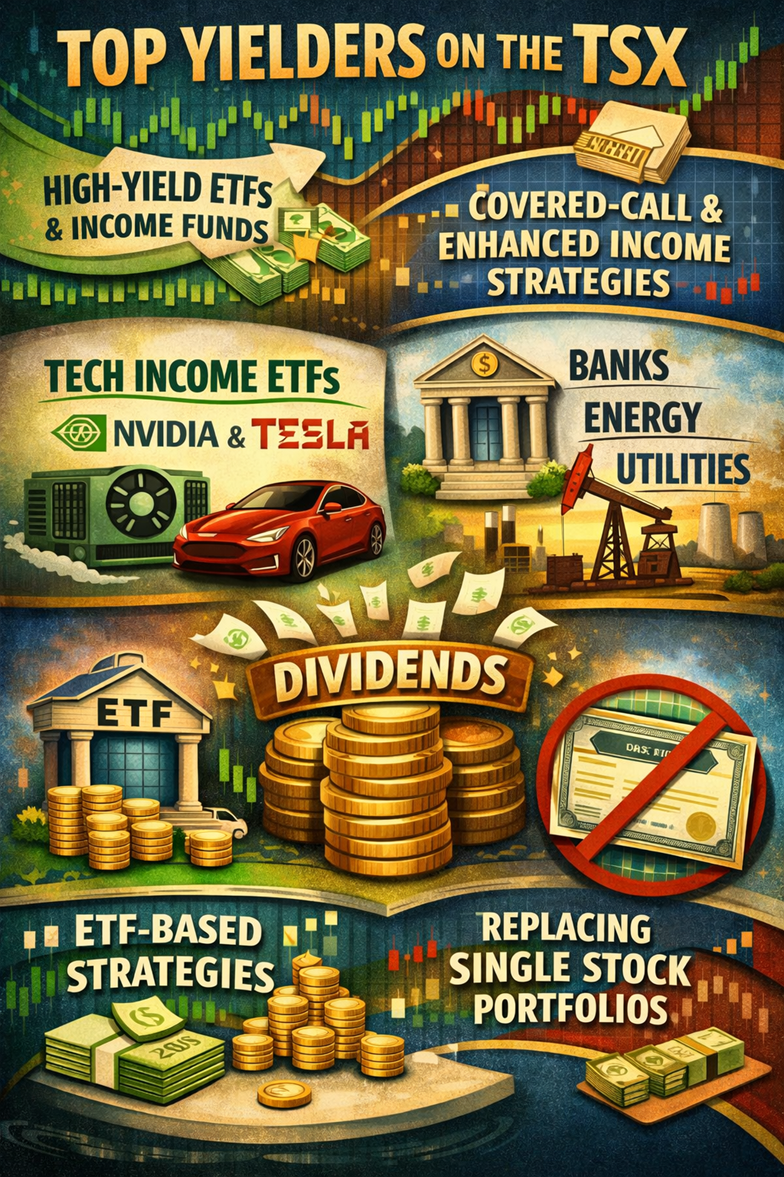
Key Highlights (March 2026)
- High-yield dividend ETFs and income funds dominate the list of top yielders on the TSX.
• Covered-call and enhanced income strategies are becoming central to dividend investing.
• Technology-linked income ETFs tied to companies like Nvidia and Tesla are rapidly gaining investor interest.
• Canada’s traditional dividend sectors — banking, energy, and utilities — remain core income pillars.
• ETF-based dividend strategies are increasingly replacing single-stock income portfolios.
Source: Kalkine Group
Introduction
Dividend investing remains one of the most popular strategies for generating reliable income in uncertain market environments.
In 2026, investors across global markets are increasingly seeking stable cash flow as interest-rate uncertainty, inflation pressures, and geopolitical risks continue to influence capital markets.
Canada’s Toronto Stock Exchange (TSX) stands out as one of the world’s most attractive dividend markets due to its strong representation of income-producing sectors such as banking, energy, infrastructure, and utilities.
In recent years, however, the dividend landscape on the TSX has evolved significantly. Traditional dividend stocks are now joined by a growing ecosystem of income-focused ETFs, structured products, and enhanced yield funds designed to maximize investor distributions.
According to TMX Money dividend rankings and recent market data, many of the highest-yielding securities on the exchange now include income funds linked to major global technology companies such as Tesla, Nvidia, and Coinbase.
These investment vehicles use strategies such as covered calls, options-based income generation, and enhanced yield distributions to deliver high monthly dividends.
For investors looking to build a diversified income portfolio, understanding how these products work — along with their risks and growth potential — is increasingly important.
Overview of Canada’s Dividend Market
Canada has historically been one of the most reliable dividend markets globally.
The Canadian equity market structure naturally favors dividend-paying companies because it is dominated by mature industries with stable cash flows.
Key dividend-generating sectors include:
- Banking and financial services
• Oil and gas energy producers
• Utilities and infrastructure companies
• Telecommunications providers
• Real estate investment trusts (REITs)
Large Canadian banks and energy producers have historically delivered consistent dividend growth for decades, making them core holdings in many global income portfolios.
However, the dividend ecosystem has expanded significantly in the past decade with the emergence of income-oriented ETFs and structured funds.
These funds allow investors to access diversified dividend streams without selecting individual stocks.
Why Dividend Investing Is Surging in 2026
Several major macroeconomic factors are driving renewed investor interest in dividend-paying securities.
1 Interest Rate Uncertainty
Although global central banks have aggressively raised interest rates over the past several years, markets are increasingly anticipating potential rate cuts.
In this environment, dividend-paying equities are becoming attractive alternatives to fixed-income assets such as bonds.
Income-focused investors are seeking predictable cash flows combined with long-term capital appreciation potential.
2 Market Volatility
Global equity markets have experienced heightened volatility due to geopolitical tensions, economic slowdowns, and monetary policy changes.
Dividend-paying securities often act as defensive investments, providing income even during periods of market turbulence.
Historically, dividend stocks have also demonstrated lower downside volatility compared with high-growth equities.
3 Innovation in ETF Income Strategies
One of the most significant developments in dividend investing has been the rapid expansion of options-based income ETFs.
These funds generate enhanced income through strategies such as:
- Covered call writing
• Options premium harvesting
• Structured distribution strategies
Such approaches allow ETFs to produce double-digit yields in certain market environments.
Top High-Yield Dividend Opportunities on the TSX
Several securities currently stand out among high-yield investments listed on the TSX.
Harvest Tesla Enhanced High Income Shares ETF (TSLY)
This ETF provides income exposure linked to Tesla stock performance.
The fund generates income primarily through covered call options, allowing it to distribute enhanced monthly dividends while maintaining exposure to Tesla shares.
It has become popular among investors seeking income from high-growth technology companies.
Harvest Nvidia Enhanced High Income Shares ETF (NVHE)
NVHE provides income exposure tied to Nvidia’s stock performance.
The fund generates yield by writing options on Nvidia shares, converting market volatility into income distributions.
With the surge in demand for artificial intelligence infrastructure, Nvidia-linked income strategies have attracted strong investor attention.
Harvest Coinbase Enhanced High Income Shares ETF (CNYE)
This ETF offers income exposure to the cryptocurrency exchange Coinbase.
The fund uses derivatives strategies to generate enhanced yield while maintaining exposure to the rapidly evolving crypto industry.
Due to the volatility of digital assets, such income strategies can deliver high yields but also carry elevated risk.
Purpose Ether Yield ETF (ETHY)
ETHY provides exposure to Ethereum while generating income through structured yield strategies.
Crypto-linked income ETFs represent one of the newest segments of the dividend market.
While potentially lucrative, they remain among the most volatile dividend investments available.
Harvest Strategy High Income Shares ETF (MSTY)
MSTY focuses on diversified income generation strategies across various sectors.
It typically distributes monthly income, making it attractive for investors seeking consistent cash flow.
Emerging Trends in Dividend Investing
Rapid Growth of Covered-Call ETFs
Covered-call ETFs have experienced explosive growth across North America.
These funds generate income by selling call options on underlying securities, collecting premiums that are distributed to investors.
The main trade-off is that upside capital appreciation may be limited if the underlying stock rallies strongly.
However, for income-focused investors, the strategy provides reliable yield.
Technology Income Funds
Traditionally, technology companies paid little or no dividends.
However, modern ETF strategies now allow investors to generate income from tech giants such as:
- Tesla
• Nvidia
• Microsoft
• Meta Platforms
This trend is reshaping dividend investing by merging growth and income strategies.
Energy Sector Income Funds
Canada’s energy sector remains one of the largest sources of dividend income.
Energy ETFs such as equal-weighted Canadian oil and gas funds provide diversified exposure to producers benefiting from stable oil prices.
High cash flows in the energy sector continue to support strong dividend distributions.
Cryptocurrency Yield Products
Crypto income funds represent a rapidly growing category of alternative dividend investments.
These funds generate yield through options strategies and structured exposure to digital assets such as Ethereum.
However, investors must consider significant volatility and regulatory uncertainty.
Key Metrics for Evaluating Dividend Investments
Investors analyzing dividend securities should consider several important financial indicators.
Dividend Yield
Dividend yield measures the annual dividend relative to the share price.
Many TSX income ETFs currently offer yields between 6% and 12%, depending on the strategy employed.
Distribution Stability
Consistent and predictable distributions are often more important than extremely high yields.
Investors should review the historical reliability of dividend payments.
Portfolio Strategy
Understanding how an ETF generates income is crucial.
Income funds may rely on:
- options trading
• derivatives exposure
• leveraged strategies
• sector concentration
Each approach carries different risk profiles.
Liquidity and Trading Volume
Higher trading volumes generally indicate stronger market participation and easier entry or exit for investors.
Most large income ETFs on the TSX trade tens or hundreds of thousands of shares daily.
Risks of High-Yield Dividend Investments
Despite their income appeal, high-yield dividend securities carry several potential risks.
Yield Traps
Extremely high dividend yields may sometimes signal financial distress or unsustainable payout structures.
Investors should always evaluate the source and sustainability of dividend payments.
Limited Capital Appreciation
Covered-call strategies generate income but can reduce upside potential if markets rally strongly.
Income investors must balance yield generation with long-term growth potential.
Sector Concentration
Many income funds are heavily concentrated in specific sectors such as technology or energy.
This concentration may increase exposure to sector-specific risks.
Cryptocurrency Volatility
Crypto-linked dividend funds remain highly speculative due to rapid price fluctuations in digital assets.
Future Growth Drivers for Dividend Investing
Several long-term trends could support continued growth in dividend strategies.
Expansion of Income ETFs
Asset managers continue to launch innovative ETFs targeting specific sectors and companies.
The number of enhanced income ETFs is expected to increase significantly over the next decade.
Demographic Shifts
Aging populations across developed economies are increasing demand for income-producing investments.
Dividend ETFs provide attractive options for retirement portfolios.
Technology-Driven Income Strategies
The ability to generate income from high-growth technology stocks represents one of the biggest shifts in dividend investing.
Options strategies allow investors to monetize volatility in tech stocks.
Stability in Energy Markets
Canada’s energy sector remains a cornerstone of dividend investing.
Stable oil prices and strong cash flows support high dividend payouts from energy companies.
Market Sentiment and Analyst Outlook
Analysts remain broadly optimistic about the long-term outlook for dividend investing.
Key factors supporting the sector include:
- increasing demand for income-generating assets
• diversification benefits within portfolios
• inflation-resistant cash flow streams
Dividend ETFs also simplify portfolio construction by providing diversified exposure to multiple income strategies.
As a result, analysts expect the global dividend ETF market to expand significantly through the late 2020s.
Long-Term Investment Perspective
Dividend investing has historically been one of the most effective long-term wealth-building strategies.
Key advantages include:
- reinvested dividends that compound returns
• reduced portfolio volatility
• consistent cash flow generation
Canada’s equity market remains particularly attractive due to strong corporate cash flows and a long tradition of dividend payments.
For long-term investors, combining traditional dividend stocks with innovative income ETFs may provide a balanced strategy for income and growth.
10 Questions Investors Are Asking About TSX Dividend Stocks
1 What are the highest dividend stocks on the TSX?
High-yield ETFs, split-share corporations, and covered-call income funds currently dominate the highest-yield rankings.
2 Are covered-call ETFs good investments?
They can provide stable income but may limit capital gains during strong bull markets.
3 Why are technology income ETFs becoming popular?
Options strategies allow investors to generate income from high-growth tech companies.
4 Is dividend investing better than growth investing?
Both strategies serve different purposes; many investors combine them for balanced portfolios.
5 What risks exist with high-yield dividend stocks?
Major risks include unsustainable yields, sector concentration, and market volatility.
6 How do enhanced income ETFs work?
They use derivatives and options strategies to generate additional income distributions.
7 Are crypto income ETFs safe investments?
They offer high yields but carry significant volatility and regulatory risks.
8 Do dividend ETFs provide monthly income?
Many income ETFs distribute dividends monthly, making them attractive for retirees.
9 Which sectors produce the strongest dividends in Canada?
Banks, energy companies, and utilities have historically produced the most reliable dividends.
10 Are dividend stocks suitable for retirement portfolios?
Yes, dividend stocks and ETFs are widely used to generate stable retirement income.
Conclusion
Dividend investing continues to evolve as financial innovation transforms how investors generate income.
The Toronto Stock Exchange remains one of the world’s premier markets for dividend opportunities, offering exposure to both traditional income sectors and modern ETF-based strategies.
Innovative funds linked to technology companies, cryptocurrencies, and enhanced income strategies are expanding the possibilities for investors seeking higher yields.
However, careful evaluation of dividend sustainability, investment strategy, and risk exposure remains essential.
For investors seeking long-term income generation and portfolio stability, TSX dividend investments will likely remain a key component of global income portfolios for years to come.


 Jun 24, 2026




 Please wait processing your request...