
 AU
AU
 UK
UK
 US
US
 NZ
NZ
 IND
IND

 CA
CA

 Share
Share
 X (Formerly Twitter)
 Whatsapp
 Facebook
 LinkedIn
 Telegram
 Email This Article
 Copy Link
 Summarize with AI
 Chat GPT
 Perplexity
As we approach 2026, the Canadian Dividend Aristocrats prove they are more than just stocks; they are businesses with the proven financial discipline to consistently increase or maintain their payouts, weathering every major economic storm from the 2008 crisis to the 2020 crash.
Built to Last: Stability and Hedge
This historical resilience provides unparalleled stability for your portfolio. Aristocrats in essential sectors like Financials and Utilities act as a critical hedge, delivering predictable income that cushions drawdowns when other parts of the market falter.
The Triple Win: Income, Growth, and Safety
Investing here offers three key benefits:
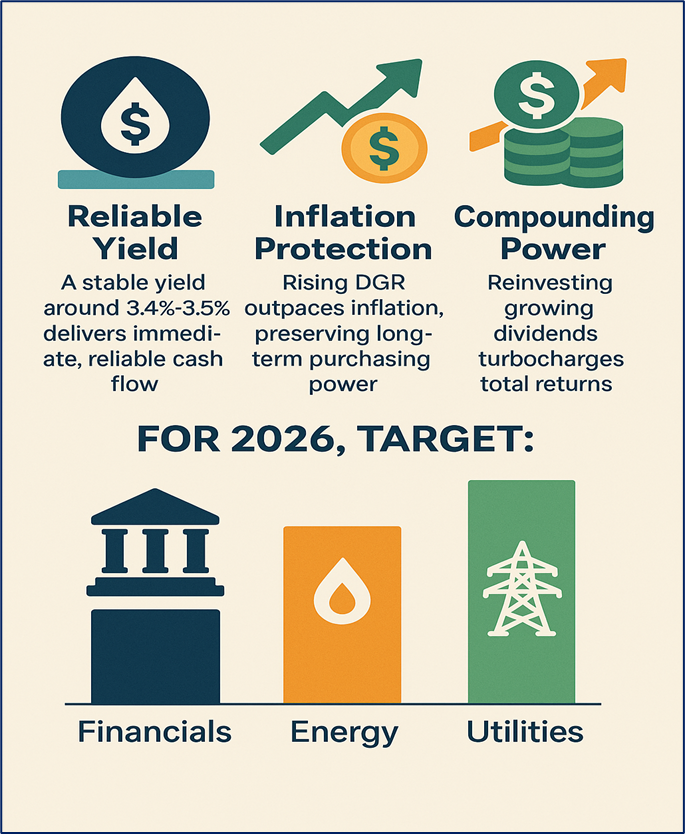
- Reliable Yield: A stable average forward yield near 3.4% to 3.5% delivers immediate, reliable cash flow.
- Inflation Protection: Crucially, the rising Dividend Growth Rate (DGR) ensures your income stream outpaces inflation, preserving your long-term purchasing power.
- Compounding Power: Reinvesting these growing dividends turbocharges total returns, turning stable income into significant wealth accumulation.
For 2026, rely on the foundational Financials for stability, but target Energy (for high yield and aggressive cash returns) and Utilities (for predictable, regulated DGR) to drive superior returns. These companies are the must-have, recession-proof anchors for the serious long-term investor.
Source: Kalkine Group
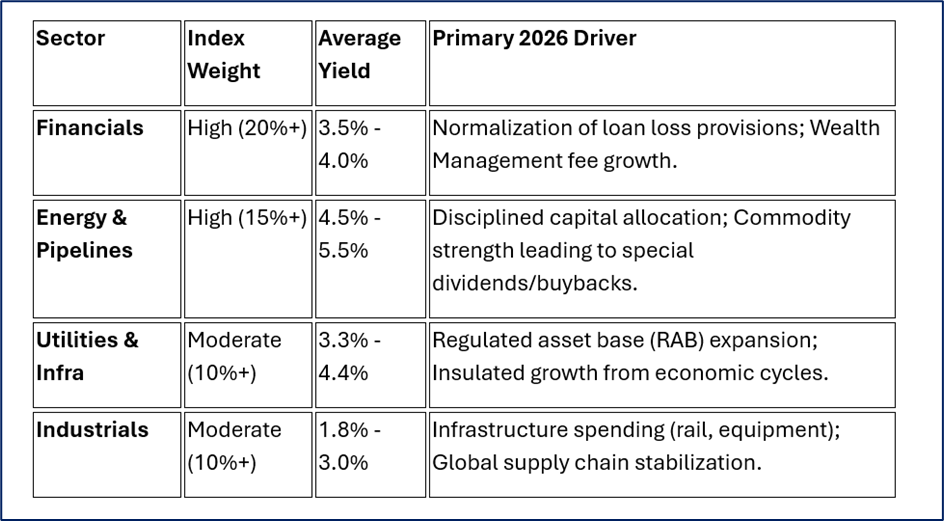
Sector Snapshot: Key Data & 2026 Outlook
Source: Kalkine Group
Yield & Growth Trajectory
- Yield Trajectory: Expect yields to remain attractive but not excessive. High stock prices driven by demand for stable income could compress yields slightly. The Forward Yield for Canadian Utilities (CU), a benchmark for stability, is currently around 4.33% to 4.38% (as of late Nov 2025).
- Dividend Growth: This is where the true wealth is built. High-quality aristocrats like Canadian National Railway (CNR) boast a long-term (10-year) dividend growth rate (DGR) historically exceeding 11%, showcasing the power of compounding.
The Full Roster: Key Stocks and Drivers for the Next Year
The Canadian Dividend Aristocrat list includes companies with stable cash flow models, providing resilience in any market cycle.
Financial Services: The Low-Volatility Anchors
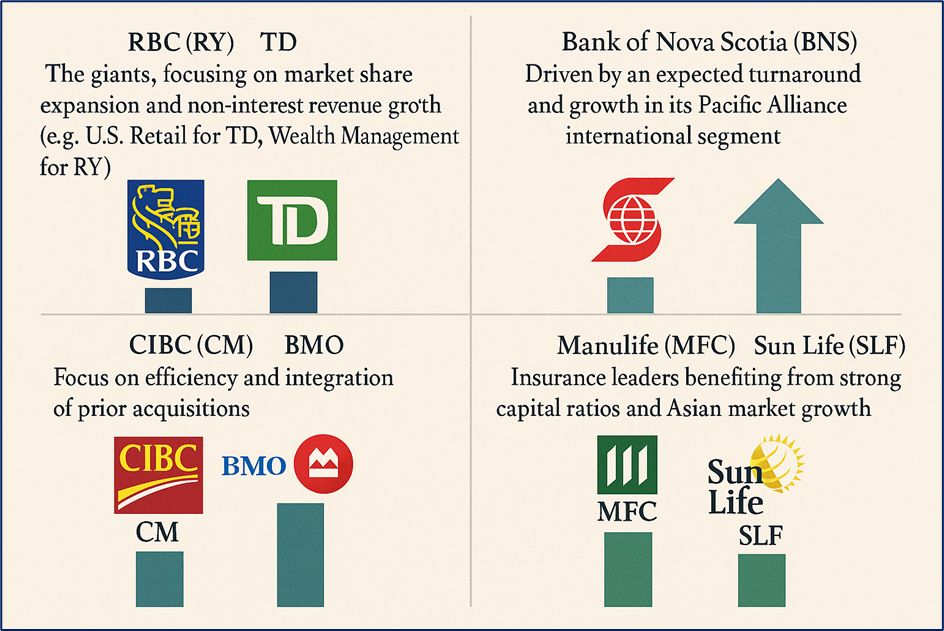
- Royal Bank of Canada (RY) & TD Bank (TD): The giants, focusing on market share expansion and non-interest revenue growth (e.g., U.S. Retail for TD, Wealth Management for RY).
- Bank of Nova Scotia (BNS): Driven by an expected turnaround and growth in its Pacific Alliance international segment.
- CIBC (CM) & Bank of Montreal (BMO): Focus on efficiency and integration of prior acquisitions.
- Manulife (MFC) & Sun Life (SLF): Insurance leaders benefiting from strong capital ratios and Asian market growth.
Source: Kalkine Group
Energy, Pipelines & Industrials: The Cash Flow Engines
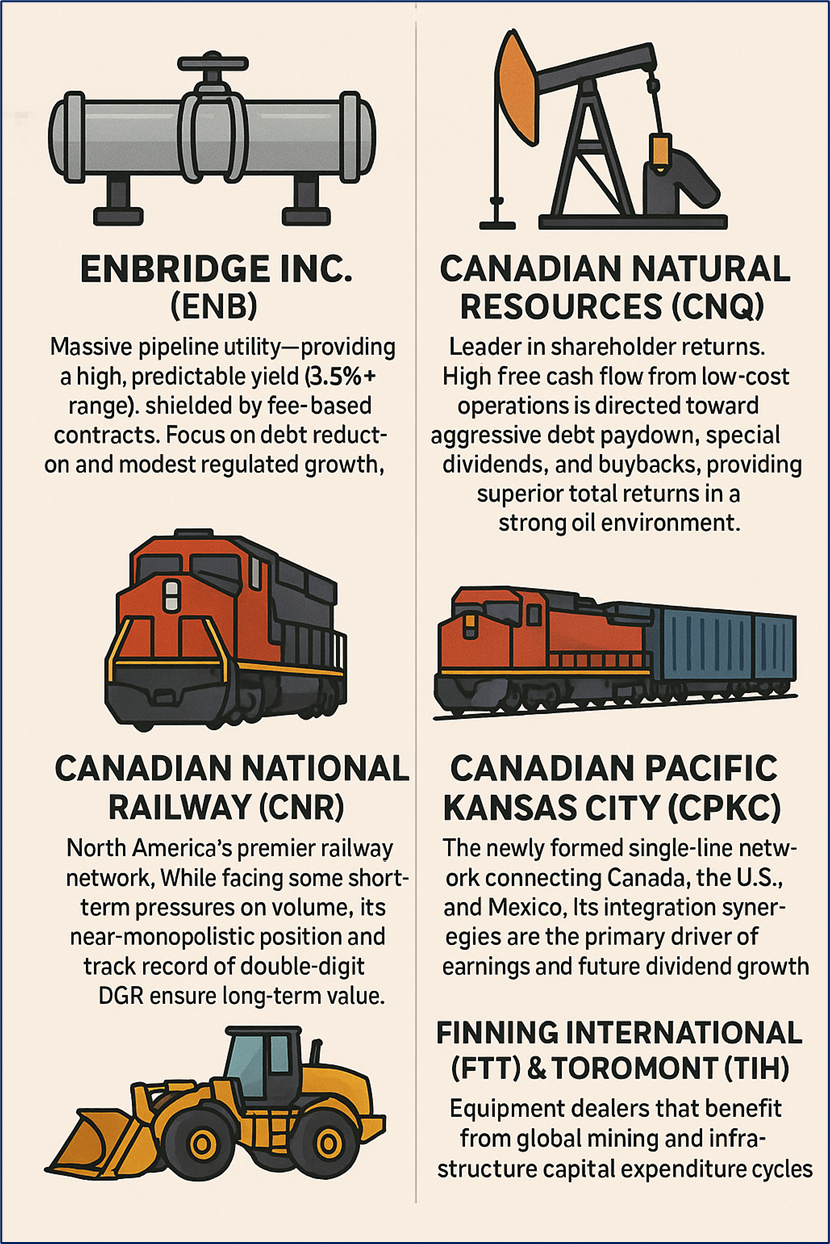
- Enbridge Inc. (ENB): Massive pipeline utility providing a high, predictable yield (5.5%+ range), shielded by fee-based contracts. Focus on debt reduction and modest regulated growth.
- Canadian Natural Resources (CNQ): Leader in shareholder returns. High free cash flow from low-cost operations is directed toward aggressive debt paydown, special dividends, and buybacks, providing superior total returns in a strong oil environment.
- Canadian National Railway (CNR): North America's premier railway network. While facing some short-term pressures on volume, its near-monopolistic position and track record of double-digit DGR ensure long-term value.
- Canadian Pacific Kansas City (CP): The newly formed single-line network connecting Canada, the U.S., and Mexico. Its integration synergies are the primary driver of earnings and future dividend growth.
- Finning International (FTT) & Toromont (TIH): Equipment dealers that benefit from global mining and infrastructure capital expenditure cycles.
Source: Kalkine Group
Utilities & Defensive Growth: The Ultimate Sleep-Well Stocks
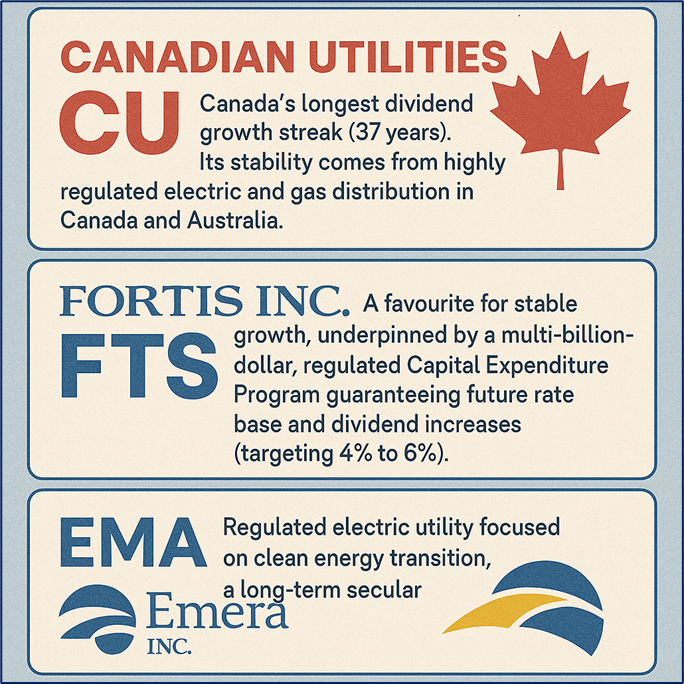
- Canadian Utilities (CU): Canada's longest dividend growth streak (37 years). Its stability comes from highly regulated electric and gas distribution in Canada and Australia.
- Fortis Inc. (FTS): A favourite for stable growth, underpinned by a multi-billion-dollar, regulated Capital Expenditure Program guaranteeing future rate base and dividend increases (targeting 4% to 6%).
- Emera Inc. (EMA): Regulated electric utility focused on clean energy transition, a long-term secular growth trend.
Source: Kalkine Group
Consumer Staples & Retail: Essential Spending
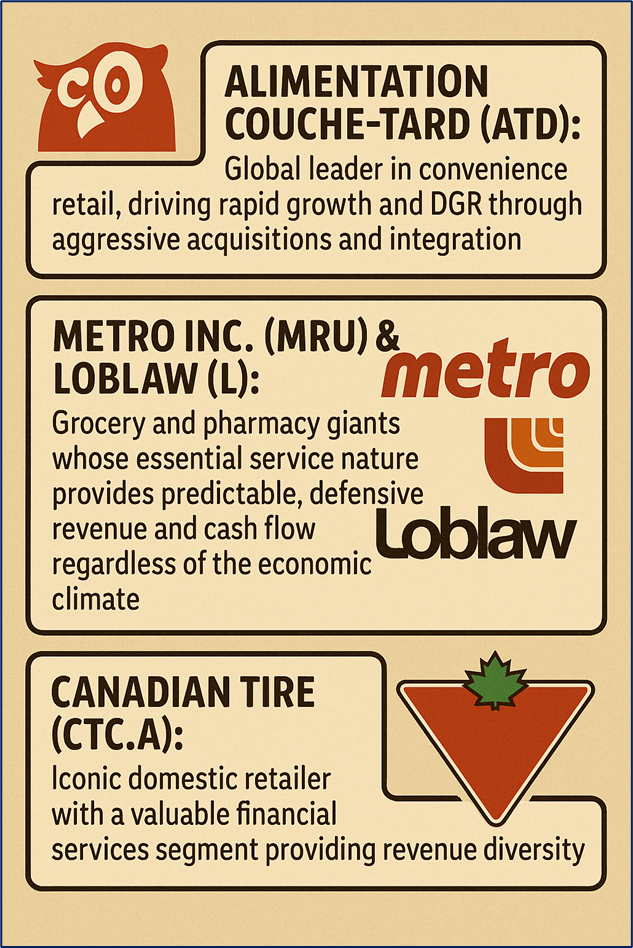
- Alimentation Couche-Tard (ATD): Global leader in convenience retail, driving rapid growth and DGR through aggressive acquisitions and integration.
- Metro Inc. (MRU) & Loblaw (L): Grocery and pharmacy giants whose essential service nature provides predictable, defensive revenue and cash flow regardless of the economic climate.
- Canadian Tire (CTC.A): Iconic domestic retailer with a valuable financial services segment providing revenue diversity.
Source: Kalkine Group
Technology & Communication Services (The Tech Growers)
Select technology and telecom companies with durable, high-margin revenue.
- TELUS Corp. (T): Major Canadian telecom with a focus on wireless, fiber-optic networks, and TELUS International (TIXT) growth.
- Open Text Corporation (OTEX): Enterprise information management software company, growing dividends through organic business and strategic acquisitions.
- Thomson Reuters (TRI): Global provider of business information and services, driven by subscription-based recurring revenue.

Source: Kalkine Group
Conclusion: 2026 Dividend Aristocrat Strategy
For 2026, the Canadian Dividend Aristocrats offer an excellent blend of income and stability. The strategy should be to select companies with low payout ratios and sector-specific growth drivers:
- Focus on FCF Quality: Prioritize companies like CNQ and ENB (Energy/Pipelines) for their sheer Free Cash Flow generation and direct cash return policies.
- Stick to Regulated Assets: FTS and CU offer almost bond-like reliability, essential for capital preservation and inflation-protected income growth.
- Watch the Banks: The Big Six are a mandatory holding for stability but expect growth in dividends to be closer to their long-term average, tracking Canadian GDP.


 Jun 24, 2026




 Please wait processing your request...