
 NZ
 UK
 US
 AU
 IND

 CA

 Share
 X (Formerly Twitter)
 Whatsapp
 Facebook
 LinkedIn
 Telegram
 Email This Article
 Copy Link
 Summarize with AI
 Chat GPT
 Perplexity

As we enter 2026, the Canadian energy landscape is defined by a "Year of the Glut." With global supply forecast to exceed demand by up to 3.85 million bpd (IEA), the TSX’s largest producers have shifted from aggressive expansion to extreme capital discipline and shareholder returns.
1. Canadian Natural Resources Ltd. (TSX: CNQ)
The Business Model: The Low-Cost King
CNQ operates as a "cash flow machine" with a vast portfolio of long-life, low-decline assets. Its model relies on maintaining one of the lowest break-even costs in North America, allowing it to remain profitable even if WTI prices dip toward $50.
Latest Financial & Operational Updates (January 2026)
- 2026 Budget: CNQ has set a disciplined C$6.3 billion capital budget, targeting 3% production growth to reach a range of $1.59 - 1.65 million BOE/d.
- Strategic Shift: The company is allocating C$175 million to FEED (Front-End Engineering) for long-term projects like the Jackfish and Pike 2 expansions, signaling a focus on 2028 and beyond.
- Cash Flow: In late 2025, CNQ reported a 9% YoY increase in Adjusted Funds Flow, generating roughly C$2.0 billion in quarterly free cash flow.
Technical Analysis
Source: Trading View
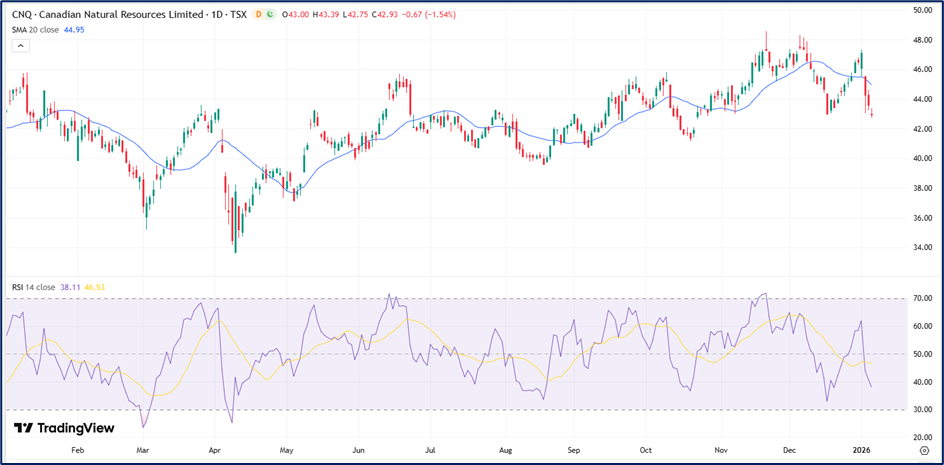
CNQ's stock is currently characterized by a stable trading pattern with an RSI near 40, indicating it is neither overbought nor oversold. It tracks closely to its 200-day moving average, serving as a defensive "safe haven" within the energy sector.
Key Risks
- A-Z Score: Currently at 2.55, placing it in a "grey zone" for financial stress (though not immediate risk).
- Maintenance: A major 35-day turnaround at the Horizon site in September 2026 will temporarily curb production by 29,000 bpd.
2. Suncor Energy Inc. (TSX: SU)
The Business Model: Integrated Efficiency
Under CEO Rich Kruger, Suncor has completed its pivot from a troubled operator to an efficiency leader. Its business model integrates oil sands mining with a massive downstream refining and retail network (Petro-Canada), allowing it to capture margins when crude prices are low but refined product demand (diesel/gasoline) remains high.
Latest Financial & Operational Updates (January 2026)
- Production Surge: Suncor's 2026 guidance projects production of $840,000 - 870,000 bbls/d, a significant jump of 100,000 bpd over 2023 levels.
- Refining Dominance: Downstream utilization is expected to hit a record 99–102%, taking advantage of high global diesel crack spreads.
- Shareholder Returns: The company has increased monthly share buybacks by 10% to C$275 million, totaling C$3.3 billion for the year 2026.
Technical Analysis
Source: Trading View
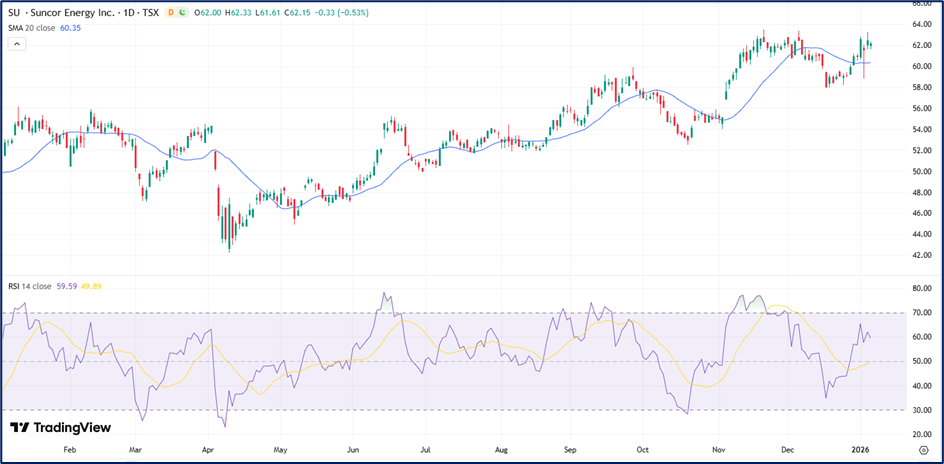
SU recently hit a new 52-week high in early January 2026, supported by a "Strong Buy" rating from Goldman Sachs. The 50-day moving average (C$43.17) is trending firmly above the 200-day average (C$41.07), suggesting a bullish breakout pattern.
Key Risks
- Pipeline Constraints: While political sentiment has improved, any delays in new West Coast pipeline projects could bottleneck Suncor's increased output.
- Regional Regulation: Heavily dependent on the continued easing of federal emissions caps.
3. Cenovus Energy Inc. (TSX: CVE)
The Business Model: The Growth Re-Rater
Cenovus is the "growth" play among the titans. Following the acquisition of MEG Energy, Cenovus has become a massive integrated player. Its model focuses on ramping up "in-flight" expansions to maximize free funds flow for debt reduction.
Latest Financial & Operational Updates (January 2026)
- 2026 Guidance: Capital investment is set at C$5.0 - 5.3 billion. Upstream production is expected to reach nearly 1 million BOE/d (945,000 - 985,000 BOE/d).
- Debt Target: The company is nearing its C$4.0 billion net debt floor. Once reached, it has committed to returning 100% of excess free funds flow to shareholders.
- New Oil: First oil from the West White Rose field is expected in Q2 2026, providing a high-margin offshore catalyst.
Technical Analysis
Source: Trading View
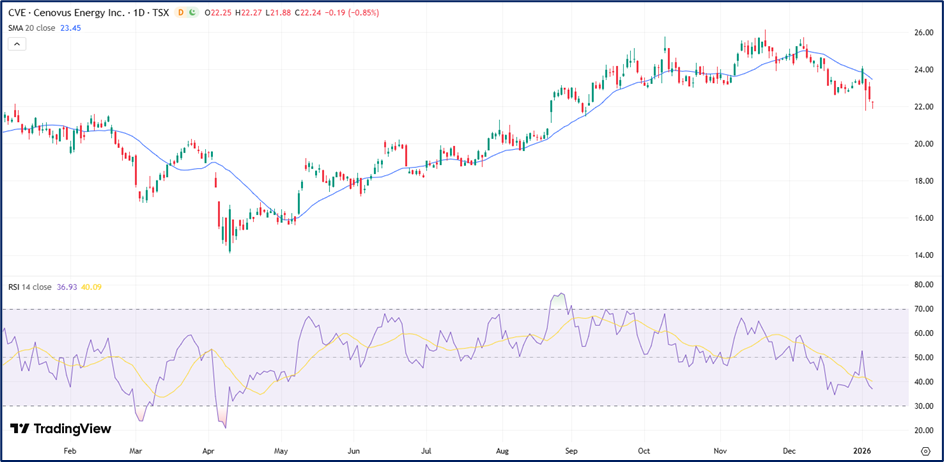
CVE has experienced volatility in early January 2026, recently pulling back 7% due to sector-wide oversupply fears. However, with an average analyst price target of C$29.59, it currently shows a projected upside of ~15-20% from its current trading range.
Key Risks
- Leverage: Maintains a higher debt-to-equity ratio (33.59) compared to CNQ and Suncor.
- Market Sentiment: As a more "beta-heavy" stock, it is more sensitive to sudden drops in WTI prices than its peers.
Conclusion: The 2026 Outlook
The "Big Three" of the TSX are no longer just oil companies; they are sophisticated cash-management entities. While the IEA warns of a massive surplus, these titans have lowered their break-evens and optimized their refining arms to survive a low-price environment.
Current Sector Drivers:
- Deregulation: The recent federal-provincial agreement easing climate regulations has lowered compliance costs.
- The "LNG Wave": Rising natural gas prices ($3.90 - $4.50/MMBtu) are providing a secondary revenue cushion.
- Institutional Rotation: Hedge funds now own over 67% of Suncor, signaling a shift from "growth" to "value" seeking.


 Nov 27, 2026





 Please wait processing your request...