
 AU
AU
 UK
UK
 US
US
 NZ
NZ
 IND
IND

 CA
CA

 Share
Share
 X (Formerly Twitter)
 Whatsapp
 Facebook
 LinkedIn
 Telegram
 Email This Article
 Copy Link
 Summarize with AI
 Chat GPT
 Perplexity
The Canadian stock market is entering its most analytically predictable trading period of the year. With the S&P/TSX Composite Index demonstrating a robust year-to-date performance, investors are keenly focused on the final surge - a phenomenon driven not by Q4 earnings, but by mandated capital flows, tax deadlines, and institutional behaviour.
Section I: The Macro Catalysts
The TSX is inherently exposed to global commodity cycles. As such, two external factors are critical in setting the tone for year-end trading: the U.S. Federal Reserve (Fed) outlook and commodity price stability.
1. The Dovish Fed Signal: A Bullish Commodity Tailwind
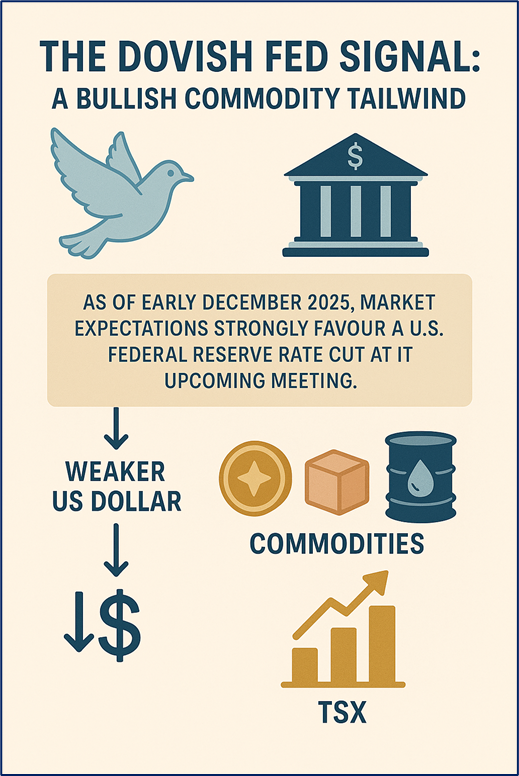
As of early December 2025, market expectations strongly favour the U.S. Federal Reserve to announce another interest rate cut at its upcoming meeting. This expectation is largely driven by cooling U.S. labour markets and inflation stabilizing near the Fed's 2% target range.
- The Currency Effect: A cut, or even a strong anticipation of one, generally weakens the U.S. Dollar (USD). Since global commodities (including gold, copper, and oil) are priced in USD, a weaker dollar makes them cheaper for international buyers, immediately boosting their effective price in other currencies.
- TSX Impact: Given the TSX’s heavy weighting in the Materials and Energy sectors, a dovish Fed stance acts as a significant tailwind, potentially fuelling a broad-based rally across the Canadian market's resource-driven segments.
Source: Kalkine Group
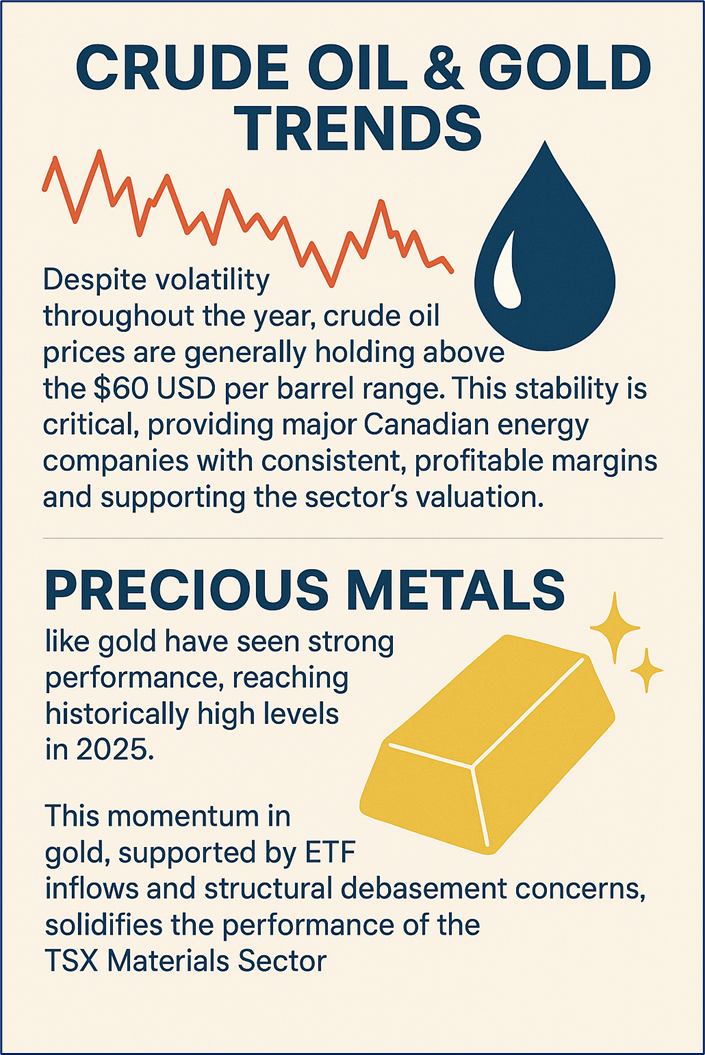
2. Energy and Gold Stability
Source: Kalkine Group
Section II: The Institutional Blueprint – Tax and Flows
The real engine behind the predictable year-end volatility is not economics, but two distinct, calendar-driven institutional activities.
1. Tax-Loss Selling (The Mid-December Lows)
In Canada, investors holding non-registered (taxable) accounts sell off underperforming assets to realize capital losses. These losses are used to offset capital gains realized elsewhere, reducing their overall tax liability for the year.
- The Deadline: To realize a loss for the 2025 tax year, the trade must settle by December 31st. Given the T+1 settlement cycle, the practical deadline for the trade execution is typically the second-last trading day of December (December 30, 2025).
- The Strategy: This concentrated selling pressure often pushes the prices of "Laggards" (stocks that have performed poorly year-to-date) to temporarily depressed levels in the first half of December. This period, before the selling pressure lifts, is strategically noted as a potential accumulation window for those looking for a rebound play.
- The Superficial Loss Rule: Canadian investors must be acutely aware of the Superficial Loss Rule, which denies the capital loss if the same or "identical property" is repurchased within 30 days before or after the sale date by the taxpayer or an "affiliated person" (including a spouse or their own Registered Retirement Savings Plan/TFSA). This rule forces selling pressure to lift sharply around year-end, setting the stage for the January Rebound.
2. Window Dressing (The Late-December Highs)
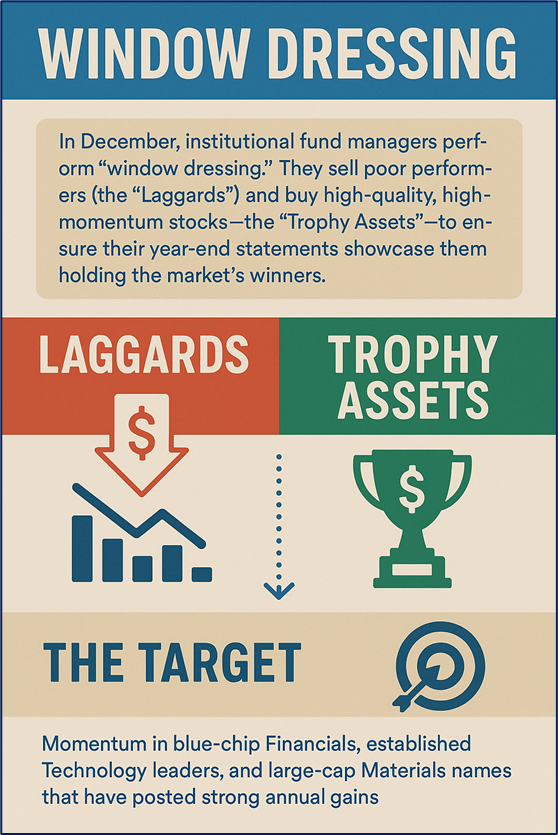
In the second half of December, institutional fund managers perform "window dressing." This involves selling poor performers (the Laggards) and buying high-quality, high-momentum stocks—the "Trophy Assets"—to ensure their year-end statements showcase them holding the market's winners.
- The Target: This action drives momentum in blue-chip Financials, established Technology leaders, and large-cap Materials names that have already posted strong annual gains. This creates an accelerated buying spree that culminates in the final trading week of the year.
Source: Kalkine Group
Section III: TSX Sectors and Stocks to Watch
Understanding these flows allows for a directional focus on where capital is either exiting or entering the market.
TSX Sector Watchlist: December 2025 Flows and Catalysts
Here is the sector category watchlist presented in a structured bullet-point format, detailing the target flow, representative stocks, and the key rationale behind the trend.
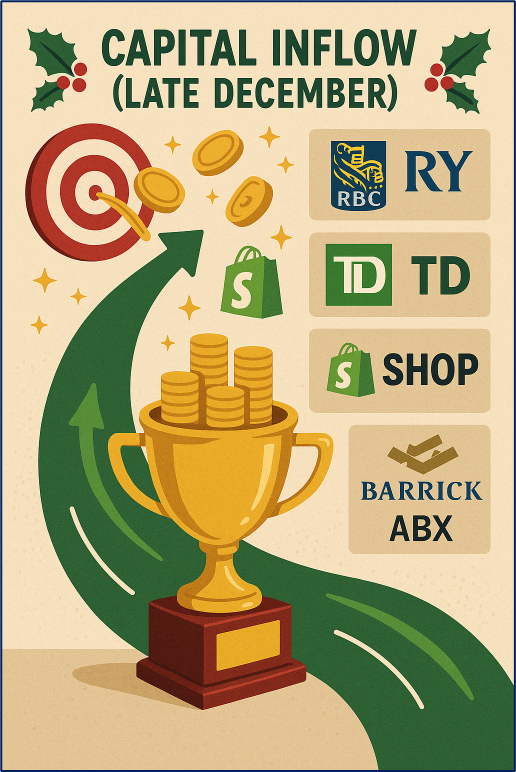
Trophy Assets (Momentum/Window Dressing)
- Target Flow/Effect: Capital Inflow (Late December)
- Stocks to Observe (Informational):
- Rationale/Key Trend: These are dominant market cap companies and year-to-date winners that fund managers often buy late in the year (Window Dressing) to showcase strong performance on their year-end portfolio statements. Their strong YTD performance drives continued momentum into year-end.
Source: Kalkine Group
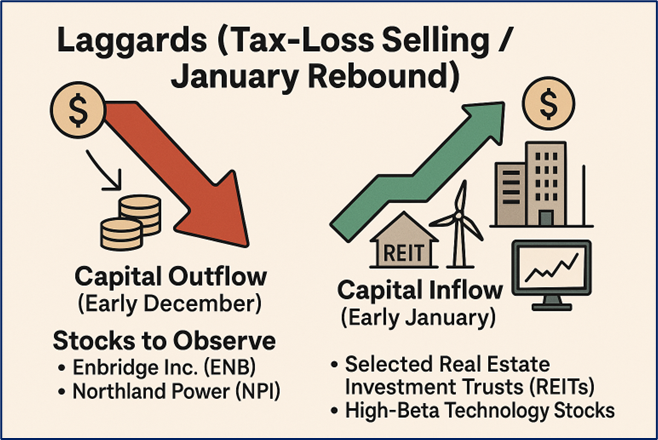
Laggards (Tax-Loss Selling/January Rebound)
- Target Flow/Effect: Capital Outflow (Early December) & Inflow (Early January)
- Stocks to Observe (Informational):
- Enbridge Inc. (ENB)
- Northland Power (NPI)
- Selected Real Estate Investment Trusts (REITs)
- High-Beta Technology Stocks
- Rationale/Key Trend: These stocks have lagged due to factors like rate sensitivity (Utilities/REITs) or recent volatility (Tech/Growth). Their prices may be artificially depressed by investors selling them to realize tax losses. This selling pressure creates a potential technical low point before a January Rebound as capital flows back in.
Source: Kalkine Group
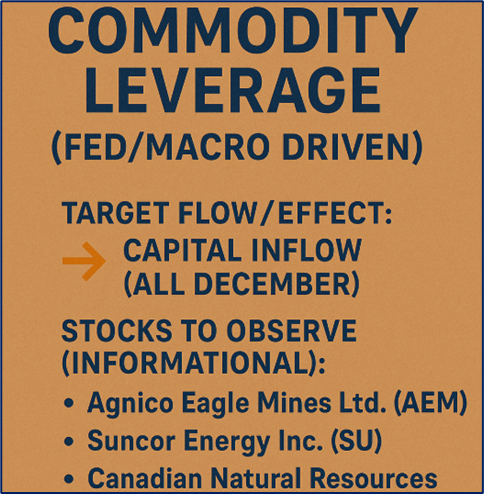
Commodity Leverage (Fed/Macro Driven)
- Target Flow/Effect: Capital Inflow (All December)
- Stocks to Observe (Informational):
- Rationale/Key Trend: These are direct beneficiaries of a potentially weaker U.S. Dollar (USD) and stable commodity prices. A dovish US Fed outlook is a structural tailwind for these heavy-weight TSX components, making them attractive throughout the month.
Source: Kalkine Group
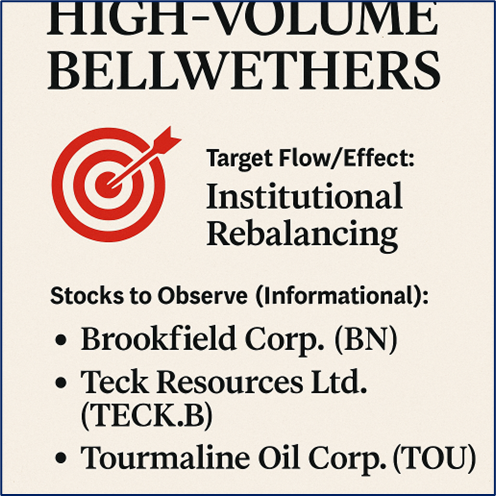
High-Volume Bellwethers
- Target Flow/Effect: Institutional Rebalancing
- Stocks to Observe (Informational):
- Brookfield Corp. (BN)
- Teck Resources Ltd. (TECK.B)
- Tourmaline Oil Corp. (TOU)
- Rationale/Key Trend: These are highly liquid, large-cap companies often used by large institutions for large-scale rebalancing and sector rotation due to their size and trading volume. Their movements can signal broader shifts in institutional sentiment.
Source: Kalkine Group
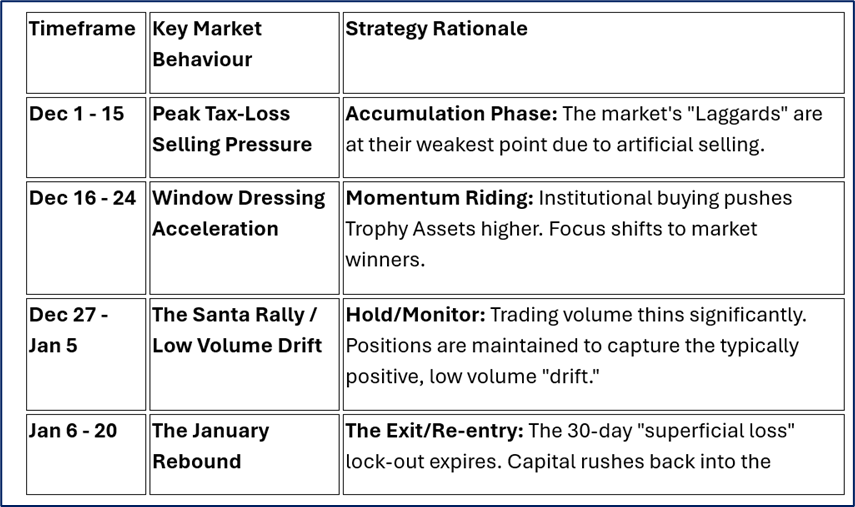
Section IV: The Strategic Calendar
The entire process unfolds across a predictable timeline, creating distinct opportunities.
Source: Kalkine Group
Conclusion: Trading the Calendar, Not the Earnings
The predictable patterns of the Toronto Stock Exchange in December offer a unique informational advantage. The major moves are dictated by institutional reporting deadlines and Canadian tax laws, temporarily decoupling market movements from core fundamentals.
For informational and educational purposes, tracking these capital flows—from the tax-driven exodus out of Laggards in early December to the vanity-driven buying of Trophy Assets late in the month, and finally to the forced re-entry of capital in early January—provides a strategic framework for understanding the year's final volatility and the first opportunities of the new year. The savvy focus remains on the calendar and the flow of money, leveraging predictability rather than speculation.


 Jun 24, 2026




 Please wait processing your request...