
 NZ
 UK
 US
 AU
 IND

 CA

 Share
 X (Formerly Twitter)
 Whatsapp
 Facebook
 LinkedIn
 Telegram
 Email This Article
 Copy Link
 Summarize with AI
 Chat GPT
 Perplexity

Key takeaways
- The 17-name group is a screener grouping, not a peer set: it mixes aerospace, supply-chain software, royalties, mine-water treatment, battery materials, carbon credits and bitcoin proxies. Treating it as one basket is misleading; ranking it by profitability tier is not.
- Only a minority earn consistent profits. CAE, Calian, TECSYS, K-Bro Linen, Diversified Royalty and DATA Communications Management post real net income; several others are lumpy, loss-making or pre-revenue.
- The strongest recent operating momentum sits with Calian (record Q2, adjusted EBITDA up 60%) and K-Bro Linen (revenue up 33% on its UK acquisition), while CAE trades near a full valuation after a softer FY2026.
- The speculative tier — Bitcoin Treasury Corporation, LQWD Technologies, Nano One, Vizsla Royalties, Base Carbon, Snipp and Sabio — is where the screener's bullish ratings look most detached from current earnings.
- Two names carry corporate-action catalysts: Vizsla Royalties is being acquired by Elemental Royalty in a roughly C$327m all-share deal, and Metatek-Group is a brand-new March 2026 TSX listing with no public track record.
Introduction: one label, seventeen very different businesses
Stock screeners are blunt instruments. Run one for Canadian "commercial services" and you get a list that, on paper, looks like a coherent sector. Look closer and it falls apart into at least eight distinct industries. This month's 17-name group includes CAE, a global flight-simulation and defence-training company worth roughly C$12bn, alongside Snipp Interactive, a micro-cap loyalty-marketing platform valued at about C$11m. It bundles a battery-materials developer that has never booked revenue with a laundry operator that runs hospitals' linens across two continents. The one thing they share is a classification code.
That matters because the same screen flags most of these names "buy" or "strong buy", ratings that flatten crucial differences in quality. A profitable, cash-generative royalty aggregator and a pre-revenue silver-royalty shell can both carry a bullish label while sitting at opposite ends of the risk spectrum. The purpose here is not to chase a single catalyst but to rank the whole group honestly: which companies already earn money, which are scaling toward it, and which are pure options on a future that may or may not arrive. As of 6 August 2026, the split between the established and the speculative is the single most useful lens on this list.
Screening and ranking methodology
The starting point is a market-data screen dated 6 August 2026, covering price, market capitalisation, trailing price/earnings, earnings per share, a headline earnings-growth figure and dividend yield for all 17 companies. Those figures are a snapshot; where they could not be independently reconciled they are flagged as "per the screener" with limited verification. Everything load-bearing — latest quarterly results, cash positions, backlog, dividends and corporate actions — has been checked against company releases, MD&A filings and reputable financial media, with the reporting date stated so readers can judge how current each number is.
Companies are sorted into three profitability tiers. Established and profitable means a track record of positive net income and self-funding operations. Early-stage or pre-profit covers real operating businesses with growing revenue that do not yet convert reliably to bottom-line profit. Speculative captures pre-revenue developers, single-asset vehicles and treasury proxies whose value rests on a thesis rather than trailing earnings. Within those tiers the rankings weigh growth, valuation, balance-sheet strength and dividend support. One data point is deliberately excluded from the analysis: the screener's headline earnings-growth column produces absurd readings — Calian shows roughly +159,894% and Snipp roughly -7,200% — because a near-zero prior-year base makes the percentage meaningless. Those artefacts are noted, not used.
Canadian market and sector backdrop
The macro setting in mid-2026 rewards cash flow over story. Canadian rates have eased from their peak but remain high enough to keep capital disciplined, which flatters dividend-paying, self-funding businesses and punishes those that must keep tapping equity markets. Defence spending is a genuine tailwind: NATO commitments and Canadian federal procurement have lifted order books at CAE and Calian, both of which now carry more than a billion dollars of defence-related backlog. That structural demand is one of the few themes that genuinely connects several names on this list. It also helps explain why the screener assigns bullish ratings so freely across the group: momentum and sentiment can lift a whole category even when individual fundamentals diverge sharply.
There is also a size effect worth naming. Roughly half of these companies are micro-caps under C$100m, where a single contract, financing or press release can move the share price by double digits in a session. Thin trading volumes amplify both gains and losses, and screener valuations for such names can lag the market by days. For the larger, more liquid names — CAE, Calian, Diversified Royalty, K-Bro and TECSYS — the quoted figures are more reliable and the investment case rests on operating performance rather than headline flow. Keeping that liquidity distinction in mind is as important as the profitability tiers when interpreting anything that follows.
Elsewhere the picture is company-specific. Trade-policy volatility and tariff uncertainty have crimped marketing budgets at Snipp and Sabio and raised input costs for print-and-communications player DATA Communications Management. The energy-transition names — Nano One in battery cathode materials, EverGen in renewable natural gas, Base Carbon in voluntary carbon credits — live and die by policy support and offtake demand rather than the broad market. And a distinct cohort, LQWD and Bitcoin Treasury Corporation, are effectively leveraged bets on the bitcoin price wearing a corporate wrapper. The rest of this piece takes each in turn before ranking them head to head.
Company-by-company assessment
CAE Inc. (TSX:CAE) — the anchor blue-chip
CAE is the heavyweight of the list, a global leader in flight simulation and pilot training with a defence-and-security arm. For fiscal 2026 (ended 31 March 2026) it reported revenue of C$4.9bn, up 4%, but net income fell 23% to C$313.1m and diluted EPS eased to C$0.97; adjusted EPS was roughly flat at C$1.20. Total adjusted backlog stood at C$19.3bn. Defence revenue grew 9% to C$2.17bn, while Civil Aviation held at C$2.74bn on a healthy 18.6% margin. Profitability tier: established and profitable.
The screener's P/E near 39 and the softer earnings tell the tension: this is a quality franchise trading at a full multiple after a transitional year. Management has laid out a transformation plan targeting C$125m–C$150m of annual run-rate savings and C$950m–C$1bn of adjusted segment operating income by FY2030. Catalysts: delivery on those cost targets, defence order momentum and any Civil margin recovery. Risks: order intake fell 35% year on year, the shares pay no dividend, and a rich multiple leaves little room for disappointment. For a company of this size, the debate is less about whether it earns money — it plainly does — and more about whether the market has already paid for the recovery the transformation plan promises.
Calian Group Ltd. (TSX:CGY) — the diversified compounder
Calian is arguably the cleanest "quality growth" story here. The Ottawa-based group spans health services, learning, IT and cyber, and advanced technologies. Its record second quarter of fiscal 2026 (reported 14 May 2026) showed revenue up 18% to C$228.7m, adjusted EBITDA up 60% to C$27.9m at a 12.2% margin, and adjusted net profit of C$15.1m. Backlog reached C$1.5bn, over C$1bn of it in defence, and net debt sat at a comfortable 1.2x EBITDA. The quarterly dividend is C$0.28. Profitability tier: established and profitable.
A note on the data: the screener's +159,894% EPS-growth figure is a statistical artefact created by a tiny prior-year earnings base and should be ignored entirely — it is not a real growth rate. Calian's actual appeal is margin expansion and defence backlog. Catalysts: Q3 results due 13 August 2026, continued margin gains and further acquisitions. Risks: integration execution, reliance on government contract timing, and a valuation (P/E near 28) that already prices in success.
TECSYS Inc. (TSX:TCS) — the SaaS transition play
TECSYS builds supply-chain management software, with a strong niche in healthcare logistics. Fiscal 2026 (ended 30 April 2026) revenue rose 9.4% to C$193.1m, but the story is the mix shift: SaaS revenue grew 20% to C$80.4m and SaaS annual recurring revenue reached C$86.8m. Adjusted EBITDA jumped 49% to C$20.0m. Reported net income was modest at C$4.0m, dented by a Q4 net loss that included C$4.7m of restructuring. The dividend is C$0.09 a quarter. Profitability tier: established and profitable, mid-transition.
This is why the screener shows a P/E above 120: earnings are temporarily suppressed by the shift to subscription revenue, which depresses near-term profit while building recurring value. Catalysts: SaaS ARR compounding, remaining performance obligations of C$243m and margin leverage as the model matures. Risks: the valuation demands flawless execution, enterprise sales cycles are long, and reported EPS may stay lumpy while the transition runs.
K-Bro Linen Inc. (TSX:KBL) — the steady operator hitting a growth spurt
K-Bro is Canada's largest laundry and linen provider for healthcare and hospitality, and it now runs a sizeable UK operation. Second-quarter 2026 results impressed: revenue rose 33% and adjusted EBITDA climbed 25.6%, driven largely by the integration of its UK Mayan acquisition alongside healthy healthcare demand. The company pays a monthly dividend that annualises to a yield of about 2.5% per the screener. Profitability tier: established and profitable.
The trailing P/E near 29 reflects both the growth and the capital intensity of the business. Catalysts: synergy capture from the UK integration, new healthcare contracts and continued organic volume. Risks: acquisitions add execution and leverage risk, labour and utility costs are meaningful, and much of the recent growth is acquisition-led rather than organic, which the market will eventually test.
Diversified Royalty Corp. (TSX:DIV) — the income engine
Diversified Royalty owns the trademarks and collects top-line royalties from a stable of franchised brands including Mr. Lube + Tires, Sutton, Mr. Mikes, Nurse Next Door, Oxford Learning, Stratus Building Solutions, BarBurrito, Cheba Hut and AIR MILES. The model is designed for cash distribution: it pays a monthly dividend of C$0.02375, or C$0.285 annualised, for a yield around 6% — the highest on this list. Q2 2026 results are due 12 August 2026. Profitability tier: established and profitable, income-oriented.
Royalty aggregators live on the durability and diversity of their royalty streams. Catalysts: the upcoming quarter, royalty-pool additions and same-store sales at key partners such as Mr. Lube. Risks: a high payout ratio leaves limited cushion, franchisee health drives the top line, and rising rates raise the bar for a yield vehicle. This is an income holding, not a growth one, and its appeal rises or falls with the direction of Canadian interest rates as much as with any operational news.
DATA Communications Management Corp. (TSX:DCM) — the deleveraging value name
DCM provides marketing and business communications — print, labels, workflow technology and related services — to large Canadian enterprises. First-quarter 2026 revenue slipped 5% to C$117.4m, but adjusted EBITDA edged up 2.7% to C$19.1m at a 16.3% margin, and net income was C$4.8m. The standout metric is the balance sheet: net debt fell 27% year on year to C$66.4m. The dividend is C$0.025 a quarter, a yield above 3% per the screener. Profitability tier: established and profitable.
At a trailing P/E under 19, DCM screens as the value option. Catalysts: continued deleveraging, margin improvement and opportunistic M&A. Risks: revenue is under pressure from secular decline in print, Canada Post labour disruption is a recurring threat, and tariff-driven cost inflation squeezes margins. This is a turnaround-flavoured value story rather than a grower.
BQE Water Inc. (TSXV:BQE) — the profitable but lumpy specialist
BQE Water treats and manages water for mining, smelting and refining across nine long-term sites in Canada, the US and China. It is genuinely profitable across a full cycle, which is rare on the venture exchange, but its quarters are volatile. Q1 2026 revenue fell to C$4.8m from C$7.4m and it swung to a C$1.3m net loss, chiefly because exceptional Q1 2025 emergency-response work at Eagle Mine did not repeat, plus transition costs at the newly acquired Britannia operation. Cash stood at C$17.7m with no debt. Profitability tier: established and profitable, but lumpy.
The screener's trailing EPS of C$3.87 and P/E near 20 reflect a strong prior 12 months, not the soft Q1. Catalysts: new treatment contracts, ramp of the Britannia site and rising global mining activity. Risks: revenue lumpiness, customer concentration and small-cap liquidity. A high share price (about C$76) on a tiny float means single contracts move the numbers.
Quarterhill Inc. (TSX:QTRH) — the turnaround in intelligent transportation
Quarterhill builds intelligent transportation systems — electronic tolling, commercial-vehicle enforcement and traffic management. It reports in US dollars: Q1 2026 revenue rose 14% to US$38.6m, adjusted EBITDA turned positive at US$2.0m (a third straight positive quarter), and gross margin expanded roughly 16 points. It still posted a net loss of US$5.2m, and cash was US$14.7m against a US$428.8m revenue backlog. Q2 results are due 13 August 2026. Profitability tier: early-stage/pre-profit (improving).
The screener shows a negative EPS and no meaningful P/E — appropriate for a company not yet net-income positive. Catalysts: the EBITDA-margin trajectory, new state tolling contracts and conversion of that large backlog. Risks: still loss-making at the bottom line, project-execution and timing risk on large public contracts, and modest cash relative to working-capital needs. Improving, but not yet proven.
Metatek-Group Ltd. (TSX:MTEK) — the brand-new listing
Metatek is the newcomer, and a genuine curiosity: it began trading on the Toronto Stock Exchange under MTEK on 19 March 2026, billed as the first technology IPO on the main board since 2021. The business is niche and asset-heavy — Full Tensor Gravity Gradiometry, an airborne geophysical survey technique used to map subsurface hydrocarbons, minerals, geothermal resources and carbon-storage sites. It has since launched a normal-course issuer bid. Profitability tier: early-stage, unproven as a public company.
The screener lists no P/E or EPS, which is fair for a company with barely a quarter of public reporting. Catalysts: first post-IPO results, survey-contract wins and demonstration of recurring demand for FTG data. Risks: no public track record, a capital-intensive model tied to a small fleet of specialist instruments and aircraft, and exposure to cyclical resource-exploration budgets. Treat it as a story to observe, not yet to underwrite.
Nano One Materials Corp. (TSX:NANO) — the pre-revenue battery bet
Nano One develops a lower-cost, lower-waste "One-Pot" process for lithium-iron-phosphate (LFP) cathode materials. It is a headline name on this list but, importantly, it has never generated revenue. Q1 2026 showed cash of C$23.0m, a quarterly net loss of C$0.9m and roughly C$3.1m of cash used in operations. Its credibility rests on strategic relationships with Worley, Sumitomo Metal Mining and Rio Tinto, and on its Candiac, Quebec facility. Profitability tier: speculative / pre-revenue.
Management targets its first commercial agreements by the end of 2026 and a demonstration-line expansion into 2027. Catalysts: signing those initial offtake or licensing deals, and any funding milestones with strategic partners. Risks: no revenue yet, a cash runway that will require careful management or fresh capital, and a battery-materials market dominated by low-cost Asian incumbents. The upside is real but entirely forward-dated.
EverGen Infrastructure Corp. (TSXV:EVGN) — the renewable natural gas developer
EverGen builds and operates renewable natural gas (RNG) infrastructure in British Columbia and beyond, converting organic waste into pipeline-grade gas. It reported record second-quarter 2026 RNG production of 54,675 gigajoules, up 10.9% year on year, following Q1 revenue growth of about 38%. The portfolio includes Fraser Valley Biogas, Sea to Sky and GrowTEC. Profitability tier: early-stage/pre-profit.
The screener shows a negative EPS, consistent with a capital-heavy developer still scaling toward profitability. Catalysts: rising production, long-term RNG offtake agreements and supportive low-carbon-fuel policy. Risks: it remains loss-making, carries development and construction risk, and depends on feedstock supply and policy incentives. A credible energy-transition operator, but one still building toward sustainable earnings, and at a market value near C$12m it sits firmly in micro-cap territory where financing needs can dilute existing holders.
Sabio Holdings Inc. (TSXV:SBIO) — the connected-TV micro-cap
Sabio sells advertising technology and services in the ad-supported streaming and connected-TV market, with a specialism in political and advocacy campaigns. Q1 2026 gross revenue fell to C$8.2m from C$9.1m on the timing of political spending, gross margin slipped to 53%, and it posted an adjusted EBITDA loss of C$3.4m and a net loss of C$4.4m. Cash was thin at C$1.0m. Profitability tier: speculative / pre-profit.
Management projects a record revenue year, with Q2 tracking more than 35% higher sequentially and roughly C$5m of political and advocacy commitments booked into the election cycle. Catalysts: the seasonal political-spending ramp and international CTV growth. Risks: a very thin cash balance, dependence on lumpy campaign timing and micro-cap liquidity. The "strong buy" screener label sits awkwardly against a C$1m cash position.
Snipp Interactive Inc. (TSXV:SPN) — the sub-scale loyalty platform
Snipp runs a promotions, rebates, loyalty and sweepstakes marketing platform for consumer brands. Q1 2026 revenue fell 21% to C$5.0m on tariff-driven budget caution and program-timing shifts; adjusted EBITDA turned slightly negative at -C$0.3m. The bright spot is a record bookings backlog of C$20.6m, up 15% year on year and over four times quarterly revenue, and cash improved to C$6.1m after a convertible-debenture financing. Profitability tier: speculative / pre-profit.
At a share price of about four cents, this is among the smallest names here. Catalysts: conversion of that record backlog into revenue and a return to positive EBITDA. Risks: sub-scale economics, dependence on discretionary marketing budgets and dilution from convertible financing. The backlog is encouraging; the revenue trend and micro-cap status keep it firmly speculative.
Vizsla Royalties Corp. (TSXV:VROY) — the takeover target
Vizsla Royalties is a precious-metals royalty company whose principal asset is a net-smelter-return royalty over the Panuco silver-gold project in Mexico, operated by its former parent Vizsla Silver. It is pre-revenue: Panuco targets first silver in the second half of 2027. The defining fact today is corporate: Elemental Royalty (Elemental Altus) agreed to acquire Vizsla Royalties in an all-share deal valued at roughly C$327m, with shareholder approval received in July 2026. Profitability tier: speculative / pre-revenue, but now an arbitrage.
The screener's C$3.70 price and negative EPS largely reflect the deal terms and the pre-production status. Catalysts: completion of the Elemental transaction and, longer term, Panuco reaching production. Risks: the value is now tied to the acquirer's shares and deal close rather than standalone fundamentals; if the deal completes, VROY effectively ceases to be an independent bet. Note carefully the relationship with Vizsla Silver, which spun it out and remains the project operator.
Base Carbon Inc. (CN:BCBN) — the volatile carbon-credit play
Base Carbon — listed on CN (formerly the NEO Exchange) under BCBN, and on the OTCQX as BCBNF — finances and develops voluntary and compliance carbon-market projects, notably cookstove and reforestation credits in Rwanda and India. Trailing revenue collapsed about 92% to roughly C$3.1m as a large prior-year credit sale did not repeat, and it posted a small net loss. The company is cash-rich relative to its market value and has been buying back stock. Profitability tier: speculative.
Verification note: this name required independent checking — it trades on CN, not the TSX or TSXV. Catalysts: new carbon-credit issuances, CORSIA-eligible demand and its buyback. Risks: extreme revenue lumpiness, reputational and quality scrutiny across voluntary carbon markets, and dependence on credit pricing. A cash-backed option on carbon markets recovering, not a steady earner.
Bitcoin Treasury Corporation (TSXV:BTCT) — the bitcoin proxy
Bitcoin Treasury Corporation is a Canadian bitcoin-native company listed on the TSX Venture Exchange under BTCT (it began trading in 2025). Its strategy is to accumulate and hold bitcoin as a treasury reserve asset; third-party trackers put its holdings at roughly 771 BTC. It has run a normal-course issuer bid. Profitability tier: speculative (asset proxy).
There is no meaningful P/E or EPS here because the entity is effectively a leveraged wrapper around a single volatile asset. Catalysts: the bitcoin price and any accretive capital-raising to buy more coins. Risks: the shares can trade above or below net asset value, crypto volatility is extreme, and dilution risk is inherent to the accumulate-more model. Verification note: ticker and TSXV listing confirmed. This is a bet on bitcoin, full stop.
LQWD Technologies Corp. (TSXV:LQWD) — the Lightning Network wrapper
LQWD is a smaller cousin of Bitcoin Treasury Corporation with a twist: as well as holding bitcoin (about 262 BTC as of mid-April 2026, at an average cost near US$77,000), it deploys that treasury as productive capital to operate enterprise-grade Bitcoin Lightning Network infrastructure. It carries no debt and its reserves are unencumbered. Profitability tier: speculative (asset proxy plus early network business).
The screener's negative EPS reflects an early-stage operating business layered on a bitcoin balance sheet. Catalysts: bitcoin appreciation, growth in Lightning routing and any yield generated on deployed coins. Risks: it combines crypto price volatility with an unproven network-fee revenue model, at micro-cap scale. Somewhat more of an operating story than a pure treasury proxy, but speculative all the same. Investors comparing it with Bitcoin Treasury Corporation are really choosing between a larger, simpler coin proxy and a smaller one with an experimental yield ambition attached.
Comparison and scoring table
The table below summarises all 17 names as of 6 August 2026. A crucial caveat: the price/earnings ratio is meaningless for loss-makers and pre-revenue companies — you cannot divide a price by an absent or negative profit — so "N/A" appears wherever there is no positive trailing net income. For the same reason, the screener's headline earnings-growth column is omitted entirely; its Calian (~+159,894%) and Snipp (~-7,200%) readings are data artefacts from tiny prior-year bases, not real growth rates.
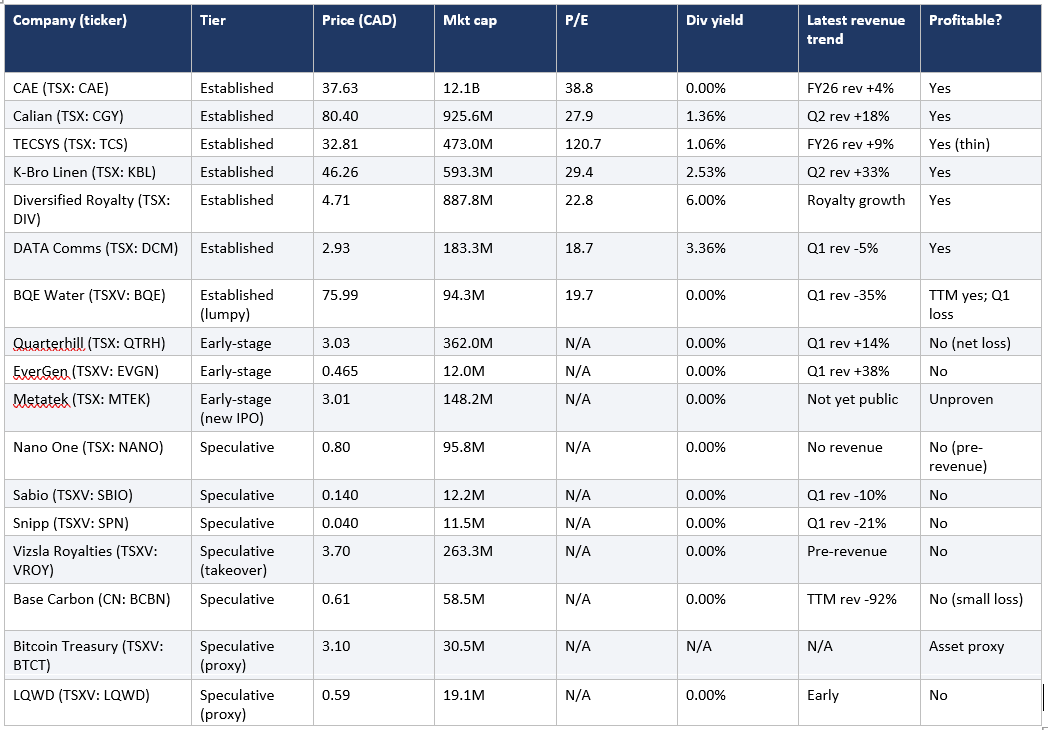
The rankings
One table cannot capture why a name deserves attention. The four ranked lists below re-sort the same 17 companies by the questions investors actually ask: which are highest quality, which are growing fastest, which pay you to wait, and which are pure speculation.
Ranked by quality and profitability
This list favours consistent net income, cash generation and balance-sheet strength over momentum.
- Calian (CGY) — record Q2, adjusted EBITDA up 60%, C$1.5bn backlog, modest 1.2x leverage and a growing dividend. The best blend of growth and profitability on the list.
- CAE (CAE) — unmatched scale and a C$19.3bn backlog, though a softer FY2026 and a full multiple keep it second rather than first.
- Diversified Royalty (DIV) — a diversified, cash-generative royalty model built for durable distributions, if not rapid growth.
- K-Bro Linen (KBL) — profitable, dividend-paying and growing fast, with the caveat that recent growth is acquisition-led.
- DATA Communications Management (DCM) — the value pick: profitable, deleveraging hard and cheap at a sub-19 P/E, against a declining-print backdrop.
- TECSYS (TCS) — high-quality recurring-revenue software, but temporarily thin earnings and a demanding valuation.
- BQE Water (BQE) — genuinely profitable through the cycle, but quarterly lumpiness and small scale cap the ranking.
Ranked by growth momentum
Here the lens is the trajectory of the business — revenue, production or recurring-revenue growth — regardless of whether it yet reaches the bottom line.
- K-Bro Linen (KBL) — revenue up 33% and EBITDA up 25.6%, the fastest top-line growth among the profitable names.
- EverGen (EVGN) — record RNG production and roughly 38% Q1 revenue growth, though still pre-profit.
- Calian (CGY) — 18% revenue growth (12% organic) with expanding margins, an unusually clean combination.
- TECSYS (TCS) — 20% SaaS revenue growth and a compounding recurring-revenue base.
- Quarterhill (QTRH) — 14% revenue growth and a genuine EBITDA turnaround, if not yet net profit.
- Sabio (SBIO) — management guides to a record year with Q2 up over 35% sequentially, from a low and volatile base.
Ranked by income
For investors prioritising yield, only a handful of these names pay a meaningful dividend.
- Diversified Royalty (DIV) — roughly 6% yield, paid monthly, purpose-built for income.
- DATA Communications Management (DCM) — above 3%, backed by improving cash flow and a shrinking debt load.
- K-Bro Linen (KBL) — around 2.5%, a monthly payer with growth alongside the yield.
- Calian (CGY) — about 1.4%; the dividend is a bonus on top of a growth thesis, not the main event.
- TECSYS (TCS) — roughly 1%, a token payout as the company reinvests in its SaaS transition.
Speculative watch tier
These names are ranked not by quality but by the nature and near-term visibility of their catalysts. Position sizing should reflect that none rests on trailing profit.
- Vizsla Royalties (VROY) — the clearest near-term catalyst is a defined corporate action: the Elemental Royalty acquisition. This is arbitrage more than fundamentals, and value now tracks the acquirer.
- Nano One (NANO) — the highest-profile bet, with credible strategic partners and a targeted first commercial deal by year-end 2026, but zero revenue today.
- Bitcoin Treasury Corporation (BTCT) — a transparent, roughly 771-BTC proxy on the bitcoin price; upside and downside both hinge on the coin.
- LQWD (LQWD) — a smaller bitcoin proxy with an added, unproven Lightning Network revenue model layered on top.
- Base Carbon (BCBN) — cash-backed exposure to voluntary carbon markets, but with extreme revenue volatility and sector scrutiny.
- Metatek (MTEK) — a brand-new listing in a niche geophysical service; intriguing, but with no public track record to judge.
- Snipp (SPN) — a record backlog is encouraging, yet the sub-scale, four-cent shares remain the most speculative operating business here.
What to monitor for the rest of August 2026
The calendar is unusually busy for this group. Three of the more substantial names report within days: Diversified Royalty on 12 August, and both Calian and Quarterhill on 13 August. Those releases will test whether Calian's margin momentum continues, whether Quarterhill can pair revenue growth with a narrower loss, and whether Diversified's royalty pool still comfortably covers its 6% distribution.
Beyond earnings, watch the Elemental Royalty–Vizsla Royalties transaction toward completion, since it removes a name from the independent universe and converts it into acquirer exposure. On the operating side, look for any first commercial-agreement signal from Nano One, updated production or offtake news from EverGen, and the seasonal political-advertising ramp that Sabio says will drive a record second half. For the bitcoin proxies, BTCT and LQWD, the only variable that really matters is the bitcoin price itself. And keep an eye on Metatek for its first meaningful set of public numbers.
Conclusion: sort the earners from the stories
The single most useful thing an investor can do with this 17-name screen is refuse to treat it as one basket. It is not a sector; it is a classification accident that happens to place a C$12bn training company next to a four-cent marketing micro-cap. Once separated by profitability tier, the group tells a clear story. A minority — Calian, CAE, TECSYS, K-Bro, Diversified Royalty and DCM — are real, profitable businesses whose shares can be judged on earnings, cash flow and dividends. A middle band, including Quarterhill and EverGen, are credible operators still working toward sustainable profit. And a speculative tail, from Nano One and the bitcoin proxies to Snipp and Sabio, trades on stories that trailing numbers cannot yet support.
None of this is a recommendation to buy or sell any of these securities, and a bullish screener rating is a starting point for research, not a guarantee of returns. The established names carry valuation and execution risk; the speculative ones carry the risk of permanent capital loss. What the ranking offers is honesty about which is which — so that investors size positions to the reality of each business rather than to the optimism of a shared label. Do your own diligence, mind the reporting dates on every figure above, and weigh each name on its own tier. The catalysts in the headline — Nano One's commercialisation push, CAE's transformation, Calian's record run and the Vizsla Royalties takeover — are real, but they sit on wildly different foundations, and a disciplined reader will treat a profitable compounder and a pre-revenue option very differently no matter how similar their screener ratings look.


 Nov 27, 2026





 Please wait processing your request...