
 NZ
 UK
 US
 AU
 IND

 CA

 Share
 X (Formerly Twitter)
 Whatsapp
 Facebook
 LinkedIn
 Telegram
 Email This Article
 Copy Link
 Summarize with AI
 Chat GPT
 Perplexity

Key takeaways
- Vizsla Royalties (TSXV:VROY) is the sharpest catalyst on this list: Elemental Royalty agreed in May 2026 to buy it for about C$327 million, offering C$4.13 in cash or 0.15 of an Elemental share, with closing targeted for the third quarter. That deal, not a static valuation, drives the stock.
- Calian Group (TSX:CGY) reports fiscal third-quarter results on 13 August 2026 after a first quarter that lifted revenue 12% to $208 million and adjusted EBITDA 28%; a screener-reported earnings-growth figure of roughly +159,894% is a statistical artefact of a near-zero comparative base, not real growth.
- Quarterhill (TSX:QTRH) agreed on 30 June 2026 to buy Conduent's tolling business for US$70 million plus shares, roughly tripling its tolling revenue and lifting combined backlog to about US$2 billion, with completion expected in the fourth quarter.
- Income seekers are drawn to Diversified Royalty (TSX:DIV), yielding about 6% on a monthly dividend, and to K-Bro Linen (TSX:KBL), whose Q2 revenue jumped 33% on its UK Stellar Mayan acquisition; DCM and DIV both report imminently.
- Loss-making and early-stage names — Nano One, EverGen, Quarterhill, Metatek and Base Carbon — carry no meaningful price-to-earnings ratio; for these, milestones and cash runway matter more than reported profits. All prices are a 6 August 2026 screener snapshot with limited independent verification.
Introduction: why catalysts, not profiles, define this month
Commercial services is a deliberately broad label. It gathers companies that sell expertise, infrastructure and recurring contracts rather than physical consumer goods: defence and health outsourcers, laundry and water-treatment operators, royalty holders, software vendors, print-and-communications firms and carbon-market intermediaries. What unites the thirteen names below is not a single end-market but a business model built on contracts, backlog and repeatable revenue. That makes them unusually sensitive to discrete events — a contract award, an acquisition, a takeover bid, a dividend change or a single quarterly print.
August 2026 is thick with such events. Vizsla Royalties sits inside a live takeover. Quarterhill is digesting its largest-ever acquisition. CAE has just unveiled a multi-year transformation plan. Calian, Diversified Royalty and DATA Communications Management all report within days of each other. Rather than parade static company profiles, this article leads with the turning points and asks a practical question for each name: what could move the shares between now and month-end, and what could go wrong? Analysis is labelled as such and separated from verified fact; figures carry their dates.
Screening methodology
The starting point was a quantitative screen of Canadian-listed commercial-services companies, captured as a snapshot on 6 August 2026, from which thirteen focus names were selected across the TSX, TSX Venture Exchange and CN. We then rebuilt each case from primary sources: company investor-relations pages, quarterly and annual reports, management discussion and analysis, earnings releases and, where available, call transcripts, supplemented by TMX data and reputable financial media. Price, market-capitalisation, price-to-earnings, earnings-per-share and yield figures shown as screen values are described as "per the screener as of 6 August 2026" and were not independently re-priced tick-by-tick; where a screen figure looked implausible we flagged it rather than repeated it. Nothing here is a recommendation, and inclusion reflects catalyst interest, not an endorsement to buy.
Canadian market and sector backdrop
Two forces shape the backdrop. First, defence spending: NATO members, Canada included, have committed to sustained increases, and that money flows disproportionately to services firms that train, equip and support armed forces. Calian, CAE and, more indirectly, Metatek all sit in that current. Second, the search for durable income and inflation-protected cash flows continues to reward royalty and contracted-revenue structures — Diversified Royalty, Vizsla Royalties and the long-term operating contracts held by BQE Water and EverGen all fit that appetite.
The Bank of Canada's rate path has eased financing pressure on capital-intensive operators and lifted the appeal of dividend payers, while a firmer silver and gold price has renewed interest in mining-linked royalties. Against that, the loonie's swings against sterling and the US dollar matter for names with heavy foreign exposure — K-Bro in the UK, BQE Water in China, Base Carbon in Vietnam and Rwanda, and Quarterhill in the United States. Corporate activity is brisk: takeovers, carve-outs and bolt-on acquisitions are the sector's dominant theme this summer, and several of the companies below are on one side or the other of a transaction.
Vizsla Royalties Corp. (TSXV:VROY) — a live takeover sets the price
Vizsla Royalties is a precious-metals royalty company spun out of Vizsla Silver (TSX/NYSE: VZLA) in 2024. Its principal asset is a net smelter returns (NSR) royalty of 2.0% to 3.5% over the Panuco silver-gold project in Mexico, covering the Copala and Napoleon deposits — an interest it expanded in June 2025 by acquiring an additional 3.0% NSR alongside a US$40 million financing. It is not an operating company; it collects a slice of revenue from a mine that Vizsla Silver is advancing toward development, which is why it reports no meaningful earnings and the screener's +100% growth figure reflects an early ramp rather than a run-rate business.
The dominant fact is corporate, not operational. On 14 May 2026 Elemental Royalty agreed to acquire Vizsla Royalties for approximately C$327 million (about US$239 million) on a fully diluted basis. Holders may elect C$4.13 in cash or 0.15 of an Elemental share, subject to a C$82 million cash cap and proration — a bid struck at a 31% premium to the unaffected price. The shares changed hands at 3.70 CAD per the screener as of 6 August 2026, below the cash figure, a spread that typically reflects deal-completion risk and timing. There is no dividend.
Catalysts are unusually concrete: completion of the Elemental transaction, targeted for the third quarter of 2026, pending court, shareholder, exchange and Mexican antitrust approvals; the shareholder vote itself, requiring a two-thirds supermajority and majority-of-minority approval; and any development news from Vizsla Silver at Panuco that alters the royalty's perceived value. Risks are the mirror image — a failed vote, a regulatory delay, or a fall in Elemental's shares that lowers the value of the stock alternative. Vizsla Royalties earns its place on the August watchlist purely as an arbitrage-flavoured situation: the outcome, not the fundamentals, is what investors are pricing.
Calian Group Ltd. (TSX:CGY) — defence and health momentum into a 13 August print
Calian is a diversified services company operating across four segments: Advanced Technologies, Health, Learning and IT & Cyber Solutions. It trains soldiers, staffs clinics, builds satellite ground systems and secures networks — a spread that has made it one of the steadier compounders on the TSX. In the first quarter of fiscal 2026 (ended 31 December 2025) it grew revenue 12% to $208.0 million, split evenly between organic and acquired growth, while adjusted EBITDA rose 28% to $22.8 million and the margin widened to 11.0%. Backlog stood at a substantial $1.4 billion, underpinning forward visibility.
Profitability is genuine: adjusted net profit reached $11.8 million ($1.03 per diluted share, up 46%), operating free cash flow was $15.8 million, and net debt sat at a conservative 1.2 times adjusted EBITDA. The shares traded at 80.40 CAD per the screener as of 6 August 2026, on a trailing P/E of about 27.9 and a yield near 1.4% from a $0.28 quarterly dividend. One caution: the screener's earnings-growth entry of roughly +159,894% is a data artefact created by dividing against a near-zero prior-period base, and should be disregarded entirely; Calian's real growth is low-double-digit and driven by acquisitions plus defence demand.
The immediate catalyst is the fiscal third-quarter 2026 release scheduled for 13 August 2026, which will test whether margin expansion and backlog conversion are holding. Further catalysts include new defence and NATO-related awards — Calian has a track record of multi-hundred-million-dollar Canadian Armed Forces mandates — and additional bolt-on acquisitions funded by its modest leverage. Risks include integration missteps, contract timing that lumps revenue between quarters, and reliance on government budgets. Calian is on the watchlist as the highest-quality operating business here, with a near-term earnings catalyst dated to the month.
Diversified Royalty Corp. (TSX:DIV) — a 6% monthly payer reporting on 12 August
Diversified Royalty is a multi-royalty company that buys the trademarks of established franchisors and licenses them back for a top-line royalty. Its stable spans Mr. Lube + Tires, Sutton, Mr. Mikes, Nurse Next Door, Oxford Learning Centres, Stratus Building Solutions, BarBurrito, Cheba Hut and a fixed AIR MILES royalty. Because it is paid on franchisee sales rather than profits, its revenue is comparatively defensive. First-quarter 2026 revenue rose 11.8% to $17.5 million and distributable cash grew 10.4% to $12.0 million ($0.0705 per share), though organic royalty growth cooled to 2.6% as Mr. Lube same-store sales normalised.
The attraction is income. DIV pays a monthly dividend, most recently $0.02375 per share ($0.285 annualised), for a yield of about 6.0% on the 4.71 CAD screener price as of 6 August 2026. The trade-off is a payout ratio that reached 101.1% in the first quarter, meaning distributable cash barely covered dividends — a metric worth watching. The balance sheet carries the debt used to fund royalty purchases, and the trailing P/E near 22.8 reflects steady but not rapid growth.
Catalysts cluster in the near term: second-quarter 2026 results are due after the close on 12 August 2026, and the monthly dividend declaration is a recurring signal of board confidence. Longer term, new royalty acquisitions — the Cheba Hut and BarBurrito additions show the playbook — expand the income base, while the February 2026 AIR MILES amendment locked in a fixed, escalating $3.9 million annual royalty. Risks are a stretched payout ratio, sensitivity to franchisee health and consumer spending, and rising rates lifting the cost of acquisition debt. DIV features as the income anchor of this list, with a dated earnings catalyst.
CAE Inc. (TSX:CAE) — a transformation plan reframes the story
CAE is a global leader in flight simulation and training, with a large and fast-growing Defense and Security arm. For fiscal 2026 (ended 31 March 2026) it reported revenue of $4.9 billion, up 4%, with Defence revenue up 9% to $2.17 billion and its margin expanding from 7.5% to 9.2% — the clearest sign that a troubled defence turnaround is taking hold. Civil Aviation revenue edged up 1% to $2.74 billion, but a Civil backlog that slipped 5% to $8.4 billion unsettled the market. Group adjusted backlog was $19.3 billion.
Reported profitability softened: diluted EPS fell to $0.97 from $1.27, and adjusted EPS was roughly flat at $1.20. Free cash flow held near $474 million, and net debt of $2.68 billion equated to about 2.3 times adjusted EBITDA. The shares stood at 37.63 CAD per the screener as of 6 August 2026 on a trailing P/E near 38.8, a premium multiple that leaves little room for disappointment. CAE pays no dividend, having redirected cash to debt reduction and its fleet.
The headline catalyst is the transformation plan unveiled with the results: management targets $125–150 million of annual run-rate savings and adjusted segment operating income of $950 million to $1 billion by fiscal 2030, partly by removing 10% of its commercial simulator fleet and reviewing non-core businesses. Execution against those milestones, continued Defence margin gains, and any recovery in Civil orders are the levers. Risks include the plan's $200–250 million cost, a Civil backlog below parity, and a rich valuation. CAE is on the list as a large-cap turnaround whose narrative was just rewritten.
Quarterhill Inc. (TSX:QTRH) — a transformational tolling acquisition
Quarterhill is an intelligent-transportation-systems (ITS) company focused on electronic tolling and enforcement for government agencies. It has spent two years narrowing to that core, and the payoff is a return to positive operating momentum: first-quarter 2026 revenue rose 14% to $38.6 million, gross margin jumped to 28% from 12%, and adjusted EBITDA turned positive at $2.0 million — a third consecutive positive quarter — even as the company still posted a net loss of $0.04 per share. Revenue backlog reached $428.8 million on the back of wins with Indiana, Illinois, New Jersey and California agencies.
The defining event came on 30 June 2026, when Quarterhill agreed to acquire Conduent's tolling business for US$70 million in cash plus shares equal to 7% of its stock. The deal roughly triples Quarterhill's tolling revenue, pushes pro-forma annual revenue above US$400 million, and lifts combined backlog to about US$2 billion, with an expected close in the fourth quarter of 2026. The shares traded at 3.03 CAD per the screener as of 6 August 2026; with no profits yet, a price-to-earnings ratio is not meaningful, and there is no dividend.
Catalysts are the acquisition's regulatory approval and closing, the integration and margin trajectory of a much larger combined tolling platform, and continued agency contract wins. Risks are real: the cash portion is debt-funded, integration of a business this size carries execution risk, and Quarterhill remains loss-making with negative operating cash flow of $5.4 million in the quarter. It earns a watchlist place as the sector's boldest bet — a small company attempting to double in size in a single stroke.
K-Bro Linen Inc. (TSX:KBL) — a UK deal reshapes the growth profile
K-Bro is Canada's largest provider of laundry and linen services to healthcare and hospitality customers, and following its Stellar Mayan acquisition it is now a substantial operator in the United Kingdom too. The transformation showed in second-quarter 2026 results: consolidated revenue surged 33% to $150.4 million, with healthcare revenue up 50% and now about 58% of the mix, and adjusted EBITDA up 25.6% to $29.8 million. The UK division contributed just over half of group revenue, a striking shift for a business that was overwhelmingly Canadian two years ago.
Profitability remains solid. Adjusted net earnings rose to $10.1 million from $7.8 million, the dividend payout ratio was a comfortable 26.6%, and net debt of $213.5 million sat below 2.5 times EBITDA on a pro-forma basis, with a $69.6 million undrawn operating line. The shares traded at 46.26 CAD per the screener as of 6 August 2026, on a trailing P/E near 29.4 and a yield of about 2.5% from a $0.30 quarterly dividend. The EBITDA margin dipped 1.2 points to 19.8%, reflecting a lower-margin UK mix and unrealised synergies.
The key catalyst is synergy capture: management says only about 40% of anticipated Stellar Mayan synergies have been realised, leaving a clear path to margin recovery. Additional catalysts are further healthcare contract wins on both sides of the Atlantic and possible bolt-on acquisitions. Risks include UK integration, foreign-exchange translation, labour and energy cost inflation in a labour-intensive business, and customer concentration in large healthcare contracts. K-Bro is on the watchlist as a defensive compounder in the middle of a growth step-change.
TECSYS Inc. (TSX:TCS) — SaaS transition builds recurring revenue
Tecsys is a supply-chain management software company serving healthcare systems, distributors and retailers, and it is well through the shift from licences to subscription. In fiscal 2026 (ended 30 April 2026) total revenue rose to $193.1 million, but the more telling numbers are recurring: SaaS revenue climbed 20% to $80.4 million, annual recurring revenue reached $86.8 million (up 13%, or 15% in constant currency), and remaining performance obligations — a bookings backlog — grew to $243.0 million. Its high-end Elite SaaS ARR grew faster still, up 19%.
The subscription transition depresses near-term reported earnings even as underlying value builds. Full-year net income was $4.0 million ($0.27 per share) and adjusted EBITDA rose sharply to $20.0 million from $13.4 million, a 10% margin; the fourth quarter itself showed a small net loss on $4.7 million of restructuring costs. The shares traded at 32.81 CAD per the screener as of 6 August 2026 on a trailing P/E of about 120.7 — optically high, but characteristic of a SaaS business deliberately trading current profit for recurring revenue. A $0.09 quarterly dividend yields around 1.1%.
Catalysts are the continued conversion of SaaS bookings into recognised revenue, ARR growth toward and beyond the $100 million mark, and margin expansion as the subscription base scales. Risks include the elevated valuation, lumpy large-deal timing, competition from far larger enterprise vendors, and currency effects on ARR. Tecsys is on the list as the recurring-revenue software play — a company whose reported P/E is close to meaningless during a model transition, and whose ARR and RPO are the numbers that matter.
DATA Communications Management Corp. (TSX:DCM) — deleveraging with a dividend, reporting 10 August
DCM is a marketing and business-communications company that manages print, labels, regulated content and tech-enabled workflow for large enterprises. Its story is one of steady deleveraging and margin discipline rather than top-line growth. First-quarter 2026 revenue fell 5.0% to $117.4 million, yet adjusted EBITDA rose 2.7% to $19.1 million (a 16.3% margin) as SG&A costs dropped more than 15%, and net income held near $4.8 million. Tech-enabled subscription revenue, a strategic priority, grew 7.4% to $6.9 million.
The balance sheet is the improving story: net debt fell 27% year on year to $66.4 million, a meaningful reduction for a company of this size. The shares traded at 2.93 CAD per the screener as of 6 August 2026 on a trailing P/E near 18.7, with a $0.025 quarterly dividend yielding about 3.4%. Gross margin slipped to 28.2%, and $1.4 million of restructuring costs in the quarter show the transition is not free.
The near-term catalyst is fixed: second-quarter 2026 results are due on 10 August 2026, and investors will look for continued debt reduction and margin resilience against soft revenue. Other catalysts include growth in higher-margin tech-enabled subscriptions and possible acquisitions once leverage is lower. Risks are structural pressure on traditional print volumes, customer concentration, and the debt load in a higher-rate environment. DCM is on the watchlist as a value-and-yield turnaround with an imminent earnings date.
Nano One Materials Corp. (TSX:NANO) — a scale-up approaching commercial proof
Nano One is a battery-materials technology company commercialising a patented "One-Pot" process for making lithium iron phosphate (LFP) cathode material with fewer steps and less waste. It owns a production site in Candiac, Québec. It is pre-revenue in any material sense — earnings per share were negative $0.13 — so no P/E applies and there is no dividend; the investment case rests entirely on execution and cash runway.
The operational catalyst is the Candiac expansion. In July 2026 the company reported detailed engineering 85% complete on a project to lift facility capacity to roughly 800 tonnes per annum, with commissioning targeted for the first half of 2027 and the line intended to enable larger-volume customer qualification. It reported approximately $24 million of undrawn contracted funding plus working capital to complete the project, backed by support from the Canadian, US, Québec and British Columbia governments. The shares traded at 0.80 CAD per the screener as of 6 August 2026, rising 8% on the day, on a market value near $96 million.
Catalysts to watch are the first commercial LFP supply or licensing agreements, which management has guided toward by end-2026; construction and commissioning milestones at Candiac; and any further government funding. Risks are stark for a pre-commercial company: cash burn against a finite runway, the need to sign paying customers, competition from entrenched Chinese LFP producers, and the possibility of dilutive financing. Nano One is on the list as the highest-risk, highest-optionality name — a technology story whose next twelve months will determine whether it becomes a commercial business.
BQE Water Inc. (TSXV:BQE) — contract wins mask a soft quarter
BQE Water treats and manages water for mining, smelting and refining operations, a niche where it operates nine long-term sites across Canada, the United States and China. It is one of the rare profitable micro-caps in this group, with trailing earnings per share of $3.87. The first quarter of 2026 was, however, weak on the surface: revenue fell to $4.8 million from $7.4 million and the company swung to a net loss of $1.3 million (a $0.98 loss per share), reflecting the timing of project phases and investment in staff training.
The balance sheet is a genuine strength: cash of $17.7 million against a $94 million market value, working capital of $20.0 million and no meaningful debt give it resilience through lumpy quarters. The shares traded at 75.99 CAD per the screener as of 6 August 2026 on a trailing P/E near 19.7, a modest multiple for a business with recurring operating contracts. BQE pays no dividend, preferring to reinvest and hold cash.
Catalysts are contract-driven: BQE assumed a 20-year operating contract at the Britannia Mine in British Columbia in January 2026, resumed emergency operations at the Eagle Gold Mine in the Yukon, and signed new work with ERDC and Canadian Royalties, with three further Western Canadian sites in advanced contracting. Each new long-term site adds durable revenue. Risks are quarter-to-quarter volatility, exposure to mining-sector capital cycles, geographic concentration in China, and margin pressure from training costs. BQE is on the watchlist as a profitable, cash-rich specialist whose backlog should reassert itself through 2026.
EverGen Infrastructure Corp. (TSXV:EVGN) — a renewable-gas turnaround gathers pace
EverGen builds and operates renewable natural gas (RNG), composting and biogas infrastructure, chiefly in British Columbia and Ontario. It is a small, capital-intensive developer, and its first quarter of 2026 marked a clear turnaround: revenue rose 38% to $2.6 million, adjusted EBITDA nearly doubled to $0.87 million, and the net loss narrowed 42% to $0.7 million. RNG production climbed 23% and incoming organic feedstock rose 38%, evidence that its facilities are ramping.
The financial repair is as important as the operational one. EverGen closed a $13 million asset-level credit facility with Farm Credit Canada and used it to pay down $12 million of corporate debt, cutting its cost of capital, and swung to a $2.1 million working-capital surplus. The shares traded at 0.465 CAD per the screener as of 6 August 2026, unchanged on the day, on a small market value near $12 million; with losses still on the books, no P/E applies and there is no dividend.
Catalysts are project-based: the activation of a 20-year RNG offtake agreement with FortisBC at Fraser Valley Biogas, regulatory approval for a new anaerobic digester at Pacific Coast Renewables, and continued production ramps that could carry EverGen toward sustained positive EBITDA. Risks are the small scale, the reliance on further financing to build out projects, feedstock and offtake dependencies, and policy exposure to renewable-gas incentives. EverGen is on the list as an early-stage infrastructure turnaround where each project milestone materially moves the story.
Metatek-Group Ltd. (TSX:MTEK) — a rare tech IPO with a defence-linked backlog
Metatek is a geophysical services company that maps the subsurface for strategic minerals, energy resources and hydrogen and helium deposits across air, land and sea. It is a newcomer to public markets: it completed the first technology initial public offering on the Toronto Stock Exchange since 2021, listing on 25 March 2026 under the ticker MTEK and raising C$35 million in gross proceeds. That novelty, and a defence-and-resources-linked backlog, are the core of its appeal.
The first reported quarter as a public company (ended 31 March 2026) was mixed. Revenue was flat at $4.1 million with a 44% gross margin and modest adjusted EBITDA of $0.4 million, but the company posted a large net loss of $11.1 million driven by an $8.7 million non-cash revaluation of convertible debt tied to the IPO — an accounting charge, not an operating loss. Adjusted backlog stood at about $77 million, up from $46 million at the IPO, to be realised over roughly 18 months. The shares traded at 3.01 CAD per the screener as of 6 August 2026; with no clean earnings base, a P/E is not meaningful, and there is no dividend.
Catalysts are backlog conversion into revenue as survey activity accelerates, new contract awards in strategic minerals and energy, and the resumption of a Dubai project paused by regional military activity. Risks include the very short public track record, project timing and geopolitical exposure, the complexity of its convertible-debt structure, and dependence on resource-sector capital budgets. Metatek is on the watchlist as a scarcity-value new listing whose reported loss should not be confused with its underlying operating performance.
Base Carbon Inc. (CN:BCBN) — a carbon-market intermediary hitting first sales
Base Carbon provides capital and expertise to carbon-removal and reduction projects, earning returns as the resulting credits are issued and sold. Note the listing: contrary to a TSXV label, its shares trade on CN (formerly the NEO Exchange) under BCBN, with an OTCQX quotation under BCBNF. It is an asset-rich but pre-earnings intermediary — first-quarter 2026 brought a small net loss of about $0.01 per share — so no P/E applies and there is no dividend.
The balance sheet frames the opportunity. At 31 March 2026 Base Carbon held total assets of $106.1 million, including $16.4 million of carbon-credit inventory, against shareholders' equity of $98.2 million — but only $2.9 million of cash, a tension between asset value and near-term liquidity. The shares traded at 0.61 CAD per the screener as of 6 August 2026, up 5% on the day, on a market value near $58 million, a substantial discount to stated book value that reflects the market's scepticism about carbon-credit realisation.
Catalysts are credit-sale driven: the company completed its first CORSIA-eligible sales of roughly 200,000 Rwanda cookstove credits in the quarter and holds about 1.1 million more in inventory, while its Vietnam programme entered a second phase with the option to buy up to millions of additional credits at $5.00 each. Continued sales, aviation-sector demand under CORSIA, and progress on an Indian afforestation project are the value triggers. Risks are carbon-price volatility, credit-quality and regulatory scrutiny, thin cash, and long project timelines. Base Carbon is on the list as a deep-value, event-driven bet on a maturing carbon market — with an active buyback that has cancelled 27 million shares since inception.
Comparison table
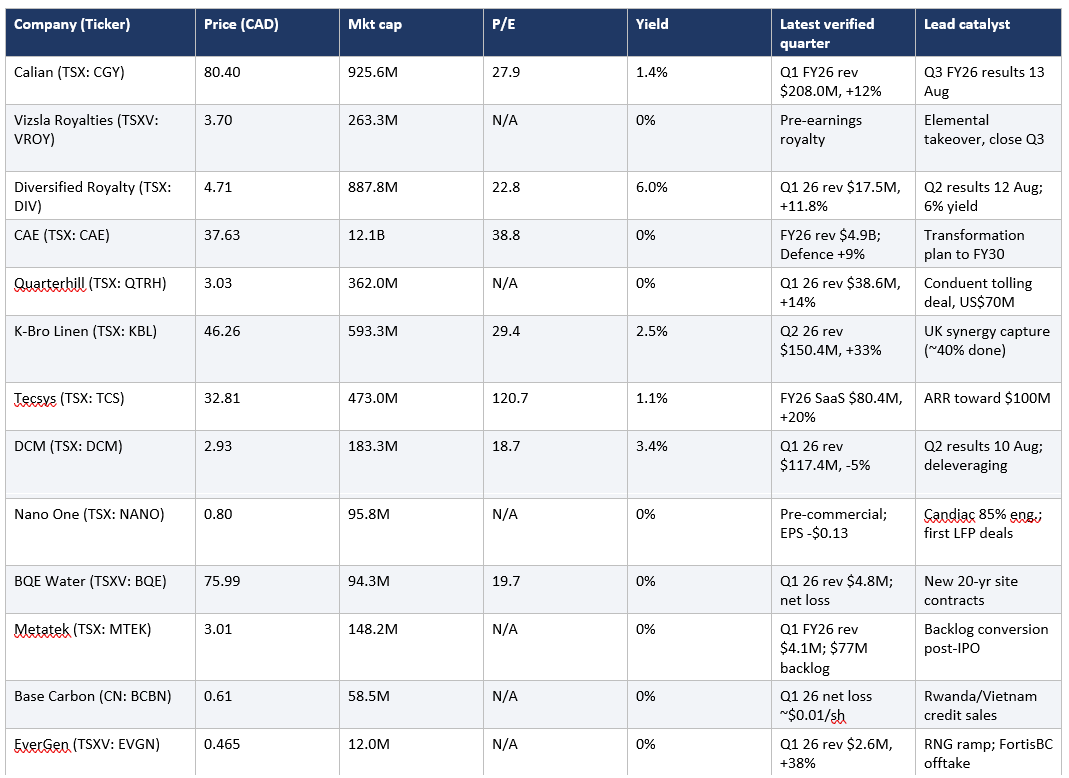
The snapshot below uses screener values as of 6 August 2026 (limited independent verification) alongside the latest verified results discussed above. Several names show "N/A" for price-to-earnings: for loss-making or pre-commercial companies (Nano One, Quarterhill, Metatek, Base Carbon, EverGen, Vizsla Royalties) a P/E ratio is arithmetically undefined or economically meaningless, because there are no positive trailing earnings to divide the price by — for these, cash runway, backlog and milestones matter more. We have deliberately not reproduced the screener's Calian earnings-growth figure of roughly +159,894%, which is a statistical artefact of dividing against a near-zero comparative base and does not describe real growth.
Rankings by catalyst strength and quality
The following ordering is analysis, not investment advice. It ranks the thirteen names by the immediacy and clarity of their near-term catalysts combined with the quality of the underlying business — how concrete the trigger is and how well-founded the company reporting it.
- Vizsla Royalties — the most defined catalyst: a signed C$4.13-per-share cash-or-share takeover with a third-quarter close. Outcome-driven and near-term, though contingent on approvals.
- Quarterhill — a transformational, signed acquisition that roughly triples tolling revenue, expected to close in Q4; high impact, higher execution risk.
- Calian — a dated 13 August earnings catalyst layered on a high-quality, cash-generative business with $1.4 billion of backlog.
- CAE — a large-cap with a freshly minted transformation plan and improving Defence margins; the catalyst is multi-year execution rather than a single date.
- Diversified Royalty — a 12 August print plus a dependable 6% monthly yield; steady rather than explosive.
- K-Bro Linen — a clear self-help catalyst (unrealised UK synergies) on top of 33% revenue growth.
- DCM — an imminent 10 August result and a visible deleveraging trajectory with a 3.4% yield.
- Tecsys — recurring-revenue momentum (ARR, RPO) that compounds quarter by quarter rather than spiking.
- Nano One — high-optionality milestones (first commercial LFP deals, Candiac commissioning) but pre-revenue risk.
- BQE Water — accumulating long-term site contracts against a soft reported quarter; profitable and cash-rich.
- EverGen — an operational turnaround with project-level triggers, constrained by small scale.
- Metatek — scarcity-value new listing with a growing backlog but a very short public record.
- Base Carbon — deep-value, event-driven carbon-credit sales, held back by thin cash and market scepticism.
What to monitor for the rest of August 2026
Three earnings dates and two live transactions dominate the calendar. Beyond the specific events below, watch commodity prices (silver and gold for Vizsla Royalties; carbon credits for Base Carbon), the Canadian dollar against sterling and the US dollar for the internationally exposed names, and any defence-procurement announcements that could benefit Calian, CAE and Metatek.
- 10 August — DATA Communications Management second-quarter 2026 results; look for continued net-debt reduction and margin resilience against a soft top line.
- 12 August — Diversified Royalty second-quarter 2026 results (after close); focus on the payout ratio and organic royalty growth, plus the monthly dividend declaration.
- 13 August — Calian Group fiscal third-quarter 2026 results; test of margin expansion, backlog conversion and any new defence or health awards.
- Progress on the Elemental–Vizsla Royalties takeover: the shareholder vote, court and antitrust approvals, and any move in Elemental's shares that changes the value of the stock alternative.
- Quarterhill–Conduent tolling deal: regulatory and TSX approval steps, financing details, and integration commentary ahead of a Q4 close.
- Milestone news from the pre-revenue names: Nano One's first commercial LFP agreements, EverGen project approvals, and Base Carbon credit-sale updates.
Conclusion
August 2026 is defined by events rather than valuations. The month's clearest catalysts are corporate: a signed takeover of Vizsla Royalties, a transformational tolling acquisition at Quarterhill, and a multi-year transformation plan at CAE. Layered on top are three dated earnings releases — DCM, Diversified Royalty and Calian — that will each test a specific thesis, from deleveraging to income durability to defence-led margin expansion. For the loss-making and early-stage names, the honest framing is that reported profits tell you little; cash runway, backlog and the timing of the next milestone tell you almost everything.
None of this should be read as a recommendation to buy or sell, and a favourable screen rating is not a guarantee of returns. The higher the potential catalyst, the higher the accompanying risk — deals can break, plans can slip, and pre-commercial companies can run short of cash. Readers should weigh each situation against their own objectives and, where appropriate, professional advice. What the thirteen names share is that the next few weeks will resolve real uncertainties, which is precisely what makes them worth watching this month. Figures cited carry their dates; screen values are a 6 August 2026 snapshot and were not independently re-priced.


 Nov 27, 2026





 Please wait processing your request...