
 NZ
 UK
 US
 AU
 IND

 CA

 Share
 X (Formerly Twitter)
 Whatsapp
 Facebook
 LinkedIn
 Telegram
 Email This Article
 Copy Link
 Summarize with AI
 Chat GPT
 Perplexity

Key Takeaways
- Three commodities capture the mid-2020s' dominant narratives — lithium (energy transition), gold (macro uncertainty) and copper (grid and EV build-out) — and Canadian-listed names offer targeted exposure to each.
- Lithium is the awkward outlier: prices have been volatile and generally weak, sharpening the contrast between US builder Lithium Americas (LAC) and low-cost Brazilian producer Sigma Lithium (SGML).
- Gold spans the spectrum, from pre-resource explorer Collective Mining (CNL) to established producer Monument Mining (MMY).
- Copper ranges from tailings-reprocessing generator Amerigo Resources (ARG) to developers Faraday Copper (FDY), Marimaca Copper (MARI) and Osisko Metals (OM).
- Every company carries commodity-price, financing and execution risk; development-stage names embed expectations that may not be realised.
Introduction
Few periods have forced resource investors to hold three contradictory ideas at once like the mid-2020s. Lithium, poster child of the energy transition, has spent much of the cycle in the doldrums, battered by oversupply even as electric-vehicle penetration climbs. Gold draws capital as a monetary hedge whenever macro uncertainty rises. Copper straddles both worlds, benefiting from structural demand tied to electrification and grid expansion.
Rather than blend these names into a single ranking, this piece groups ten Canadian-listed miners by commodity. We lead with the sharpest contrast: lithium, where a US builder still pouring concrete meets a Brazilian producer already banking revenue. All information reflects a research cut-off of 24 July 2026; nothing here is a forecast of events yet to occur.
Commodity and Macroeconomic Overview
The three metals are driven by genuinely different forces. Lithium has been the difficult one: concentrate and carbonate prices have been volatile and, for stretches, weak, as new supply outran demand. Low-cost producers have retained margin while higher-cost and pre-production names have felt the squeeze. The long-run story tied to electric vehicles and grid storage remains intact, but the near-term price signal has not been supportive.
Gold has told a happier story: macro uncertainty, shifting rate expectations and central-bank buying have underpinned firmer bullion prices, lifting producers and developers alike.
Copper occupies the electrification narrative, with demand from renewable generation, transmission, electric vehicles and power infrastructure supporting firm pricing while supply constraints add to the case. Underlying all three are shared macro variables — rates, the US dollar, inflation and growth — so every valuation below is sensitive to forces beyond a company's control.
Lithium Plays
Lithium Americas Corp (LAC)
Lithium Americas Corp (TSX/NYSE: LAC) is the archetypal big-build story. Its Thacker Pass project in Humboldt County, Nevada, ranks among the largest known lithium resources in North America and is in active construction, with Phase 1 designed for roughly 40,000 tonnes per annum of lithium carbonate. The build is backed by a US Department of Energy loan facility of about US$2.23 billion (a US$432 million advance drawn in February 2026), by General Motors (38% of the joint venture) and by Orion. LAC held roughly US$1.2 billion in total and restricted cash but is pre-revenue, with a trailing net loss near US$111.8 million; a Q2 2026 update is due mid-August. The risks are a weak lithium price, cost overruns and reliance on continued DOE disbursement.
Sigma Lithium Corporation (SGML)
Sigma Lithium Corporation (NASDAQ/TSXV: SGML) is the counterpoint: a producer, not a builder. Its Grota do Cirilo operation in Minas Gerais, Brazil, runs a "Greentech" plant at around 240,000 tonnes per annum of high-grade spodumene concentrate, with Phase 2 and Phase 3 in planning. In Q2 2026 Sigma produced 35,000 tonnes, beating 33,000-tonne guidance by roughly 6%. Q1 2026 was a record quarter — revenue of US$42 million and a 61% gross margin — while total debt fell to about US$134 million. It is a low-cost operator (CIF China cash cost near US$624 per tonne), though cash stood at only about US$28 million in mid-May 2026, with full Q2 2026 financials due mid-August. The risks are lithium-price volatility, a modest cash buffer and Phase 2/3 execution.
Gold Plays
Collective Mining Ltd (CNL)
Collective Mining Ltd (TSX/NYSE American: CNL) is a high-conviction, high-risk exploration play. Its Guayabales project in Colombia's Caldas district hosts the Apollo porphyry-breccia system, a pre-resource target where a maiden NI 43-101 resource is aimed for Q4 2026. The company reported around US$135 million in cash at December 2025, describes itself as fully funded for 2026, and counts Agnico Eagle among strategic holders, though the roughly US$1.2 billion market capitalisation embeds substantial expectation. Investors may watch the drill cadence and pivotal maiden resource; the risks are stark — no resource yet, Colombian jurisdiction and dilution against a US$500 million shelf.
GoldMining Inc (TSX: GOLD / NYSE American: GLDG)
GoldMining Inc trades as GOLD on the TSX and GLDG on NYSE American, and should not be confused with Barrick, which uses "GOLD" on the NYSE. It is a counter-cyclical project accumulator, not a producer, holding roughly 13.1 million ounces gold-equivalent (measured and indicated) across the Americas. Its most advanced asset, Sao Jorge in Brazil, received a positive PEA on 11 June 2026 (after-tax NPV5% of US$532 million, 42.4% IRR). A mid-year update reported cash plus listed securities of about US$185 million and no debt; it also holds stakes in USGO, Gold Royalty and NevGold. Investors may watch drill results, value-unlock deals and gold-price leverage; risks include every project being pre-production, holding-company valuation dynamics and jurisdiction across Brazil and Colombia.
Rio2 Limited (TSX: RIO)
Rio2 Limited (TSX: RIO), distinct from Rio Tinto, is transitioning from developer to producer. Its Fenix gold mine in Chile's Atacama poured first gold on 23 January 2026 and is ramping toward 20,000 tonnes per day, with commercial production targeted for Q4 2026. It also completed the acquisition of the producing Condestable copper-gold mine in Peru in January 2026. Cash rose to about US$93.1 million at the end of Q1 2026, a quarter that delivered operating cash flow near US$22.8 million but also exposed ramp-up shortfalls such as permit delays and equipment failures. Investors may watch the Fenix ramp, commercial-production declaration and deleveraging; the risks are execution and heap-leach recovery, integrating a new country and metal, and a balance sheet carrying vendor notes and a gold stream.
Monument Mining Limited (MMY)
Monument Mining Limited (TSXV: MMY) is the group's established, cash-generative small producer. Its 100%-owned Selinsing gold mine in Pahang, Malaysia, produced 11,700 ounces in the quarter to 31 March 2026, generating revenue of US$47.04 million and net income of US$22.65 million at an AISC of US$1,583 per ounce. Cash and equivalents are roughly US$101.76 million, and a development-stage Australian asset, Murchison/Burnakura, adds optionality. Full-year FY2026 results (year-end 30 June) are not yet released. Investors may watch those results, Buffalo Reef expansion and the sulphide transition; the risks centre on oxide depletion at Selinsing and the metallurgy of the sulphide switch, plus small-cap liquidity and gold-price dependence.
Copper Plays
Faraday Copper Corp (FDY)
Faraday Copper Corp (TSX: FDY), part of the Lundin Group, is a US-domestic copper developer. Its flagship Copper Creek in Arizona carries a 2023 PEA (after-tax NPV7% of US$713 million, US$798 million initial capex). On 2 July 2026 Faraday signed a definitive agreement to acquire the neighbouring San Manuel district from BHP, a deal not yet closed. A C$100 million March 2026 placement involving the Lundin Family Trust and BHP lifted cash to roughly C$120.8 million. Investors may watch the San Manuel closing (expected by end-Q3 2026), Phase IV drilling and progress toward a PFS; risks include the capex gap versus cash, deal-completion risk, US permitting and valuation after a sharp re-rating.
Marimaca Copper Corp (MARI)
Marimaca Copper Corp (TSX: MARI; ASX: MC2) is a Chilean copper developer approaching construction. Its Marimaca Oxide Deposit carries an August 2025 definitive feasibility study (US$587 million initial capex, 31% post-tax IRR) and won environmental approval in November 2025. A roughly C$409 million equity raise completed in February 2026, leaving cash near US$147 million at 31 March 2026 with zero debt; a US$587 million debt-financing process is underway, while the Pampa Medina discovery has produced high-grade drill hits. Investors may watch the sectoral permit, debt package and final investment decision, all targeted for Q4 2026; risks include the unclosed debt package, single-commodity and single-country concentration, and first-build cost inflation.
Amerigo Resources Ltd (ARG)
Amerigo Resources Ltd (TSX: ARG) is the copper group's producer and income name. It operates the 100%-owned Minera Valle Central in Chile, reprocessing fresh and historic tailings from Codelco's El Teniente mine under an agreement extended to 2037 — reprocessing rather than fresh mining, a different risk profile. H1 2026 copper output was 31.2 million pounds, and the company is effectively debt-free with cash of US$50.3 million at 30 June 2026. It returns capital via dividends and buybacks (US$41.7 million in H1 2026), and declared a C$0.18 performance dividend in July. Investors may watch full Q2 financials, dividends and copper-price direction; risks include single-asset concentration, dependence on Codelco for feed, and clear gearing to the copper price.
Osisko Metals Incorporated (OM)
Osisko Metals Incorporated (TSX: OM), distinct from the other Osisko entities, is an earlier-stage, Canada-focused critical-metals developer. Its flagship Gaspe Copper project in Quebec is among the largest undeveloped copper-molybdenum deposits in North America; an April 2026 update lifted measured and indicated resources to 1,834 million tonnes at 0.32% copper-equivalent. A strategic register including Agnico Eagle, CDPQ and Franco-Nevada backs a project described as fully funded to a construction decision, but the timeline is long: a PEA in H2 2026, feasibility in 2027 and production only around 2032. Investors may watch the Gaspe PEA as the biggest near-term catalyst; risks include large future capex against losses, moderate grade and a lengthy permitting runway.
Comparison Table
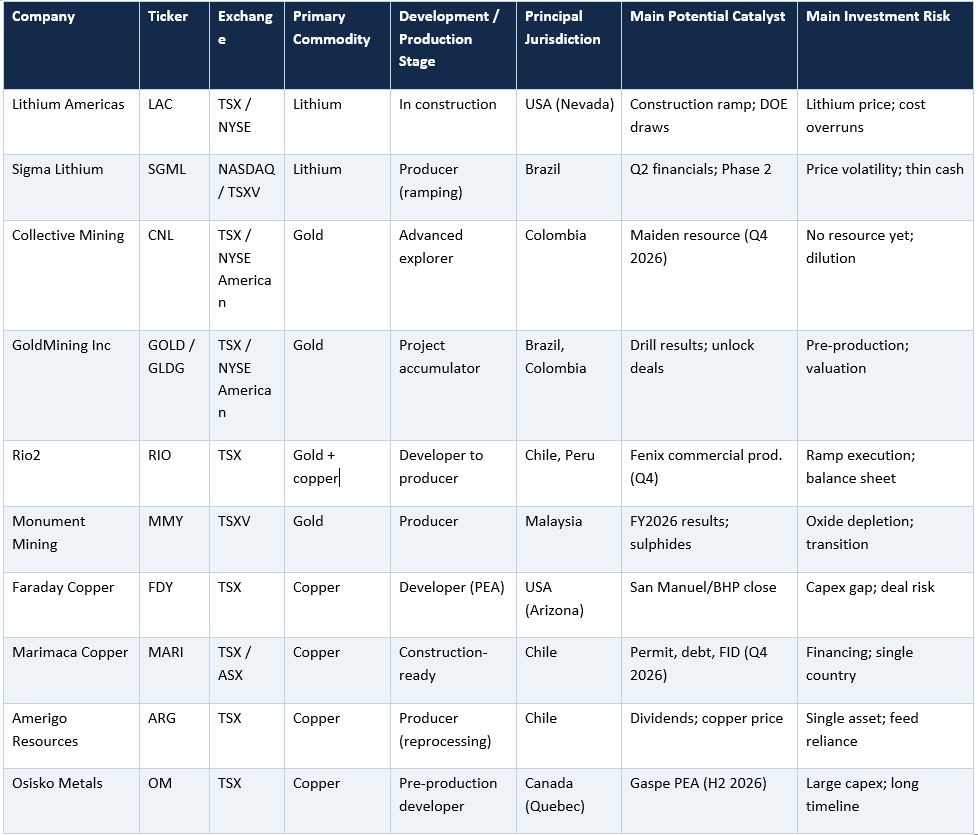
Key Risks Investors Should Consider
Commodity price is the master variable across all ten names — lithium for SGML and LAC, gold for CNL, GLDG, RIO and MMY, and copper for FDY, MARI, OM and the highly geared ARG.
Financing and dilution risk is acute for the pre-revenue developers LAC, MARI and FDY, whose large capital programmes and debt packages remain open, while execution risk runs from first-of-scale construction at Thacker Pass to ramp-up shortfalls at Rio2's Fenix. Jurisdiction adds another layer across Colombia, Chile, Peru, Brazil and Malaysia, and single-asset or single-country concentration amplifies these exposures. Several of these stocks have also re-rated sharply, embedding expectations that require flawless delivery.
Conclusion
These ten miners map onto the mid-2020s' three commodity narratives: LAC's capital-intensive US build versus SGML's low-cost Brazilian production in lithium; CNL's exploration through to MMY's cash generation in gold; and ARG's reprocessing alongside the copper development bets of FDY, MARI and OM.
The appeal is targeted exposure; the caveat is that each theme carries its own risks, and lithium in particular has been a difficult place to be. None of these names is without material commodity-price, financing, execution or jurisdictional risk, and several trade on demanding valuations. Investors should weigh catalysts and risks together, treating every figure here as a snapshot as at 24 July 2026.


 Nov 27, 2026





 Please wait processing your request...