
 NZ
 UK
 US
 AU
 IND

 CA

 Share
 X (Formerly Twitter)
 Whatsapp
 Facebook
 LinkedIn
 Telegram
 Email This Article
 Copy Link
 Summarize with AI
 Chat GPT
 Perplexity

Key takeaways
- A powerful precious-metals move, gold near US$4,057 and silver near US$57.75 an ounce on 23 July 2026, has pulled a wave of junior explorers off multi-year lows, per Trading Economics.
- The eight companies span Mexican and Nevadan silver-gold systems, an Ontario open-pit gold developer, a Peruvian silver-copper-manganese project, a Bolivian silver-tin deposit and an Ontario palladium-copper builder.
- Several are drilling into eye-catching high grades, while others are advancing feasibility studies or approaching construction decisions.
- Recurring watch-points include large but early-stage resources, activist and strategic shareholders, and sizeable capital still to be funded.
- Each carries meaningful exploration, financing, jurisdiction and commodity-price risk; nothing here is a certainty.
The August 2026 backdrop for precious-metals juniors
Few environments have been as kind to Canadian gold and silver stocks as the one that greeted investors in the northern summer of 2026. Gold traded around US$4,057 an ounce on 23 July, higher by more than a fifth over twelve months, while silver had staged an even more dramatic advance to roughly US$57.75, up close to 48 per cent year on year, according to Trading Economics. The gold-to-silver ratio had compressed toward 70 to 1, a shift that historically signals silver outperformance and that has drawn generalist capital back to a sector left for dead only two years earlier.
The equity response has been forceful. The 2026 edition of the TSX Venture 50, the exchange’s ranking of top performers, saw its constituents rise an average of 431 per cent and raise about C$1.5 billion in fresh capital, with mining names dominating, per StreetwiseReports. Developers have begun stress-testing project economics at gold prices above US$4,000 and, in some cases, US$4,400, a level that transforms the cash-generating potential of even modest deposits. That leverage is precisely why emerging explorers and developers, rather than the majors, have captured so much of the market’s attention.
It would be a mistake, though, to treat the group as a single trade. The eight companies below sit at very different points on the risk curve, from a newly listed explorer sitting on a C$115 million treasury to a fully permitted developer negotiating a billion-dollar project-finance package. Some are silver-first, some gold-first, and two carry a decisively different primary metal, manganese in one case, palladium in another, that changes the investment logic entirely. The sections that follow lay out what is verifiable about each, and where genuine uncertainty remains.
Gold, silver and the polymetallic angle
Gold’s strength has rested on a foundation of central-bank buying rather than speculative froth. The World Gold Council and mining.com point to official-sector purchases on the order of 850 tonnes projected for 2026, a structural bid that has kept the metal firm even through episodes of profit-taking. For a gold developer, a durable four-figure price is the difference between a marginal project and a compelling one, which is why 2026 has seen a rush to refresh feasibility studies at higher price decks.
Silver’s dual identity, both monetary hedge and industrial input for solar panels and electronics, has amplified its move and rekindled the perennial supply-deficit debate. That combination rewards high-grade silver discoveries, several of which feature below. It is worth noting that many so-called silver juniors are in truth polymetallic, carrying lead, zinc, copper, gold or tin credits that materially change their economics and their exposure. In two cases here the "silver" label is genuinely misleading: one company’s value is now dominated by manganese, a battery and steel input, and another sits at the edge of the palladium and copper markets. Investors weighing Canadian gold and silver stocks should therefore read past the name to the revenue mix, because the underlying commodity cycle, and its policy overlay, drives the outcome.
The equity leverage embedded in these stories is worth spelling out. When gold moves from US$2,000 to US$4,000, a project’s revenue roughly doubles while much of its cost base, labour, power, reagents, stays broadly fixed, so margins and net-present-values expand far faster than the metal price itself. That is the mathematics behind the outsized share-price gains of 2026 and behind the flurry of developers re-cutting feasibility and preliminary economic studies at higher price decks. It also explains why several companies below have chosen this moment to publish or refresh their economics: a study that looked marginal a year ago can look transformative today. The corollary is that the same leverage works in reverse, so a sustained pullback in gold or silver would compress these valuations at least as quickly as the rally inflated them.
Investment themes for emerging gold and silver miners
Three currents run through this cohort. The first is high-grade discovery. Bonanza intercepts, some exceeding 1,000 and even 2,000 grams per tonne silver-equivalent, have been the fuel for several re-ratings in 2026, though spectacular narrow-vein hits must still be converted into economically continuous resources. The second is corporate agency: activist investors, cornerstone backers and management teams with prior build-and-sell track records feature prominently, and their presence often shapes whether a company grows, gets funded or is sold.
The third current is the capital gap between paper value and construction cost. More than one company here has published a study describing a project worth hundreds of millions, or billions, yet must still raise sums comparable to, or larger than, its own market value to build. That gap is not fatal, plenty of mines get financed, but it defines the dilution, partnership or takeover paths ahead. With those themes in mind, the profiles below examine each company’s assets, ownership, stage, recent results, balance sheet, strategy and the specific reasons for both interest and caution.
The eight emerging gold and silver companies
Capitan Silver Corp. (TSXV:CAPT)
Capitan Silver, formerly Capitan Mining, is a Vancouver-based explorer whose entire story sits at the 100 per cent-owned Cruz de Plata project in the historic Peñoles district of Durango, Mexico. The property spans a roughly 20-kilometre mineralised system with two distinct engines: the near-surface Capitan Hill oxide-gold zone and the Jesús María silver trend. In September 2025 the company published a maiden inferred resource at Capitan Hill of 39.8 million tonnes grading 0.41 grams per tonne gold plus 3.3 grams per tonne silver, for roughly 525,000 gold ounces, according to Junior Mining Network.
The excitement has come from the silver side. A 60,000-metre, multi-rig campaign launched in January 2026 has produced a steady stream of high-grade hits along Jesús María, including 1.1 metres at 1,077 grams per tonne silver-equivalent in July 2026 and, earlier, an intercept of 1.5 metres at 2,451 grams per tonne. With roughly 61 holes awaiting assays and four rigs turning, news flow is dense. The project is well financed after a C$29 million raise capped in January 2026 that included a C$6 million investment from Schroders, per Newsfile.
What differentiates Capitan is the dual optionality of a defined oxide-gold body and a growing high-grade silver system on one 100 per cent-owned, district-scale land package, backed by an institutional cornerstone. Chief executive Alberto Orozco has assembled a technical team with Mexican operating experience, and the strategy is a deliberate drill blitz aimed at a maiden Jesús María silver resource, the clearest catalyst ahead.
The cautions are real. The published resource is inferred only, no economic study yet exists, and residual royalties of about two per cent remain on the ground. As a single-asset explorer in Mexico, Capitan carries jurisdiction and permitting exposure, and, tellingly, the shares near C$1.75 sat below the C$2.03 price of the recent raise, a reminder that even strong drill results do not guarantee share-price support. Its market value was roughly C$225 million.
The reason Capitan draws a following is the rare pairing of a defined, near-surface oxide-gold resource that could underpin a straightforward heap-leach scenario with a high-grade silver discovery still in its early innings. In a market rewarding both bulk-tonnage gold economics and bonanza silver grades, that dual identity gives the company two ways to create value from a single land package. Investors will be watching whether the Jesús María intercepts knit together into a coherent, mineable resource, and whether management can lift the share price back above the level of its most recent institutional financing, a practical test of market confidence.
Mayfair Gold Corp. (TSXV:MFG)
Mayfair Gold offers a more advanced, and more unusual, proposition. Its 100 per cent-owned Fenn-Gib project near Timmins in northeastern Ontario is a large open-pit gold deposit with an indicated resource of 4.3 million ounces. In January 2026 the company delivered a pre-feasibility study outlining probable reserves of 1.04 million ounces, initial capital of about C$450 million and, at a US$3,100 gold price, an after-tax net present value of C$652 million; at prices near recent spot levels the study’s value rose sharply, per PR Newswire. The reserve represents only about a quarter of the indicated resource, leaving substantial expansion headroom.
The distinctive feature is governance. The activist short-seller Muddy Waters, run by Carson Block, built a 16.1 per cent position and, at the June 2026 annual meeting, succeeded in reconstituting the board, an outcome confirmed by Newswire. The company also listed on the NYSE American under the ticker MINE in January 2026 and appointed Drew Anwyll, a mining engineer with development pedigree, as chief executive in May. The board’s stated focus is cost discipline and value realisation, and observers note that Muddy Waters’ prior involvement in GT Gold ended in a sale to Newmont, a possible template.
For investors, the appeal is a large, 100 per cent-owned Ontario gold deposit with a robust study and considerable reserve upside, now overseen by an unusually motivated, cost-focused board. The differentiator is the activist-driven governance angle layered on a conventional development story.
The risks are equally clear. The roughly C$450 million capital bill exceeds the company’s market value of about C$226 million, pointing to dilution, a partner or a sale, and the relatively modest 1.29-gram reserve grade with a high strip ratio leaves less margin for error. The activist-installed team is newly in place and unproven together, permitting timelines stretch toward a 2028 construction decision, and ownership is concentrated. This is a development story with a live corporate overlay rather than a settled one.
Aftermath Silver Ltd. (TSXV:AAG)
Aftermath Silver carries a silver name but, on the latest numbers, a manganese heart. Its flagship Berenguela project in southern Peru, now 100 per cent owned after a staged acquisition completed in January 2026, hosts a measured-and-indicated resource of 51.55 million tonnes containing 122.5 million ounces of silver, 717 million pounds of copper and 2.93 million tonnes of manganese, per Yahoo Finance. Strikingly, manganese, a critical input for batteries and steel, accounts for roughly three-quarters of the deposit’s in-situ value, recasting Aftermath as much a critical-minerals story as a silver one.
The company launched a pre-feasibility study at Berenguela in February 2026 with DRA Global leading, and infill drilling has returned strong results, including 62.3 metres at 81 grams per tonne silver with 1.99 per cent copper in June 2026. In a distinctive move, Aftermath formed a United States critical-metals and defence advisory board in mid-2026, including retired senior military officers, to position Berenguela as allied supply, per Newsfile. It is backed by a US$20 million financing in December 2025 in which Eric Sprott participated as a cornerstone holder.
What sets Aftermath apart is genuine three-metal exposure, silver, copper and manganese, in a single 100 per cent-owned, pre-feasibility-stage asset, plus a differentiated funding angle through its US strategy. Chief executive Ralph Rushton’s plan is to advance the study while courting non-dilutive American support. The chief risk is that Berenguela’s manganese value depends on hydrometallurgy that is unproven at scale, and no economic study has yet been published. Single-asset dependence, Peruvian and Chilean jurisdiction, dilution and the possibility that the US narrative does not convert to funding all temper the case. The shares traded near C$0.65 for a market value around C$222 million.
The company reported cash of roughly US$18.5 million with no debt, a reasonable cushion for the study phase, though the eventual build will require far more. What makes Aftermath worth watching is that it sits at the intersection of two narratives investors are paying up for in 2026, high-grade silver and domestically aligned critical minerals, while carrying a large defined resource and a credible cornerstone in Eric Sprott. The open question is execution: manganese recovery via hydrometallurgy is the hinge on which most of Berenguela’s value turns, and until the pre-feasibility study quantifies that flowsheet and its costs, the three-quarters of in-situ value attributed to manganese remains a promising but unproven proposition.
Blossom Gold Inc. (TSX:BGAU)
Blossom Gold is one of the best-funded new listings in the sector. The company went public in early February 2026 through a reverse takeover involving Investmin Resources, raising about C$115 million at C$1.00 a share, per Newsfile. Its single asset is the Rosebud gold-silver project in Pershing County, Nevada, a past-producing underground mine operated between 1997 and 2000 by a Newmont-Hecla joint venture that yielded nearly 397,000 ounces of gold. Blossom is reinterpreting the brownfield as a bulk-tonnage, open-pit heap-leach opportunity.
An inferred resource effective November 2025 outlined 70.8 million tonnes at 0.62 grams per tonne gold and 6.49 grams per tonne silver, roughly 1.29 million gold ounces and 13.4 million silver ounces. With Bureau of Land Management approval secured in March 2026 for an 80,000-foot, four-rig program, and the reopening of an underground portal underway from July 2026, the company is drilling aggressively. Early open-pit results in June 2026 included a broad 294.2-metre interval at 0.245 grams per tonne gold from surface, consistent with a low-grade, high-tonnage model.
The differentiator is the combination of an unusually large treasury, a permitted, past-producing brownfield with proven gold endowment, and roughly 1.29 million ounces already defined before the current drilling. Chair Dino Titaro and chief executive Rick Winters lead a board with Nevada experience, and concentrated institutional holders anchor the register. The reasons for caution are that the entire resource is inferred and unaccompanied by any economic study, the company has acknowledged historical database gaps requiring confirmatory work, and Nevada water rights, permitting and royalty burdens, including a 3 per cent underlying net smelter return, weigh on future economics. Key catalysts are metallurgical bottle-roll results expected in August 2026 and an upgraded resource anticipated in early 2027. The shares traded near C$2.13 for a market value around C$280 million.
Southern Silver Exploration Corp. (TSXV:SSV)
Southern Silver Exploration is advancing one of Mexico’s larger undeveloped silver systems. Its 100 per cent-owned Cerro Las Minitas project in Durango, in the prolific Faja de Plata belt, is a high-grade silver-lead-zinc deposit that has seen more than 90,000 metres of drilling. A resource effective March 2024 defined roughly 302 million ounces of silver-equivalent across the indicated and inferred categories, and an updated preliminary economic assessment in mid-2024 outlined an after-tax net present value of US$501 million and a 21.2 per cent internal rate of return on initial capital of US$388 million, per the company.
Crucially, that study assumed a silver price of just US$23 an ounce, far below current levels, which makes an imminent resource-and-study refresh, expected around the third quarter of 2026, the pivotal catalyst. Recent drilling at the newly acquired Puro Corazón zone has been strong, including 10.4 metres at 743 grams per tonne silver-equivalent in early 2026, extending the system. The strategy under president Lawrence Page is to grow and upgrade the resource, then re-cut the economics at prices that better reflect the market.
The differentiator is a large, high-grade, 100 per cent-owned underground silver system in a tier-one district with a positive, and now conservative-looking, economic study. The offsets are a thin treasury of about C$5 million against a US$388 million build, meaning a major financing or partner will be required, alongside Mexican permitting policy, an inferred-heavy resource and the leverage, and volatility, that comes with silver-price sensitivity. The shares near C$0.52 gave a market value around C$184 million after a strong twelve-month run.
The investment logic hinges on that price gap. Because the last published economics used a silver assumption roughly a third of the prevailing spot price, a refreshed study on the same resource, at prices closer to reality, would mechanically imply a much larger net present value, before accounting for any resource growth from Puro Corazón. That is a large part of why the stock featured in the 2026 TSX Venture 50 and why investors are watching the third-quarter updates so closely. The counterpoint is that a higher-value study still needs to be financed, and a company with about C$5 million in the treasury is a long way from funding a US$388 million mine, so the market will also be gauging how, and on what terms, that capital eventually arrives.
Roxmore Resources Inc. (TSX:RM)
Roxmore Resources is a newly assembled Nevada gold vehicle led by executives with a notable build-and-sell record. Formerly the investment company Axcap Ventures, it rolled up gold assets through 2025, completed a one-for-ten share consolidation and rename in November 2025, and uplisted from the CSE to the Toronto Stock Exchange in February 2026, per Junior Mining Network. Its flagship is the 100 per cent-owned Converse gold project on Nevada’s Battle Mountain-Eureka trend, a large, low-grade, bulk-tonnage system.
A preliminary economic assessment in April 2026 was eye-catching: at a US$3,600 gold price it outlined an after-tax net present value of US$2.7 billion and a 43 per cent internal rate of return on pre-production capital of US$829 million, per the company. Management, led by former Roxgold chief executive John Dorward and backed by a C$32.6 million placement with cornerstone investor L1 Capital, is drilling 30,000 metres and advancing toward pre-feasibility and permitting. The team’s pedigree, Roxgold was sold to Fortuna and Fronteer to Newmont, is a large part of the draw.
Two cautions deserve emphasis. First, the resource confidence is a live question: the 2026 estimate used in the assessment showed 2.16 million indicated and 3.04 million inferred ounces, a significant migration into the lower-confidence category relative to figures cited at acquisition, and investors should read the technical report carefully before anchoring on any single ounce count. Second, the economics are highly gold-price-sensitive given the low 0.43-to-0.65-gram grade, the US$829 million capital bill dwarfs the roughly C$239 million market value, and multi-year Nevada permitting lies ahead. A short, complex corporate history adds to the due-diligence burden. The shares traded near C$2.85.
Set against those cautions, the reason Roxmore attracts attention is the combination of one of the larger undeveloped gold resources in Nevada with a management team that has twice before taken a development story to a profitable sale. In a gold market above US$4,000, a low-grade, high-tonnage deposit that looks marginal at US$1,500 can look robust, and the April assessment’s headline figures reflect that leverage. The market will be watching whether continued drilling firms up grade continuity and confidence, and whether the team repeats its playbook of building value toward a transaction rather than a decades-long solo build.
Generation Mining Ltd. (TSX:GENM)
Generation Mining is the outlier of this group and deserves a clear label: its Marathon project in Ontario is primarily a palladium and copper development, with gold, platinum and silver as by-products, rather than a gold or silver mine. It is included here as an emerging precious-metals-linked developer, but the revenue mix is dominated by palladium and copper, which changes the commodity exposure entirely. That distinction matters, because palladium has been a weaker market than gold or silver in this cycle.
On its own terms, Marathon is one of the most de-risked development stories in Canada. It is fully permitted, having received its final permits in 2025, and a feasibility study update outlined an after-tax net present value of C$1.07 billion and a 28 per cent internal rate of return at conservative metal prices, rising to roughly C$2.2 billion at late-2025 spot prices, per Business Wire. Reserves stand at 128.3 million tonnes. A Wheaton Precious Metals stream of C$240 million and credit-approved senior debt from export and infrastructure lenders form the backbone of a roughly C$969 million financing package against a near-C$1.0 billion capital cost.
The differentiator is scarcity: very few shovel-ready, permitted platinum-group-metal and critical-mineral projects exist in tier-one jurisdictions, and government-backed lenders plus the Wheaton stream have heavily de-risked the build. Chief executive Jamie Levy’s near-term task is to close the remaining funding gap of roughly C$150 million, likely through an equity raise in the second half of 2026, ahead of a construction decision, with first production targeted around 2028. The principal risks are palladium-price weakness, that residual funding gap and attendant dilution at a market value near C$209 million, and the execution challenge of building a billion-dollar mine. For precious-metals investors, Marathon is best viewed as palladium-and-copper leverage with gold and platinum kickers, not a bullion proxy.
The palladium backdrop is the swing factor. Unlike gold and silver, palladium has faced structural questions as the vehicle fleet electrifies and autocatalyst demand matures, which has weighed on sentiment toward the metal even during a broad commodities upcycle. Generation Mining’s feasibility economics remain positive across a range of assumptions, and the copper by-product provides a hedge into a tight copper market, but the project’s ultimate returns are more sensitive to the palladium price than to gold. That nuance is why Marathon belongs in a precious-metals-linked discussion with an asterisk: the de-risking, permitting and financing progress are genuinely advanced, yet the commodity driving most of the revenue marches to a different beat than the bullion powering the rest of this list.
Eloro Resources Ltd. (TSX:ELO)
Eloro Resources rounds out the list with a very large silver-tin system in Bolivia. Its Iska Iska project in the Potosí department is a polymetallic breccia complex in which Eloro holds full economic control, royalty-free, through a Bolivian subsidiary. An updated open-pit resource in April 2026 outlined 85.2 million indicated tonnes at 40 grams per tonne silver and a very large 945 million inferred tonnes at 8.5 grams per tonne, together with meaningful tin, zinc and lead, for roughly 358 million contained ounces of silver, per Newsfile. The tin content is strategically notable, and in February 2026 Eloro was accepted into the United States Defense Industrial Base Consortium, underscoring a critical-minerals angle unusual for a silver junior.
It is important to be precise about stage: Eloro has not yet published a preliminary economic assessment, so any net-present-value or capital figure would be premature, and the older, higher headline silver-equivalent numbers have been superseded by the April 2026 estimate. In July 2026 the company began a 40,000-metre expansion and infill program, expected to run into early 2027, to support a first economic study. A C$17 million financing in March 2026 funded the work. Chairman and chief executive Tom Larsen leads a team that recently strengthened its Latin American technical bench.
What differentiates Eloro is the sheer scale of the polymetallic endowment plus genuine tin and critical-minerals exposure and royalty-free economic control. The dominant risk is jurisdiction: Bolivia carries elevated political, permitting, currency and social risk relative to Mexico, Nevada or Ontario, and that single factor colours the entire thesis. Add financing and dilution needs, silver and tin price volatility, and the challenge of converting a heavily inferred, low-grade resource into economic reserves, and the caution list is long. The shares traded near C$1.86 for a market value around C$217 million.
For investors comfortable with Bolivian risk, the attraction is straightforward: few juniors offer a silver resource of this magnitude alongside a genuine tin credit at a time when tin has become a recognised critical mineral and Washington has taken a strategic interest. The looming first economic study, still a year or more away, is the milestone that would translate the resource into value the market can underwrite, and the current drilling is the necessary groundwork. Until then, Eloro remains a scale-and-optionality story whose central variable is not geology but the stability of the jurisdiction that hosts it.
Comparing the eight companies
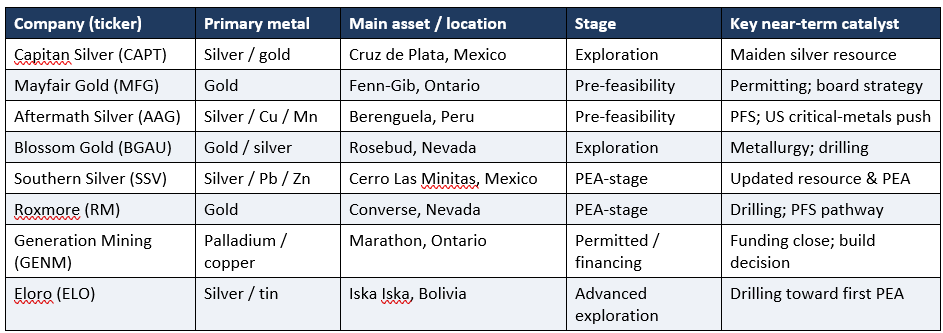
The following table condenses the primary metal, main asset, stage and key near-term catalyst for each company. It highlights how varied the group is: two are at or near a construction pathway with published feasibility or pre-feasibility studies, three are drill-stage explorers chasing high grades, one is a well-funded new listing, and two carry primary metals, manganese and palladium, that sit outside the gold-and-silver label. Market values are approximate and dated to each profile; readers should verify live figures independently.
Major potential catalysts into August 2026 and beyond
The catalyst calendar is what gives this group its near-term energy. Capitan Silver’s continuous assay flow points toward a maiden Jesús María silver resource; Southern Silver’s updated resource and re-cut economic study, expected around the third quarter, could reset a project whose last assessment used a silver price less than half of today’s. Aftermath Silver’s pre-feasibility work and its United States critical-metals initiative offer discrete milestones, as does Blossom Gold’s metallurgical testing in August ahead of an upgraded resource in early 2027.
Further along the development curve, Mayfair Gold’s permitting and engineering progress under its new board, Roxmore’s continued Converse drilling and move toward pre-feasibility, and Generation Mining’s effort to close its financing package and reach a construction decision are the events to track. Eloro’s large drill program will build toward its first economic study, though that lies further out. As always, catalysts are double-edged: a soft study, a permitting delay or a disappointing hole can compress a junior’s valuation as quickly as good news expands it.
Key risks investors should weigh
Financing sits at the centre of the risk map. Several companies here, notably Southern Silver, Mayfair Gold, Roxmore and Generation Mining, must raise capital comparable to or larger than their market values to build, which typically means dilution, a strategic partner, streaming or a sale. Even the best-funded name, Blossom Gold, will eventually need far more than its current treasury to reach production. Investors should assume additional equity issuance is likely across most of the group.
Beyond funding, resource confidence is a recurring concern: much of the defined metal is inferred and may not convert, and at least one company has seen a meaningful reclassification of ounces into lower-confidence categories. Commodity exposure is not uniform, silver, gold, manganese, palladium and tin each march to different drums, and the two non-precious-primary names carry that distinction plainly. Jurisdiction ranges from lower-risk Ontario and Nevada to Mexico, Peru and, most acute, Bolivia. Metallurgical uncertainty, permitting timelines, management transitions and the sheer volatility of small-cap equities complete the picture. None of these companies should be treated as a guaranteed outcome.
Conclusion
The 2026 bull market in precious metals has given emerging Canadian gold and silver stocks their best backdrop in years, and the eight companies here illustrate both the opportunity and its texture. There are high-grade Mexican silver systems still early in the drill bit, a large Ontario gold deposit under activist stewardship, a well-capitalised Nevada newcomer, a Peruvian project quietly transformed by manganese, a Bolivian polymetralic giant with a tin twist, and a permitted Ontario developer whose real leverage is palladium. Each has a defined asset base and a near-term catalyst capable of moving its shares.
Yet the same profiles show why discernment matters more than enthusiasm. Funding gaps, inferred resources, mislabelled primary metals, and jurisdictional risk that ranges from benign to significant all feature. This article sets out verified facts alongside the open questions not to endorse or discourage any particular security, but to give readers a factual foundation for their own research. In a sector where fortunes turn on a single drill hole, permit or financing, that independent diligence is indispensable.


 Nov 27, 2026





 Please wait processing your request...