
 NZ
 UK
 US
 AU
 IND

 CA

 Share
 X (Formerly Twitter)
 Whatsapp
 Facebook
 LinkedIn
 Telegram
 Email This Article
 Copy Link
 Summarize with AI
 Chat GPT
 Perplexity

key takeaways:
- The six companies offer three distinct themes — gold, uranium and critical minerals — and a wide range of stages, from producing mines to pre-resource exploration.
- Lion One Metals (LIO) is a producing gold miner in financial distress, working through a lender default and forbearance while gold prices sit near records.
- TNR Gold (TNR) provides low-capital royalty exposure to the very large Los Azules copper project, but any pay-off is years away.
- Premier American Uranium (PUR) and Atico Mining (ATY) face defining study and construction decisions on Cebolleta and La Plata respectively.
- West High Yield Resources (WHY) and Grid Metals (GRDM) are critical-mineral plays in magnesium and cesium, dependent on financing, partners and thin specialty markets.
Introduction
Some of the most closely followed stories on the Canadian junior boards in 2026 sit at the meeting point of three powerful themes: the enduring appeal of gold, the revival of uranium, and the scramble to secure critical minerals outside Chinese-dominated supply chains. As late August 2026 approaches, a cluster of small companies straddling those themes has been appearing side by side on investor screeners, each offering a different way to play the same underlying forces.
This article examines six of them: Lion One Metals (TSXV: LIO), a gold producer in Fiji working through a period of financial stress; TNR Gold (TSXV: TNR), a royalty and exploration company with exposure to one of the world's largest undeveloped copper deposits; Premier American Uranium (TSXV: PUR), a United States-focused uranium developer; Atico Mining (TSXV: ATY), a copper-gold producer in Latin America; West High Yield Resources (TSXV: WHY), a British Columbia magnesium developer; and Grid Metals (TSXV: GRDM), a Manitoba explorer that has pivoted towards the specialty metal cesium.
They range from producing miners to pre-revenue explorers, and their fortunes are tied to very different commodities. What they share is that each is a small company whose valuation could be reshaped by a manageable number of upcoming events — and each carries risks that are just as capable of moving the shares the other way. As with any coverage of early-stage resource companies, nothing here is a recommendation; it is an attempt to lay out the facts and the uncertainties so readers can form their own view.
The commodity backdrop: gold firm, uranium reviving, critical minerals in policy focus
Gold has been the steadying force in the resource market through 2025 and into 2026, trading at historically high levels on the back of macroeconomic uncertainty and sustained central-bank buying. High realised gold prices have been a lifeline for producers and a re-rating catalyst for explorers, though they cannot by themselves fix a stretched balance sheet.
Uranium has been the sector's structural growth story. A widening gap between reactor demand — supported by life extensions, new builds and, increasingly, the power needs of data centres — and constrained mine supply has underpinned firmer uranium prices and a wave of investor interest in developers with assets in stable jurisdictions such as the United States. The economics of individual projects nonetheless remain sensitive to the uranium price and to the cost of building mines.
The critical-minerals theme is more policy-driven. Western governments have moved to support domestic and allied supply of materials deemed strategic — from magnesium to the specialty metal cesium — through funding programmes, offtake support and trade measures. That backdrop can create opportunity for small companies holding the right deposits, but specialty-metal markets are often thin, opaque and dependent on a handful of buyers. Copper, meanwhile, has stayed comparatively well supported, which matters for the copper-exposed names here.
It is worth stressing how differently these forces land on a small company depending on its stage. A producer such as Lion One or Atico feels the commodity price immediately, in revenue and margins, but also in the terms on which it can refinance debt. A royalty holder such as TNR Gold feels it only indirectly and with a long lag, through the pace at which the operator of its underlying asset chooses to build. And a pre-revenue developer such as Premier American Uranium, West High Yield or Grid Metals feels it mostly through sentiment and access to capital — a strong metal price makes financing easier and cheaper, a weak one can stall a project regardless of its geological merit. Reading these six companies therefore means matching each commodity theme to where the business actually sits on the path from discovery to production.
Lion One Metals (TSXV: LIO)
Company, ticker and exchange
Lion One Metals Limited trades on the TSX Venture Exchange under LIO, on the US OTC market as LOMLF, and in Frankfurt. It is a gold producer — and, importantly for any assessment, a company navigating acute financial stress rather than a simple growth story.
Principal commodities and flagship project
Lion One's asset is the Tuvatu Alkaline Gold Project on Viti Levu in Fiji, a high-grade epithermal gold system that it holds through a Fijian subsidiary under a Special Mining Lease. The mine poured first gold in 2024 and has been ramping up underground mining and on-site processing since.
Recent developments
The past year has been turbulent. The company reported quarterly gold recoveries, commissioned a new flotation circuit and expanded plant capacity from 300 towards 400 tonnes per day. But it also declared an event of default on its senior debt facility, went through several changes of chief executive, saw founder Walter Berukoff retire, and appointed Ian Berzins as president and chief executive in June 2026. In July 2026 it announced a forbearance agreement with its senior lender, extending repayment terms — a critical step in managing its debt.
Resource estimates
A 2024 technical report outlined indicated resources of about 175,000 ounces of gold and inferred resources of about 339,000 ounces at high grades of roughly 7.6 to 8.5 grams per tonne, at Tuvatu. There are no declared reserves, and an earlier preliminary economic assessment from 2020 should be treated as dated historical context rather than current guidance.
Financial position
This is the crux of the Lion One story. The company reported cash of about C$14.9 million as of 30 September 2025 but with negative working capital of roughly C$9.2 million. Senior debt owed to Nebari funds stood at around US$31.2 million under the July 2026 forbearance, with a repayment deadline extended to the end of 2026. Lion One has funded itself through near-continuous, heavily dilutive placements, including roughly C$32.8 million of convertible debentures and units across June and July 2026, in part to cure defaults. Investors should treat this as a going-concern-risk situation.
Market capitalisation, catalysts and risks
Lion One's market capitalisation was around C$48 million in early July 2026 on a share price near C$0.12, and its share count has been rising rapidly. The pivotal catalysts are refinancing or repaying the Nebari debt, ramping the plant to and beyond nameplate capacity, and resolving governance uncertainty. The risks are severe and unusually front-of-mind for this company: liquidity and solvency pressure, relentless dilution at a low share price, operational ramp-up lag, governance instability and single-asset, single-country concentration. Lion One is extremely leveraged to the gold price; the high realised prices of recent quarters have been supporting revenue and its refinancing capacity, and a gold pullback would sharply worsen its position.
Why investors are watching
Lion One draws attention precisely because it is a high-grade, producing gold mine trading at a distressed valuation while gold sits near record levels — a classic high-risk, high-reward turnaround setup. If new management can stabilise the balance sheet, lift throughput and refinance the debt into a supportive gold market, the operational leverage is considerable. If it cannot, the same leverage works brutally in reverse. This is a situation defined by its risks, and it should be approached with that firmly in mind.
TNR Gold (TSXV: TNR)
Company, ticker and exchange
TNR Gold Corp. trades on the TSX Venture Exchange under TNR and on the US OTC market as TRRXF. It describes itself as a green-energy-metals royalty and gold company.
Principal commodities
TNR's exposure spans copper, through its flagship royalty, plus lithium and gold.
Flagship interests and locations
TNR's headline asset is a net smelter return royalty of 0.4% (about 0.36% net to the company) over the Los Azules copper project in San Juan Province, Argentina — one of the world's largest undeveloped copper deposits, being advanced by McEwen Copper. TNR also holds a lithium royalty over the Mariana project in Salta, Argentina, a roughly 90% interest in the early-stage Shotgun gold project in Alaska, and a net-profits interest near the Josemaría development.
Recent developments
In May 2026 TNR completed a C$4.17 million strategic placement with Altius Resources, which also took a right of first offer over certain shareholder-held royalty interests, and Altius increased its stake further in July 2026. On the underlying asset, McEwen Copper released a definitive feasibility study for Los Azules in October 2025 and appointed Société Générale to arrange a senior debt package in May 2026. The project was also approved under Argentina's RIGI large-investment incentive regime in September 2025.
Resource and study figures
The Los Azules feasibility study — which describes the underlying project, not TNR's royalty directly — reported an after-tax net present value at an 8% discount rate of about US$2.94 billion, an internal rate of return near 19.8%, initial capital of roughly US$3.17 billion and a 21-year mine life, with proven-and-probable reserves of around 10.2 billion pounds of copper. Because TNR holds a royalty, it would carry none of that construction cost.
Financial position, market capitalisation and catalysts
TNR is a small royalty and exploration company; its most recent capital event was the C$4.17 million Altius placement, and a precise dated cash balance was not readily verifiable. Its market capitalisation was around C$60 million in late July 2026 on a share price near C$0.25, having risen substantially off its lows. The key catalysts are a Final Investment Decision on Los Azules, targeted around the end of 2026, the closing of the project's debt financing, and construction progress towards potential first copper around 2030.
Risks, sensitivities and why investors are watching
The main risks are the long lead time before royalty revenue begins, dependence on McEwen Copper securing multi-billion-dollar financing, and Argentine jurisdictional risk — partly mitigated by the RIGI regime's stability guarantees. Copper is the dominant price driver. The appeal for investors is the leverage: a tiny royalty over a genuinely enormous copper deposit offers exposure to a potential world-class mine without the dilution and capital burden of building it, which is why the story attracts those with a long time horizon. The trade-off is that the pay-off, if it comes, is years away and hinges on decisions made by others.
Premier American Uranium (TSXV: PUR)
Company, ticker and exchange
Premier American Uranium Inc. trades on the TSX Venture Exchange under PUR and on the US OTCQB market as PAUIF. It is a pure-play United States uranium explorer and developer.
Principal commodities and flagship projects
The company is focused entirely on uranium across a portfolio of United States projects. Its flagship development asset is the wholly owned Cebolleta project in the Grants Mineral Belt of New Mexico. It also holds the Kaycee in-situ recovery exploration project and the Cyclone project, both in Wyoming, having broadened its footprint through the acquisition of Nuclear Fuels, completed in September 2025.
Recent developments
Premier American closed the all-share acquisition of Nuclear Fuels in September 2025, released a preliminary economic assessment and updated resource for Cebolleta in October 2025, and closed a C$15 million bought-deal financing in February 2026. Through the first half of 2026 it advanced metallurgical drilling at Cebolleta and a large drill programme at Kaycee, and signalled a 2026 focus on metallurgy and organic advancement rather than further acquisitions.
Resource estimates and economics
The Cebolleta preliminary economic assessment, based on a resource effective in May 2025, reported indicated resources of about 20.3 million pounds and inferred resources of about 7.0 million pounds of uranium oxide. Its base case, at a US$90 per pound uranium price, produced an after-tax net present value of about US$83.9 million and an internal rate of return of 17.7%, over a 13-year life, with total capital estimated at around US$224 million. These are early-stage study figures. Kaycee and Cyclone are exploration targets without defined resources.
Financial position and market capitalisation
The company reported cash of roughly C$1.2 million at the end of 2025, before the February 2026 raise of C$15 million, in which strategic shareholders participated. A precise mid-2026 cash figure was not confirmed. Premier American's market capitalisation was around C$44 million in late July 2026 on a share price near C$0.46 — well below its February placement price.
Catalysts, risks, sensitivities and why investors are watching
Catalysts include Cebolleta metallurgical results aimed at lifting the assumed recovery rate, an optimised study, and 2026 drill results from Wyoming. Risks include a thin cash position and recurring dilution, the fact that two of its projects are targets rather than resources, and the modest headline economics that are sensitive to the uranium price and to construction-cost inflation. The equity is highly geared to the uranium price. Investors are drawn by the combination of a sizeable United States uranium resource, in-situ recovery exploration upside in Wyoming, and a policy environment that favours domestic supply — while recognising that the project economics, as they stand, need both a supportive uranium price and metallurgical improvement to shine.
Atico Mining (TSXV: ATY)
Company, ticker and exchange
Atico Mining Corporation trades on the TSX Venture Exchange under ATY and on the US OTC market as ATCMF. It is one of the few genuine producers in this group.
Principal commodities and flagship projects
Atico produces copper and gold, with silver and zinc credits. Its operating asset is the El Roble underground copper-gold mine in Chocó Department, Colombia, in which it holds about 90% and which now operates under a new 30-year mining title signed in May 2025. Its development project is the wholly owned La Plata copper-gold-silver-zinc deposit in Ecuador.
Recent developments
In February 2026 Atico received the environmental licence for La Plata and began targeting a construction decision in the second or third quarter of 2026. It signed an Investment Protection Agreement with Ecuador in September 2025 covering the roughly US$158 million La Plata investment, reported high-grade El Roble drilling in January 2026, and swung back to a net profit in the first quarter of 2026.
Resource, reserve and production figures
La Plata's 2024 feasibility study outlined probable reserves of about 2.5 million tonnes at 1.59% copper, 2.28 grams per tonne gold, 30.4 grams per tonne silver and 2.18% zinc, with an after-tax net present value at a 5% discount rate of about US$93 million, an internal rate of return of 25.1% and initial capital of roughly US$91 million. At El Roble, Atico produced about 9.2 million pounds of copper and 8,013 ounces of gold in 2025, and guided to 11.5–12.5 million pounds of copper and 9,000–10,000 ounces of gold in 2026.
Financial position and market capitalisation
Atico's balance sheet has been under strain. It reported a working-capital deficit of about US$9.6 million at the end of March 2026, improved from roughly US$20 million at the end of 2025, alongside an arbitration-related payable and a convertible debenture maturing in December 2027. First-quarter 2026 revenue rose to about US$30.6 million and it recorded net income of US$2.8 million, helped by strong realised prices. Its market capitalisation was around C$35 million in mid-July 2026 on a share price near C$0.20.
Catalysts, risks, sensitivities and why investors are watching
The central catalyst is a construction decision and financing for La Plata's roughly US$91 million capital cost, alongside continued El Roble drilling to extend mine life. Risks include the stretched balance sheet, financing and dilution risk for La Plata, single-producing-asset concentration and Latin American jurisdictional risk in both Colombia and Ecuador. As a relatively high-cost small producer, Atico's margins are highly sensitive to the copper and gold prices. Investors are watching because the company pairs current copper-gold production with a fully permitted, feasibility-stage growth project — a combination that could re-rate the shares if La Plata is financed and built, but that depends on repairing the balance sheet first.
West High Yield Resources (TSXV: WHY)
Company, ticker and exchange
West High Yield (W.H.Y.) Resources Ltd. trades on the TSX Venture Exchange under WHY and on the US OTC market as WHYRF. It is an Alberta-based company with a critical-minerals project in British Columbia.
Principal commodities and flagship project
The company's focus is magnesium, extracted from magnesium-rich serpentine ore, with silica and nickel credits. Its flagship is the Record Ridge project near Rossland in southern British Columbia, advanced in partnership with the Osoyoos Indian Band.
Recent developments
West High Yield has been steadily clearing permitting hurdles. It received a British Columbia Mines Act permit in October 2025, posted an initial reclamation bond in December 2025, and in June 2026 saw a court dismiss a judicial review that had challenged the determination that no formal environmental assessment was required. In March 2026 it signed a definitive forward-sales agreement with United States-based Galaxy Trade and Technology, priced at US$500 per tonne with a substantial deposit held in trust, contingent on the project reaching operational status.
Resource estimates
The company's resource rests on a National Instrument 43-101 estimate of about 43 million tonnes at an average 24.61% magnesium, containing roughly 10.6 million tonnes of magnesium. Investors should note this leans on a 2013 technical report; no updated resource or feasibility study was identified for 2025–26, and there are no reserves.
Financial position, market capitalisation and catalysts
West High Yield raised roughly C$1.2 million across two tranches in June 2026 and about C$0.5 million in January 2026, but a clear recent cash balance and a total construction-capital figure were not disclosed, and the company describes itself as in advanced stages of arranging construction financing. Its market capitalisation was around C$39 million in late July 2026 on a share price near C$0.32. Catalysts include finalising remaining permits, closing construction financing, building a pilot plant and targeting first commercial ore sales around the end of 2026.
Risks, sensitivities and why investors are watching
Risks are significant: financing risk given an undisclosed capital cost and reliance on small placements, execution risk with no operating history against an ambitious timeline, the age of the underlying technical work, and the conditional nature of the Galaxy offtake. The fixed-price forward sale dampens near-term magnesium-price sensitivity for contracted volumes but caps upside and introduces United States-dollar-versus-Canadian-dollar exposure. Investors are watching because Record Ridge is a domestic magnesium project — a critical mineral where Western supply is limited — with a signed offtake and most of its permits in hand. The question is whether the company can fund and build it on the timeline it has set.
Grid Metals (TSXV: GRDM)
Company, ticker and exchange
Grid Metals Corp. trades on the TSX Venture Exchange under GRDM and on the US OTC market as MSMGF. Once framed as a lithium junior, it has increasingly become a cesium story.
Principal commodities and flagship projects
Grid Metals now points to the specialty metal cesium as a leading value driver, alongside lithium and a nickel-copper-platinum-group portfolio, all in Manitoba. Its Falcon West and Donner Lake projects host lithium and high-grade cesium in the Bird River greenstone belt near the Tanco mine, while its Makwa-Mayville and Thompson East nickel-copper-platinum-group projects are being advanced through partner earn-ins with Teck Resources and Boliden respectively.
Recent developments
In July 2026 Grid Metals signed a joint-venture agreement with Avenir Minerals on the Falcon West cesium project, under which Avenir bought 15% for C$3.75 million with options to increase its stake. Through late 2025 and 2026 the company reported striking cesium intercepts — including 12.9% cesium oxide over 3.8 metres and, in an earlier batch, 20.45% over 3.3 metres — and signed earn-in deals that shift much of its exploration cost onto major-company partners.
Resource estimates
Grid Metals holds a defined inferred lithium resource at Donner Lake of about 6.81 million tonnes at 1.39% lithium oxide, and an updated nickel-equivalent resource at Makwa. Crucially, it does not yet have a compliant cesium resource; the headline cesium grades come from narrow drill intercepts, and a maiden cesium resource is still to come.
Financial position, market capitalisation and catalysts
A clean cash balance was not clearly disclosed, but recent inflows include the C$4 million placement of October 2025, the C$3.75 million from the Avenir joint venture in July 2026, and staged cash from partners — and, importantly, most of the company's exploration is now funded by Teck, Boliden and Avenir rather than by issuing its own shares. Its market capitalisation was around C$29 million in late July 2026 on a share price near C$0.13–0.14. Catalysts include a maiden cesium resource at Falcon West, further drill assays, and partner-funded programmes at Thompson East and Makwa.
Risks, sensitivities and why investors are watching
Risks include the early exploration stage, the absence of a compliant cesium resource, dependence on multiple partners with diluted interests, and the thin, opaque nature of the cesium market itself, which has very few buyers. Lithium-price weakness was part of what drove the pivot to cesium. Investors are watching because Grid Metals offers exposure to a genuinely scarce specialty metal, with much of its exploration cost carried by major partners — an unusually capital-efficient structure for a micro-cap. The counterweight is that cesium's tiny market and the lack of a defined resource make the value hard to pin down.
Comparison table
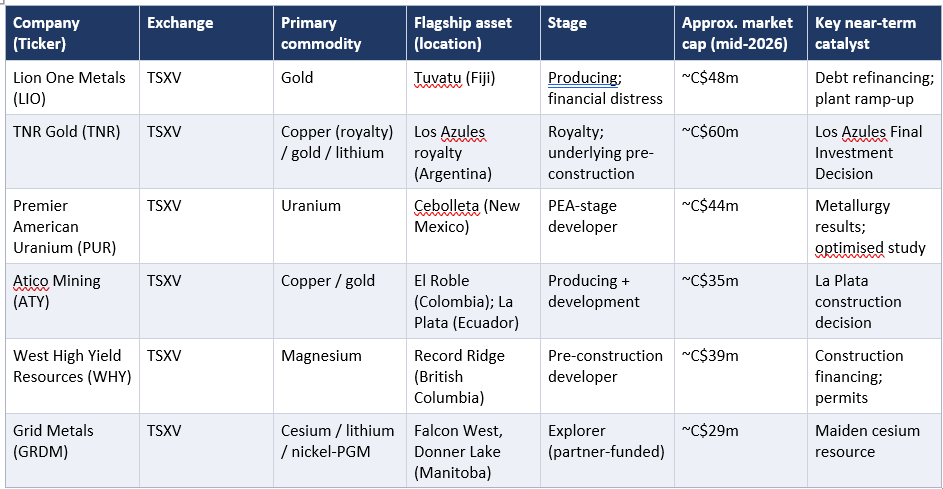
Key catalysts to watch
For this group, the coming months carry several potentially defining events. Lion One Metals (LIO) is a balance-sheet story first and foremost: any refinancing or repayment of its Nebari debt, together with evidence that the Tuvatu plant is reaching and holding higher throughput, would be pivotal. TNR Gold (TNR) is waiting on decisions at the asset level — a Final Investment Decision on Los Azules and the closing of that project's debt package would validate the royalty thesis, even though production remains years away.
Among the developers, Premier American Uranium (PUR) has metallurgical results and an optimised Cebolleta study on the horizon, while Atico Mining (ATY) faces a construction-and-financing decision on La Plata that would materially change its growth profile. West High Yield Resources (WHY) needs to convert its permits and its Galaxy offtake into a funded, building project, with first sales targeted around year-end. Grid Metals (GRDM) offers a cleaner exploration catalyst: a maiden cesium resource at Falcon West, which would also trigger elements of its Avenir agreement.
Major risks investors should consider
The risks in this group are varied but serious. The most acute sit with Lion One Metals, whose lender default, forbearance arrangement, negative working capital and rapid dilution place it firmly in turnaround-or-distress territory; the high gold price is helping, but the situation is defined by its financial risk. Atico Mining carries a lighter but still real version of the same theme, with a working-capital deficit and near-term debt obligations to manage even as production continues.
Financing and dilution risk runs through the whole list. West High Yield, Premier American Uranium and Grid Metals are all pre-revenue and must fund their next steps from the market or from partners; where partners carry the cost, as at Grid Metals, dilution is reduced but so is the company's ultimate ownership. Commodity-price sensitivity is equally pervasive: gold underpins Lion One and part of the value at TNR and Atico; uranium drives Premier American; copper drives Atico and TNR's royalty; and the specialty and critical metals behind West High Yield and Grid Metals trade in thin markets that can be volatile and hard to read.
Jurisdiction adds a further layer. Argentina, Colombia, Ecuador and Fiji each carry political, fiscal or currency considerations, only partly offset by mechanisms such as Argentina's RIGI regime or Ecuador's investment-protection agreement. British Columbia, Manitoba, New Mexico and Wyoming are lower-risk, but even there permitting timelines and community relations can delay progress. Finally, resource risk remains: several headline assets — Grid Metals' cesium in particular — do not yet have a defined resource, so the market is pricing potential rather than proven metal.
Conclusion
Lion One Metals (LIO), TNR Gold (TNR), Premier American Uranium (PUR), Atico Mining (ATY), West High Yield Resources (WHY) and Grid Metals (GRDM) are six very different companies pointed at three of the market's biggest resource themes. One is a producing gold miner fighting to stabilise its finances; another is a royalty holder betting on a giant copper project it will never have to build. Two are developers — one in uranium, one in copper-gold — approaching decisions that could transform them, and two are critical-mineral plays, in magnesium and cesium, trying to turn Western supply-chain anxiety into funded projects.
For investors interested in gold, uranium or critical minerals, this group offers a spread of entry points and risk profiles, from producing cash flow to pure exploration optionality. Each also comes with a clearly defined set of hazards — balance-sheet stress, financing needs, commodity-price swings and jurisdictional uncertainty — that deserve as much attention as the upside. This article sets out those facts and risks; it does not tell anyone what to do with them. The right course, as always, is to dig into the primary disclosures and reach an independent conclusion.


 Nov 27, 2026





 Please wait processing your request...