
 NZ
 UK
 US
 AU
 IND

 CA

 Share
 X (Formerly Twitter)
 Whatsapp
 Facebook
 LinkedIn
 Telegram
 Email This Article
 Copy Link
 Summarize with AI
 Chat GPT
 Perplexity


Key Takeaways
- Canada is emerging as a global critical-minerals powerhouse
Stable policy support, geopolitical alignment, and Western supply-chain reshoring are positioning Canada as the preferred supplier of copper, nickel, potash, uranium, and battery metals.
- TSX senior miners are outperforming due to scale, capital access, and ESG strength
Large-cap names like Agnico Eagle Mines, Barrick Gold, Nutrien, Cameco and Franco-Nevada continue to attract institutional and sovereign wealth flows, widening the gap with juniors.
- Gold is experiencing a powerful 2025 safe-haven revival
Agnico Eagle, Barrick and royalty plays like Franco-Nevada benefit from rising prices, healthy margins, and robust free cash flow as inflation and geopolitical risks stay elevated.
- Copper demand is accelerating from electrification, AI, and energy-grid investment
Ero Copper, First Quantum Minerals, and Ivanhoe Mines are structurally linked to multi-year demand for EVs, renewables, data-center power systems, and transmission infrastructure.
- Nuclear energy’s global comeback is boosting Canada’s uranium sector
Cameco is at the center of a long-term supply deficit as more countries restart, expand, or initiate nuclear programs for energy security and decarbonization.
- ESG, permitting, and Indigenous partnerships now determine project success
Access to capital, regulatory approvals, and project timelines increasingly depend on sustainability metrics and Indigenous co-development frameworks.
- Juniors face liquidity stress despite exploration potential
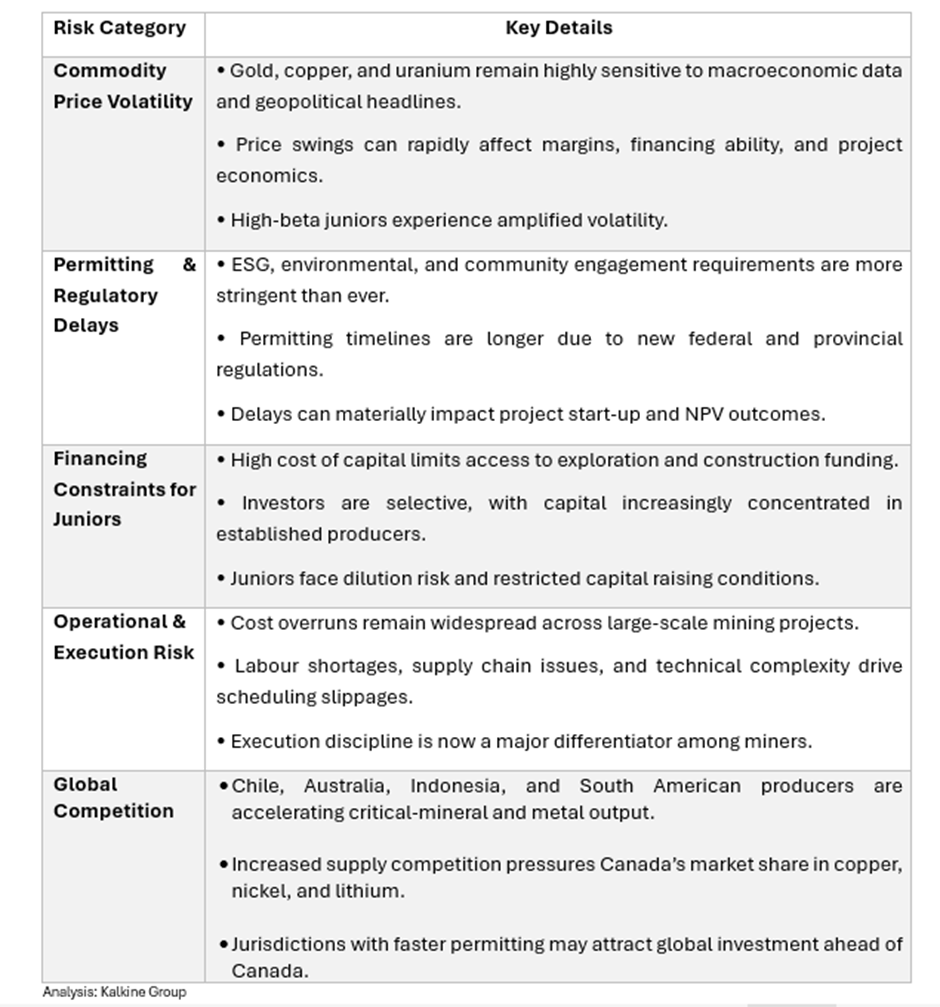
High financing costs, volatile commodity markets, and risk-sensitive investors create a challenging environment for small and mid-cap miners.
- Capital intensity and execution risk remain key pressure points
Rising development costs, operational complexity, and project delays can materially impact profitability even during strong commodity cycles.
- Canada holds a strategic geopolitical advantage
Stable governance, clean-energy-powered mines, and G7-aligned supply chains make Canada a preferred alternative to higher-risk jurisdictions.
- The 2025 Canadian mining upcycle is structural, not short-term
Long-term demand for critical minerals, gold, and uranium - combined with supportive policy and global supply-chain restructuring - suggests a sustained multi-year supercycle.
A Sector at the Center of a Global Realignment
Canada is entering a new mining supercycle. The rise of critical minerals, gold’s safe-haven resurgence, the nuclear power revival, and the need for secure, low-carbon supply chains have aligned to put Canadian miners in a leadership position. Backed by stable government support and increased global funding for clean-energy transition metals, TSX-listed miners are outperforming peers worldwide.

1.1 Critical Minerals Strategy: The Policy Engine Behind the Boom
The Federal Government has accelerated its critical-minerals strategy with:
- C$500M CMIF (Critical Minerals Infrastructure Fund) second call (2025)
- C$110M extension of the Mineral Exploration Tax Credit through 2027
- C$50M for Indigenous partnerships, geoscience, and innovation
These steps directly strengthen project execution, infrastructure readiness, and exploration capacity.
1.2 Canada’s Geopolitical Advantage: Reliability in a Fragmented World
As global alliances divide and supply chains move away from China and Russia, Canada’s mineral sector is emerging as a trusted alternative.
- The G7 Critical Minerals Production Alliance aims to reduce dependency on adversarial nations.
- Canada offers political stability, clean-energy powered mines, and robust ESG frameworks - major advantages versus competitors.
1.3 Canada’s Production Base: Deep, Diversified, Decarbonized
The Mining Sector Performance Report confirms:
- Over 60 minerals produced
- ~200 operating mines nationwide
- World leadership in potash, uranium, and several critical minerals
- Mines powered increasingly by hydropower and renewables, giving Canada a carbon-intensity advantage

2.1 Nutrien (TSX: NTR): Global Food Security Play
Strengths
- Largest potash producer globally
- Rising fertilizer demand amid geopolitical tensions
- Essential supplier for global agriculture cycles
Risks
- Highly cyclical fertilizer pricing
- Potential margin compression during global slowdowns
2.2 Agnico Eagle Mines (TSX: AEM): The Gold Sector’s Stability Backbone
Production Strength
- Q3 2025 output: 866,936 oz
- 2025 guidance: 3.3–3.5 million oz
- Strong cost control: AISC $1,250–$1,300/oz
Financial Resilience
- Record adjusted earnings
- Active debt repayment
- Consistent free cash flow acceleration
Risks
- Gold price volatility
- Cost pressures across global operations
2.3 Franco-Nevada (TSX: FNV): Low-Risk Royalty Growth Engine
Why It Matters
- Leverages gold exposure without mining risk
- Stable cash flows, diversified royalties
- High-margin model
Risks
- Dependent on performance of partner mines
- Limited control over operational risks
2.4 Barrick Gold (TSX: ABX): Dual Gold–Copper Catalyst
2025 Highlights
- Gold reserves up 23% (Reko Diq)
- Gold production target: 3.15–3.5M oz
- Copper guidance: 200,000–230,000 tonnes
Strategic Importance
- Copper is the backbone of clean energy, EVs, and data centers
- Barrick’s pivot to large copper assets enhances long-term growth
2.5 Cameco (TSX: CCO): The Nuclear Energy Revival Champion
2025 Adjusted Outlook
- Uranium production: 14–15M lbs (due to operational delays)
- Sales/delivery: 32–34M lbs
Macro Drivers
- Nuclear renaissance across the U.S., EU, India, and Asia
- World seeking stable, long-term uranium supply
Risks
- Long project timelines
- Geopolitical supply issues (Kazakhstan, etc.)
2.6 Ero Copper (TSX: ERO): Electrification-Focused Copper Growth
Positioning
- Strong exposure to copper demand from EVs, grids, semiconductors
- Expansion pathways ahead
Risks
- Capital-intensive expansion
- Commodity price correlation
2.7 Lundin Gold (TSX: LUG): High-Grade Gold with Expansion Levers
Key Strengths
- High-grade orebody
- Ability to scale production at competitive cost
- Strong leverage to gold prices
Risks
- Operational concentration
- Funding and market cyclicality
2.8 First Quantum Minerals (TSX: FM): A Crucial Copper & Nickel Supplier
Why It Matters
- One of Canada’s most globally diversified miners
- Copper and nickel central to EV batteries, green grids, and solar
Risks
- Geopolitical exposures
- Higher operating costs, large capex needs
2.9 Ivanhoe Mines (TSX: IVN): The High-Upward-Leverage Developer
Strategic Assets
- Large-scale copper and PGM deposits
- Potential to be among the biggest future producers
Risks
- Highest among the majors: financing, permitting, ESG execution
2.10 Silver & Junior Plays (PAAS, AYA, SIL, AGX, IPT)
Silver miners benefit from:
- Solar panel manufacturing
- Electronics and battery technology
- High-beta to gold risk-on cycles
Juniors bring exploration upside but also financing and liquidity risks.

3.1 Capital Concentration: The Big Getting Bigger
- Majors absorbing capital due to robust balance sheets and lower risk
- Juniors facing financing bottlenecks despite exploration potential
3.2 ESG & Indigenous Partnerships: Success Factor, Not Compliance Box
- ESG now tied to permits, funding, and market access
- Indigenous agreements required for de-risking long-life projects
- CMIF funding tied directly to ESG-aligned infrastructure
3.3 Clean Energy & Security of Supply
- Copper, uranium, lithium, nickel, graphite central to net-zero goals
- Canada’s resources + political stability = preferred Western partner
- G7 alliance adds strategic value to Canadian exports
3.4 Long-Term Execution Risk: Mines Take Years, Not Months
- Capex overruns common
- Delays can push projects over economic thresholds
- Companies with disciplined capital allocation will lead
3.5 Gold’s Resurgence in an Unstable Macro World
- Inflation persistence
- Rising geopolitical uncertainty
- Gold ETFs seeing net inflows globally
- Canadian producers benefiting from safe-haven demand

Conclusion: A Balanced, Future-Ready Approach to Canada’s 2025 Mining Supercycle
In this new phase of the global commodity supercycle, a balanced exposure framework is becoming essential. Senior producers provide the stability that institutions value, royalty companies offer lower-risk, cash-flow-focused optionality, and critical-mineral developers supply the long-term growth needed for the world’s electrification ambitions.
As ESG credibility increasingly determines permitting speed and access to capital, an ESG-first lens is now a practical necessity rather than a branding exercise. Investors and industry participants alike must also recognize that world-class critical-mineral projects require 5–10 years to move from exploration to production, making a multi-year horizon crucial for capturing the sector’s full potential.
Supported by powerful policy incentives and international demand for secure Western supply chains, Canada’s mining sector is entering a period where structural tailwinds outweigh cyclical noise. In this environment, diversifying across gold, copper, uranium, and silver offers a natural hedge against commodity volatility while positioning participants at the heart of one of the most important industrial transitions of the decade.


 Nov 20, 2026





 Please wait processing your request...