
 NZ
 UK
 US
 AU
 IND

 CA

 Share
 X (Formerly Twitter)
 Whatsapp
 Facebook
 LinkedIn
 Telegram
 Email This Article
 Copy Link
 Summarize with AI
 Chat GPT
 Perplexity

Key Takeaways
- Global tech volatility is shaping Canadian markets, especially the domestic tech space.
- Energy and utilities are demonstrating relative stability amid broader weakness.
- Financials remain steady, awaiting clearer rate signals.
- Real estate and discretionary retail are softer in today’s environment.
- Sector rotation is visible, with investors favouring stability over high-valuation growth names.
Global equity markets are seeing renewed pressure as a sharp technology-sector cooldown, combined with cooling expectations for early Federal Reserve rate cuts, weighs on sentiment. With U.S. mega-cap tech names easing and bond yields staying elevated, the market mood has turned more cautious.
Canada’s TSX is showing a mixed pattern, with defensive pockets displaying resilience while interest-sensitive and growth-oriented segments soften.

- Canada’s Markets Feel the Tech Pulse
Even though the TSX isn’t as tech-heavy as the Nasdaq, Canadian companies linked to AI, semiconductors, cloud services, and data centers often follow global tech trends. When giants like Nvidia, AMD, or Alphabet dip, investor sentiment softens, and Canadian tech-related stocks tend to move down the next day.
- Interest-Rate Watch: U.S. Signals Affect Canada
If U.S. inflation remains high, the Fed may hold off on rate cuts. The Bank of Canada then needs to pace its own decisions carefully to maintain stability. A slower adjustment can affect the Canadian dollar and import costs, influencing households and businesses alike.
- Bond & Yield Shifts Show the Immediate Impact
U.S. Treasury yields often rise when rate-cut expectations fade, and Canadian bond yields typically follow. Even moderate moves can influence:
- Housing affordability
- Borrowing costs for businesses
- Refinancing conditions
- Equity valuations
Canada’s housing market is particularly sensitive, making these shifts important for investors and homeowners.
- Household Sensitivity Highlights Vulnerability
Canadian households carry one of the highest debt-to-income ratios in the developed world. With peak mortgage renewal season around 2025–2026, any delay in interest-rate adjustments abroad can affect monthly payments and household budgets.
- Canada’s Economy Mirrors U.S. Demand
Exports in energy, autos, manufacturing, lumber, and metals are closely tied to U.S. economic activity. When U.S. markets soften, Canadian GDP, jobs, and exports can feel the impact, showing how interconnected the two economies are.
Canada tends to mirror global cycles, especially through technology, financials, energy, and materials, making the TSX a useful lens to assess the trend. Here’s a clear sector-wise breakdown of how Canada fits into the global move - including key TSX stocks to illustrate trends.
- Tech Tumbles: Growth Names Feel the Heat
High-valuation and growth-linked stocks remain sensitive to global rate expectations.
TSX tech performance today reflects the same pattern observed across U.S. and European markets.
Key TSX Names:
- Celestica Inc (TSX: CLS): Celestica faced pressure as the broader tech sell-off and fading rate-cut expectations weighed on high-growth hardware names, pulling the stock lower despite strong recent results.
- Shopify Inc (TSX: SHOP): Growth expectations and global tech sentiment influence movement.
- Constellation Software Inc (TSX: CSU): Recurring software revenues keep earnings steadier but valuation still reacts to global tech cycles.
- Lightspeed Commerce Inc (TSX: LSPD): Transaction-based revenue makes it reactive to risk sentiment.
- Docebo Inc (TSX: DCBO): Cloud-focused model ties it to broader SaaS market direction.

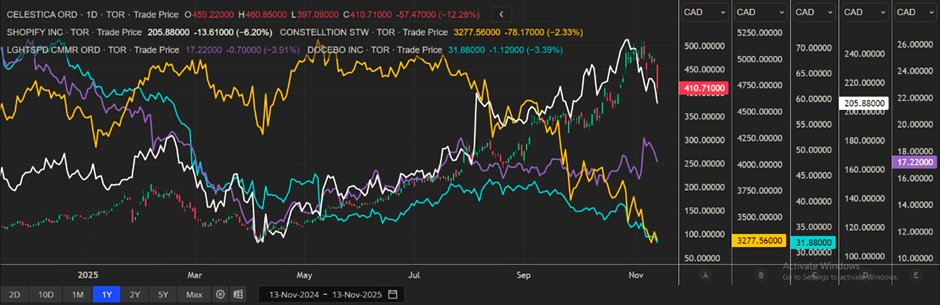
Source: EODHD/Others; Date: 13 November 2025
- Financials Hold Steady Amid Rate Uncertainty
Canadian banks are closely tied to yield curves and economic expectations.
With rate-cut hopes cooling, margin outlook becomes mixed, keeping the sector steady but not strongly directional.
Key TSX Names:
- Royal Bank of Canada (TSX: RY): Margin expectations adjust with shifting rate expectations.
- Toronto Dominion Bank (TSX: TD): Sensitive to both U.S. and Canadian interest-rate paths.
- Bank of Montreal (TSX: BMO): Broad North American exposure reflects macro conditions.

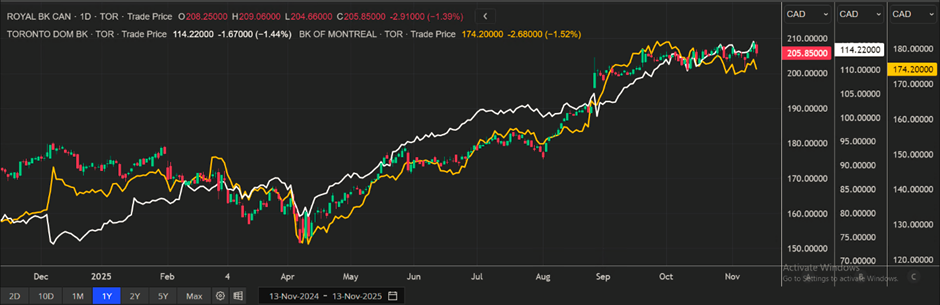
Source: EODHD/Others; Date: 13 November 2025
- Energy Stands Firm: Commodities Cushion the Blow
Energy stocks are showing relative steadiness despite broader market weakness.
Crude demand, export volumes, and refining spreads give the sector its own drivers.
Key TSX Names:
- Canadian Natural Resources (TSX: CNQ): Commodity exposure can soften global tech weakness.
- Enbridge (TSX: ENB): Pipeline operations provide steady cash-flow behaviour.
- Suncor Energy (TSX: SU): Integrated model aids stability across market cycles.
- Teck Resources (TSX: TECK.B): Materials demand linked to global industrial indicators.

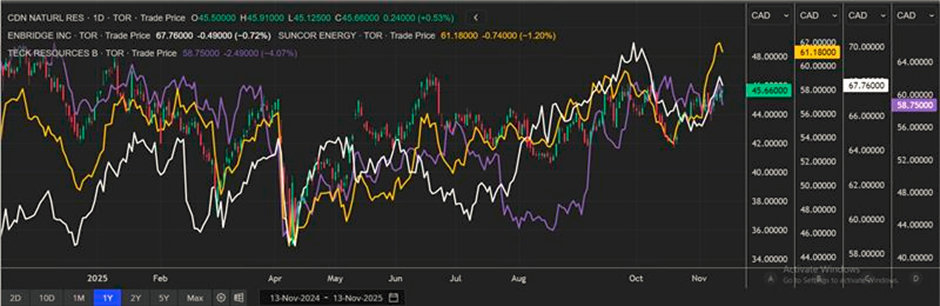
Source: EODHD/Others; Date: 13 November 2025
- Consumer Stocks: Staples vs. Discretionary Split
Canadian consumer stocks are showing two-track movement:
- Consumer Staples - More Stable
- Metro Inc. (TSX: MRU): Essential-goods demand remains steady and less cyclical.
- Consumer Discretionary - Softer
- Aritzia (TSX: ATZ): Discretionary spending may slow in cautionary macro periods.

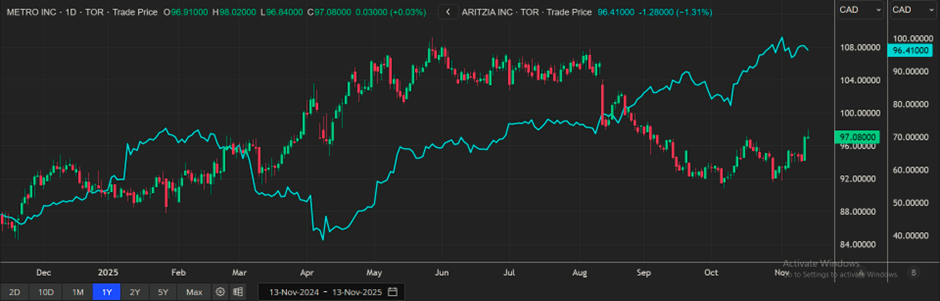
Source: EODHD/Others; Date: 13 November 2025
- Real Estate Under Pressure
Real estate remains sensitive to rate expectations. Higher yields and slower leasing conditions keep sentiment softer.
Key TSX Names:
- RioCan REIT (TSX: REI.UN): Retail-focused REITs face rate-linked funding and occupancy considerations.
- Allied Properties REIT (TSX: AP.UN): Office exposure continues to adjust to demand changes.

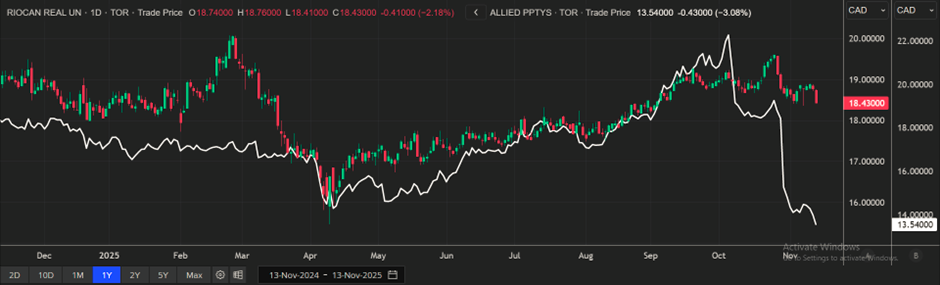
Source: EODHD/Others; Date: 13 November 2025
- Telecom - Mixed but Steady
Telecom names remain influenced by capital needs and dividend considerations.
Key TSX Name:
- BCE Inc (TSX: BCE): Yield-focused name reacts to rate-driven shifts in investor preference.

- Industrials & Manufacturing - Watching Global Demand
Industrial names remain tied to global manufacturing and mobility activity.
Key TSX Name:
- Magna International (TSX: MG): Movement linked to worldwide auto production and supply chain trends.

- Utilities - Showing Defensive Strength
Utilities tend to attract flows when markets rotate toward stability.
Key TSX Name:
- Fortis Inc (TSX: FTS): Regulated operations support predictable earnings during volatility.

Conclusion
Canada’s TSX mirrors global market volatility, with tech and high-growth stocks under pressure while energy, utilities, and consumer staples provide stability. Investors are clearly rotating toward steady, cash-flow-driven sectors as uncertainty around interest rates and global growth continues. For those tracking TSX stocks today, this mixed-market environment highlights key opportunities in defensive sectors while cautioning on speculative growth plays. Stay informed on Canada’s stock market trends to spot the top Canadian stocks to watch amid global tech pullbacks and sector rotations.
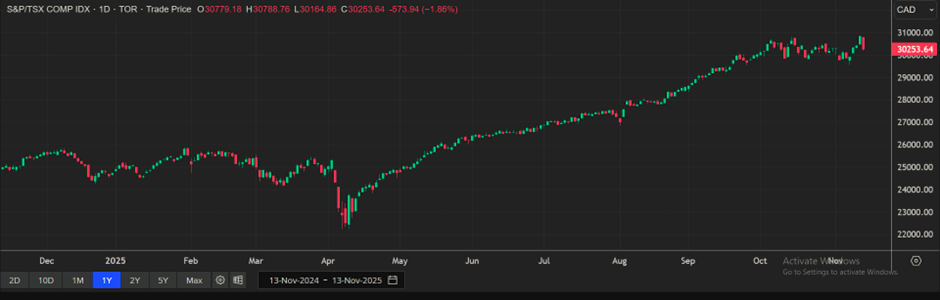
Source: EODHD/Others; Date: 13 November 2025


 Nov 20, 2026





 Please wait processing your request...