
 AU
AU
 UK
UK
 US
US
 NZ
NZ
 IND
IND

 CA
CA

 Share
Share
 X (Formerly Twitter)
 Whatsapp
 Facebook
 LinkedIn
 Telegram
 Email This Article
 Copy Link
 Summarize with AI
 Chat GPT
 Perplexity
Key Takeaways
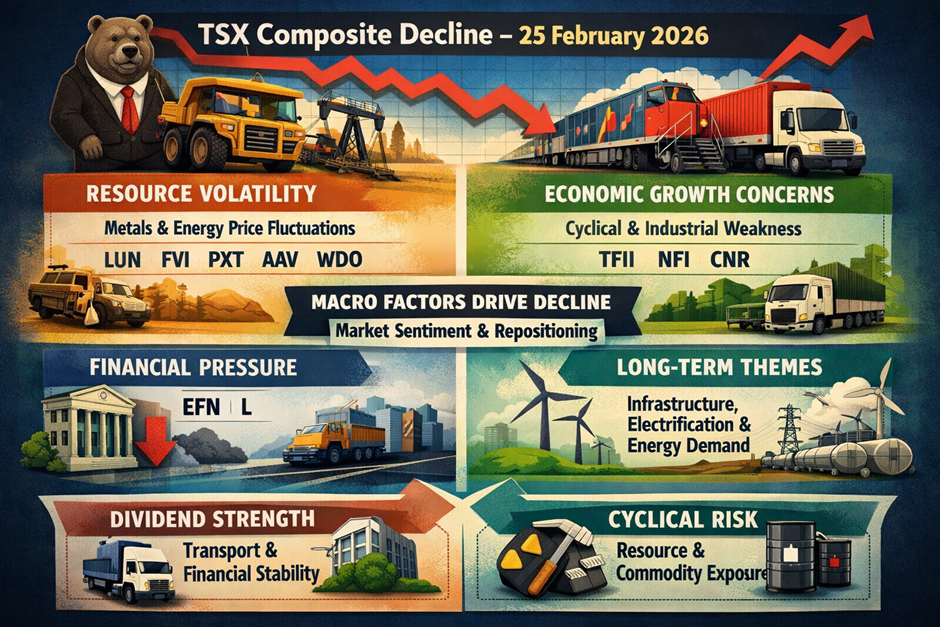
- The decline across multiple TSX Composite stocks on 25 February 2026 was primarily driven by macroeconomic sentiment, commodity price fluctuations, and sector-specific investor repositioning rather than structural deterioration in business fundamentals.
- Resource-linked companies (LUN, FVI, PXT, AAV, WDO) reacted to metals and energy price volatility, while cyclical transport and industrial names (TFII, NFI, CNR) reflected economic growth concerns.
- Financial and defensive exposures (EFN, L) saw valuation compression following strong prior performance and interest-rate sensitivity.
- Long-term structural themes such as infrastructure investment, electrification demand, logistics growth, and North American energy supply remain supportive for several companies.
- Dividend sustainability remains strongest among transport and financial names, while commodity companies remain more cyclical.
Source: Kalkine Group
Why Did These TSX Composite Stocks Decline on 25 February 2026?
The TSX Composite Index experienced notable volatility in late February 2026, with several prominent Canadian stocks trading lower due to a combination of global macroeconomic uncertainty, commodity price movements, interest-rate expectations, and investor sector rotation. Investors searching for TSX stock forecast 2026, Canadian stock market predictions, TSX dividend stocks to buy now, TSX Composite outlook March 2026, best TSX stocks for long term are reacting to a rapidly evolving economic environment shaped by inflation trends, central bank policy signals, and global growth expectations.
Canada’s equity market has a strong correlation with commodities and global trade cycles. As a result, fluctuations in oil prices, copper demand, freight activity, and currency movements directly influence investor sentiment toward TSX-listed companies. The declines observed on 25 February 2026 were largely attributed to:
- Commodity price consolidation following earlier rallies
- Interest-rate uncertainty affecting valuations
- Canadian dollar volatility impacting exporters
- Profit-taking after strong year-to-date gains
- Sector-specific earnings or guidance concerns
Importantly, the sell-off appeared more cyclical than structural, suggesting that long-term fundamentals for several companies remain intact.
How Did Global Markets, the Canadian Economy, and the Canadian Dollar Influence Sentiment?
The Canadian economy entering March 2026 shows moderate growth with persistent inflationary pressures, creating uncertainty around future monetary policy decisions. Canada’s economic sensitivity to natural resources means that global commodity trends strongly affect TSX performance.
Key macro influences included:
- Oil and natural gas price volatility impacting energy producers
- Copper and metals demand concerns linked to global manufacturing trends
- Freight demand normalization after pandemic-era supply disruptions
- Higher borrowing costs affecting capital-intensive industries
- CAD currency fluctuations impacting multinational earnings
These factors collectively created a risk-off environment across multiple TSX sectors.
What Company-Specific Factors Contributed to Each Stock’s Decline?
- Consumer spending uncertainty and margin pressure concerns due to inflation.
- Valuation adjustment following strong defensive sector performance.
EFN (Element Fleet Management)
- Interest-rate sensitivity affecting financing costs and credit outlook.
- Profit-taking after sustained stock appreciation.
- Oil price consolidation and capital allocation expectations.
- Production outlook considerations.
- Copper price volatility and global demand uncertainty.
- Commodity sector sentiment shifts.
- Precious metals price fluctuations and cost inflation concerns.
- Operational variability across mining assets.
- Freight cycle normalization and margin compression fears.
- Economic growth sensitivity in logistics demand.
- Gold price movements and production performance expectations.
- Supply chain recovery progress offset by profitability uncertainty.
- Execution risk on large order backlog.
- Natural gas price volatility and investor sentiment swings.
CNR (Canadian National Railway)
- Economic activity sensitivity impacting volume expectations.
- Sector rotation despite strong long-term fundamentals.
How Do Sector Trends Shape the Future Outlook?
Energy and mining sectors remain inherently cyclical but benefit from structural drivers such as electrification, infrastructure spending, and energy security concerns.
Transport and logistics sectors depend heavily on economic growth cycles but possess strong long-term demand drivers tied to global trade expansion.
Consumer and financial sectors remain sensitive to interest rates and household spending health.
Sector outlook summary:
- Short term: Elevated volatility and macro sensitivity
- Medium term: Stabilization as economic conditions normalize
- Long term: Structural growth supported by global demand trends
What Is the Dividend Outlook Across These Stocks?
Dividend visibility varies significantly:
- Relatively stable dividend profiles: CNR, EFN, TFII
- Commodity-dependent dividends: AAV, PXT
- Limited or variable dividend exposure: Mining and turnaround companies
Dividend growth potential remains strongest in companies with consistent cash flow generation and strong balance sheets.
What Strategies Could Investors Consider Across Time Horizons?
Short-term perspective (3–6 months)
- Monitor macroeconomic indicators and commodity prices closely
- Expect continued volatility across cyclical sectors
- Focus on risk management and diversification
Medium-term perspective
- Potential opportunities may emerge as valuations normalize
- Sector rotation could benefit quality cyclicals
- Earnings recovery could drive sentiment improvement
Long-term perspective
- Structural growth themes such as infrastructure, electrification, logistics, and energy demand remain supportive
- Companies with strong competitive advantages may outperform over time
- Dividend reinvestment could enhance compounding returns
Are These Stocks Bullish, Bearish, or Neutral Right Now?
Short-term sentiment assessment:
- Bearish to neutral: Commodity-linked names due to price volatility
- Neutral: Financial and consumer names
- Neutral to slightly bullish: High-quality transport companies
Long-term sentiment assessment:
- Bullish: CNR, TFII, EFN (structural advantages)
- Moderately bullish: LUN, AAV (commodity leverage)
- Higher uncertainty: NFI, FVI, WDO (execution and cycle risks)
What Do Analysts and Valuations Suggest About Future Potential?
Consensus views from major Canadian brokerages (including RBC Capital Markets, TD Securities, BMO Capital Markets, Scotiabank, and National Bank Financial) generally indicate:
- Strong long-term fundamentals for transport and logistics leaders
- Commodity price sensitivity driving mining and energy valuations
- Stable growth expectations for financial service providers
Analyst sentiment suggests macro factors rather than company-specific deterioration drove the February decline.
What Bull and Bear Scenarios Could Shape Future Performance?
Bullish scenario drivers:
- Commodity price recovery
- Interest-rate stabilization or easing
- Strong global economic growth
- Margin expansion and earnings surprises
- Infrastructure investment acceleration
Bearish scenario drivers:
- Global economic slowdown
- Persistent inflation and higher interest rates
- Commodity price weakness
- Demand contraction across sectors
- Operational or execution risks
What Are the Key Risks Investors Should Monitor?
- Commodity price volatility
- Interest-rate policy changes
- Currency fluctuations (CAD)
- Economic recession risks
- Regulatory and geopolitical uncertainties
Frequently Asked Questions
Why did TSX stocks fall in February 2026?
The decline was driven by macroeconomic uncertainty, commodity price movements, and sector-specific sentiment shifts.
Are TSX stocks still attractive for long-term investors?
Many TSX companies benefit from structural resource demand and infrastructure growth trends.
Which sectors look strongest long term in Canada?
Transport, energy, and critical minerals sectors have strong structural drivers.
Do these companies pay dividends?
Some provide stable dividends, while others have cyclical or variable payouts depending on commodity prices.
Final Investment Perspective (Informational Only)
The February 25, 2026 weakness across these TSX Composite stocks appears primarily linked to macro sentiment and cyclical market dynamics rather than fundamental deterioration. Historically, Canadian equities have demonstrated resilience during commodity cycles, and periods of volatility often create opportunities for investors focused on long-term structural trends.
Companies with strong competitive positioning, disciplined capital allocation, and resilient cash flows may continue to perform over extended time horizons, while acknowledging that short-term risks remain elevated.


 Jun 24, 2026




 Please wait processing your request...