
 NZ
 UK
 US
 AU
 IND

 CA

 Share
 X (Formerly Twitter)
 Whatsapp
 Facebook
 LinkedIn
 Telegram
 Email This Article
 Copy Link
 Summarize with AI
 Chat GPT
 Perplexity

Key takeaways
- MTY Food Group delivered softer second-quarter numbers and is closing 68 underperforming corporate outlets, yet its franchise-heavy model still threw off C$32.2m of free cash flow in the quarter, underpinning a dividend that yields north of 4%.
- Cineplex posted its strongest quarterly box office since 2019 in the June quarter, a sign that theatrical attendance is normalising even though the company remains loss-making at the net line and carries a heavy lease-adjusted debt load.
- Stingray Group grew fiscal-2026 revenue almost 22% as its TuneIn acquisition beat early synergy targets, but a non-cash radio goodwill write-down pushed the group to a reported net loss, illustrating why headline earnings can mislead.
- Two constituents were reshaped by disposals: Transcontinental sold its packaging arm and returned C$20 a share to holders, while Global Education Communities exited college ownership to become a pure-play student-housing operator.
- Loss-making does not mean value-destroying: at Cogeco, Cineplex, Stingray and Blue Ant Media, statutory losses stem largely from non-cash impairments, so cash flow and leverage matter more than a meaningless price-to-earnings ratio.
Introduction: why Canadian consumer services matter this August
Consumer services is one of the more revealing corners of the Canadian market because it sits directly downstream of household budgets. When Canadians feel squeezed, they trade down from restaurants, delay a trip to the cinema, or cut discretionary subscriptions; when confidence returns, those same categories recover quickly. That makes the sector a useful barometer, and August 2026 is an instructive moment to take its temperature. The Bank of Canada has spent the past year navigating a delicate path between cooling inflation and a labour market that has lost some momentum, and the tariff frictions that dominated 2025 trade headlines have left their mark on business investment. Against that backdrop, the companies in this screen have had to prove they can defend margins without a tailwind from the consumer.
The ten names below are deliberately diverse. They range from a C$4bn collision-repair consolidator to a micro-cap student-housing developer worth less than C$20m, and from a franchisor of more than 90 restaurant brands to a lottery-ticket printer that is quietly building an online-gaming business. What unites them is that each derives the bulk of its revenue from serving consumers, whether directly or through the businesses that do. Several are in the middle of genuine transformations, having sold divisions, completed sizeable acquisitions or floated on the exchange within the past year. That churn is precisely what makes the group worth watching now, because transitions create both opportunity and the potential for disappointment.
Screening methodology
The starting point was a stock-screener snapshot dated 6 August 2026 covering Canadian consumer-services listings, from which the ten companies here were drawn. We then treated every screener figure as a starting hypothesis rather than fact. For each company we searched primary sources first: regulatory filings on SEDAR+, investor-relations pages, quarterly and annual reports, management discussion and analysis, and earnings releases and call transcripts. Where those were unavailable we turned to established financial media and reputable market-data services. Prices, market capitalisations, dividend yields and valuation multiples cited as of 6 August 2026 come from the screener snapshot and, unless independently confirmed, are labelled accordingly; verification of intraday prices was limited by the nature of the exercise. Reported operating results — revenue, earnings, cash flow, debt, dividends and corporate actions — were checked against company disclosures and are attributed to the relevant filing date. Where a figure could not be verified, we say so rather than guess. No price target, transaction or quotation in this article has been invented. Analyst-consensus labels reflect the screener's summary rating and should be read as a crowd-sourced signal, not a recommendation from this desk.
The Canadian market and consumer-services backdrop
Canadian equities entered the second half of 2026 in reasonable health, with the S&P/TSX Composite supported by resource strength even as rate-sensitive and consumer-facing sectors traded more cautiously. The consumer-services cohort specifically has been shaped by three forces. First, disinflation has eased input-cost pressure for restaurant operators and packaged-goods printers, but wage growth and elevated occupancy costs continue to squeeze margins at the store level. Second, the shift of advertising and entertainment spending toward digital and streaming formats keeps reshaping the media names, rewarding those with scalable technology platforms and punishing legacy broadcast assets, several of which have been written down this year. Third, capital allocation has become a defining theme: boards have been busy selling non-core divisions, buying back shares and, in a couple of cases, returning large lumps of capital to holders.
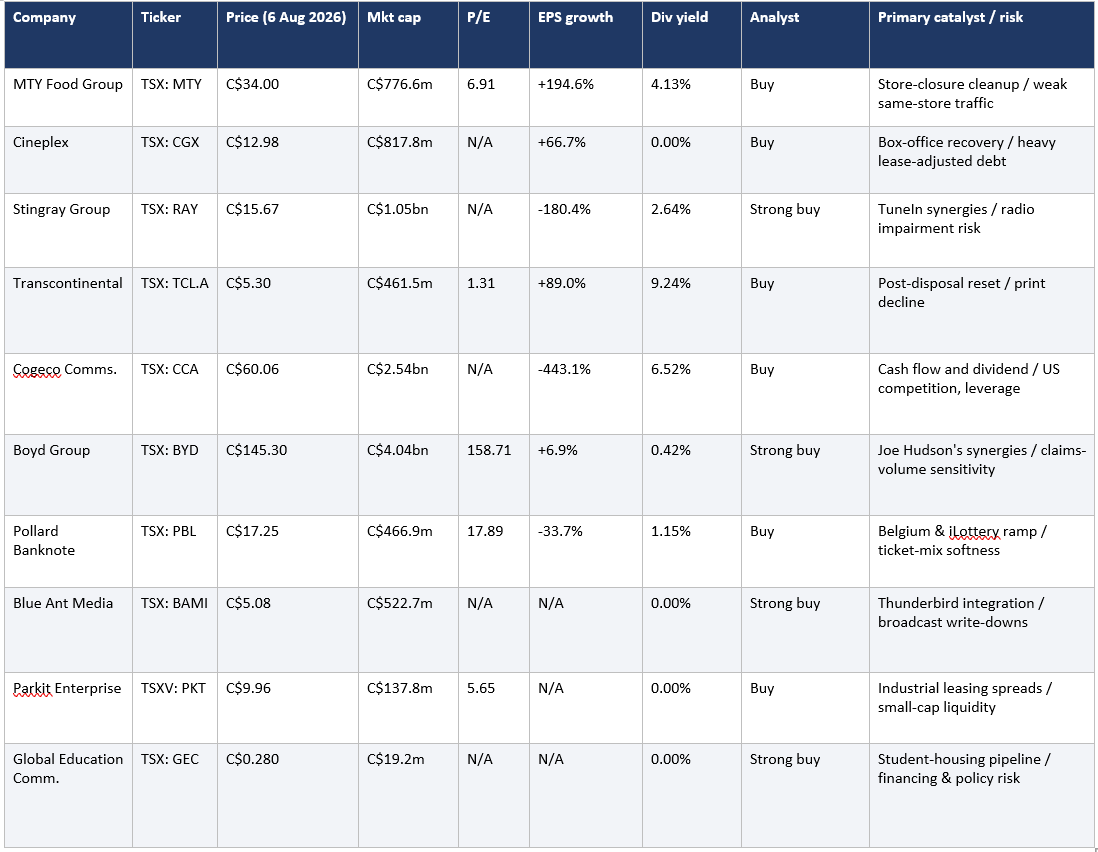
That last point deserves emphasis because it distorts several of the screener metrics. A one-off gain on a business disposal can inflate trailing earnings per share and collapse a price-to-earnings ratio to a level that looks absurdly cheap, as it has at Transcontinental. Conversely, a non-cash impairment can turn a cash-generative business into a reported loss-maker overnight, as it has at Cogeco, Stingray and Blue Ant Media. For that reason, this screen leans on cash flow, leverage and the direction of underlying operating earnings rather than headline net income. Read the company sections below with that lens, and the comparison table's use of ‘N/A' for loss-makers becomes self-explanatory: a price-to-earnings multiple built on negative or artificially boosted earnings conveys no useful information.
MTY Food Group Inc. (TSX:MTY)
MTY is one of North America's largest franchisors, operating and licensing more than 90 restaurant banners — among them Cold Stone Creamery, Papa Murphy's, Wetzel's Pretzels and a long tail of Canadian quick-service brands — across roughly 7,040 locations at the last count. Because the great majority of those outlets are franchised, MTY collects royalties and fees rather than carrying full restaurant-level cost risk, which is why the model converts a high share of revenue into cash.
The second quarter of fiscal 2026, covering the 13 weeks to 31 May 2026, was nonetheless a soft one. Revenue fell 8.2% to C$279.9m and system-wide sales slipped 3.5% to about C$1.4bn, with same-store sales down 2.1% as traffic weakened across Canada, the United States and international markets. Net income dropped to C$15.4m, or C$0.67 a diluted share, from C$57.3m a year earlier, and adjusted EBITDA eased 14% to C$60.2m. The counterpoint was cash: operating cash flow rose 25% to C$43.0m and free cash flow reached C$32.2m, comfortably covering the dividend. Management announced plans to shut 68 underperforming corporate locations within nine months, booking a C$7.5m impairment in the quarter and guiding to C$10m–C$12m of total closure costs.
On the balance sheet, MTY held C$63.0m of cash against long-term debt of C$594.1m and repaid C$15.7m during the quarter, continuing a steady deleveraging that has been management's priority since the pandemic-era acquisition spree. The board declared a quarterly dividend of C$0.37 a share, payable 14 August 2026, which against the screener price of C$34.00 equates to a yield of a little over 4%. The screener's price-to-earnings ratio of 6.91 and trailing EPS of C$4.92 flatter the picture: they capture a stronger prior-year period, so the very large ‘EPS growth' figure in the snapshot reflects the trailing window rather than current momentum, which is clearly negative. Catalysts to watch include the pace and cost discipline of the store-closure programme, any resumption of tuck-in acquisitions now that leverage is lower, and stabilisation of same-store traffic. The principal risks are a further softening in discretionary dining, integration fatigue across a sprawling brand portfolio, and franchisee financial health in a higher-cost environment. MTY earns its place on the August watchlist because it is a proven cash compounder trading at a modest multiple while it works through a self-inflicted but manageable soft patch.
Cineplex Inc. (TSX:CGX)
Cineplex is Canada's dominant cinema operator, complemented by its location-based entertainment arm (The Rec Room and Playdium), its media and advertising business, and the Scene+ loyalty programme. The investment case has for years hinged on a single question: would theatrical attendance recover to a level that covers the group's substantial fixed and lease costs? The most recent data offer the most encouraging answer in some time.
In the first quarter of 2026, to 31 March, Cineplex reported revenue of C$291.0m, its highest first quarter since 2019, as attendance jumped 17.3% to 9.842 million patrons. Box-office revenue rose 25% and box office per patron reached a first-quarter record of C$12.94, while concession spend per patron also set a record. The net loss narrowed to C$22.4m from C$35.1m a year earlier, and adjusted EBITDAaL swung to a positive C$4.1m from a loss. Momentum then built through the spring: the company disclosed on 10 July 2026 that second-quarter box office reached C$176.2m, up 11% year on year and the strongest since 2019, with June box office running at 108% of the prior year. Full second-quarter financial statements were still to be released around the screener date, so the Q1 figures remain the latest fully verified results.
Cineplex carries meaningful debt — a legacy of the pandemic — though it has extended maturities out to 2028 and 2029 and resumed modest share repurchases, buying back 463,506 shares for C$5.0m in the first quarter. It pays no dividend, consistent with the screener's 0% yield, and the ‘N/A' price-to-earnings ratio reflects the continuing net loss rather than any data gap. The bull case rests on a strong film slate, the high-margin recovery in premium formats and concessions, and continued growth at Scene+ and the entertainment venues. The risks are equally clear: box-office performance is inherently lumpy and slate-dependent, streaming remains a structural competitor for viewer time, and the debt load leaves limited room for a downturn. Cineplex makes the list because operating leverage is finally working in its favour, and a sustained attendance recovery would flow disproportionately to the bottom line.
Stingray Group, Inc. (TSX:RAY)
Stingray is a Montreal-based music, media and technology company whose reach extends from in-store and television music services to a fast-growing digital-advertising and streaming-audio business. Its fiscal 2026, ended 31 March 2026, was defined by the integration of TuneIn, the internet-radio platform it acquired to scale its consumer audio and advertising footprint.
For the full year, revenue rose 21.9% to C$471.6m and adjusted EBITDA grew 12.6% to C$160.2m, while adjusted free cash flow improved 22.1% to C$102.1m — a healthy conversion rate that anchors the dividend. The reported figures were messier: the group posted a net loss of C$28.6m, or C$0.42 a share, against net income of C$36.4m the prior year, and the fourth quarter alone carried a net loss of C$64.6m after a C$64.7m goodwill impairment tied to its legacy radio assets. Strip out that non-cash charge and adjusted net income was C$90.3m, or C$1.33 a share. Management said TuneIn had already surpassed C$42m of revenue synergies and C$12m of cost savings within six months, and that its FAST (free ad-supported streaming television) channel revenue grew more than 60%.
Net debt stood at about 2.38 times pro-forma adjusted EBITDA, a level the company can service comfortably given its cash generation, and it declared a quarterly dividend of C$0.085 a share while repurchasing C$12.9m of stock during the year. The screener shows a 2.64% yield and, correctly, no meaningful price-to-earnings ratio given the statutory loss. Note that Stingray trades through several share classes (RAY, RAY.A and RAY.B), so quoted prices and yields vary slightly by line. Catalysts include further TuneIn monetisation, continued FAST-channel and programmatic-advertising growth, and deleveraging. Risks centre on the secular decline of traditional radio, the possibility of further impairments, and execution across a broadening digital portfolio. Stingray features prominently because the cash-generative core is expanding briskly even as accounting charges obscure the picture — exactly the kind of disconnect that rewards a closer look.
Transcontinental Inc. Class A (TSX:TCL.A)
Transcontinental has been transformed over the past year. Long known as a hybrid packaging-and-printing group, it completed the sale of its packaging business on 6 March 2026 and returned capital to shareholders through a special distribution of C$20.00 a share paid on 20 March. What remains is a leaner company built around its retail-services and printing operations — including in-store marketing and flyer distribution — and a books-and-education publishing arm.
The second quarter of fiscal 2026, to 26 April 2026, captured this pivot. Revenue from continuing operations fell 5.0% to C$269.2m and adjusted operating earnings before depreciation and amortisation slipped 1.7% to C$45.4m, reflecting the structural decline in traditional print volumes partly offset by in-store marketing. Net earnings from continuing operations were C$4.3m, or C$0.05 a share, while adjusted net earnings were C$16.0m, or C$0.19. The eye-catching numbers, however, came from discontinued operations: the packaging disposal generated net earnings of C$221.9m in the quarter, which is what lies behind the screener's trailing EPS of C$4.04 and its startlingly low price-to-earnings ratio of 1.31. Both figures are artefacts of a one-off gain and should not be read as a durable earnings base — an important caveat, because on continuing operations the multiple is far higher.
The disposal materially strengthened the balance sheet: net indebtedness fell to C$436.1m from C$740.4m, cutting the leverage ratio to 2.14 times from 3.49. The board declared a quarterly dividend of C$0.05 a share; the screener's headline 9.24% yield reflects the trailing twelve months, which included the pre-restructuring payout, so the forward yield on the reset dividend is considerably lower and verification here was limited. Catalysts include redeployment of the disposal proceeds, growth in in-store retail marketing, and any further portfolio simplification. Risks are the secular erosion of print, customer concentration in retail services, and uncertainty over capital-allocation priorities now that the cash has landed. Transcontinental belongs on the watchlist as a post-transformation special situation: cleaner, less indebted, but with an earnings base that the market is still learning to value.
Cogeco Communications Inc. (TSX:CCA)
Cogeco is a cable and telecommunications operator serving broadband, video and mobile customers in Canada and, through its larger American footprint, in parts of the United States. It is included here as a consumer-services constituent because its revenue is overwhelmingly household subscriptions, and because its recent quarter is a case study in why reported losses require context.
In the third quarter of fiscal 2026, to 31 May 2026, revenue eased 4.7% to C$696.7m and adjusted EBITDA declined 3.0% to C$351.5m, with the American segment down 10.1% amid intensifying competition and the Canadian segment broadly stable. The headline was a net loss of C$1.36bn attributable to owners, driven by a pre-tax impairment of roughly C$2.2bn against the U.S. assets — a non-cash write-down, not a cash outflow. Crucially, free cash flow actually rose 17.6% to C$169.2m, and the board raised the quarterly dividend 7% to C$0.987 a share, signalling confidence in the underlying cash engine even as it acknowledged competitive pressure. The screener's negative EPS of C$26.49 and ‘N/A' multiple are entirely a function of that impairment.
Net indebtedness of about C$4.44bn is the central risk: this is a capital-intensive business, and the U.S. market has proved tougher than management hoped, which is why the impairment was booked. Encouragingly, Cogeco reported a fourth consecutive quarter of positive Ohio internet-subscriber growth and reconfirmed its fiscal-2026 guidance, and it is pursuing a transformation plan aimed at wireless growth and cost efficiency. The screener yield of 6.52% is well supported by free cash flow on current evidence, though a high payout against a leveraged balance sheet always warrants scrutiny. Catalysts include traction in mobile, stabilisation of U.S. broadband, and debt reduction; the risks are further competitive share loss, additional write-downs and refinancing costs. Cogeco earns attention as a deep-value, high-yield telecom where the market is pricing in considerable pessimism.
Boyd Group Services Inc. (TSX:BYD)
Boyd is one of North America's largest non-franchised operators of collision-repair centres, trading in the U.S. under the Gerber Collision & Glass banner and in Canada as Boyd Autobody & Glass, alongside its Assured Automotive network. Growth has come from a disciplined blend of same-store gains and acquisitions, and the first quarter of 2026 showcased both.
For the quarter to 31 March 2026, sales rose 28.1% to a record C$996.7m and adjusted EBITDA jumped 51.9% to C$122.4m, lifting the margin two percentage points to 12.3%. Same-store sales grew 1.7%, or about 2.6% adjusting for adverse U.S. weather, marking a third consecutive quarter of positive comparisons after a difficult 2025. The company reported a net loss of C$7.9m — a reminder that heavy depreciation and acquisition-related costs can mask operating strength — while adjusted net earnings surged 144% to C$16.1m. The transformational event was the integration of the Joe Hudson's Collision Center chain, which added 258 locations and took Boyd's total to 1,312, a 33% increase year on year; management said the system conversion finished on schedule and had already delivered more than C$20m of synergies.
Pro-forma debt leverage improved to 2.9 times from 3.1, and the company continued its long-standing modest dividend of C$0.156 a share for the quarter, consistent with the screener's slim 0.42% yield — Boyd is a growth-and-reinvestment story, not an income one. The screener's price-to-earnings ratio of 158.71 looks extreme precisely because statutory earnings are depressed by non-cash and integration items; on a cash or adjusted basis the business is far more reasonably valued. Second-quarter results were scheduled for 12 August 2026, just after the screener date, so the Q1 numbers are the latest verified set. Catalysts include Joe Hudson's synergy capture, continued market-share gains from insurers consolidating repair volume, and a return to stronger organic growth. Risks are claims-volume sensitivity to insurance and driving trends, labour availability, and acquisition-integration execution. Boyd's ‘strong buy' screener tag reflects its record of compounding, and it stays on the list as a scale consolidator hitting its stride.
Pollard Banknote Limited (TSX:PBL)
Pollard Banknote is a leading printer of instant-lottery tickets for government and charitable lottery operators worldwide, increasingly complemented by digital gaming through its iLottery joint venture and by a fast-growing charitable-gaming division. It is a classic ‘picks-and-shovels' supplier to the regulated lottery industry, which lends the business a defensive, contract-driven quality.
The first quarter of 2026, to 31 March, was subdued. Revenue slipped 3.1% to C$141.7m and net income fell to C$3.5m, or C$0.13 a share, from C$11.7m and C$0.43 a year earlier, while adjusted EBITDA dropped 29.7% to C$21.5m. Management attributed the weakness in instant tickets to a less favourable customer and product mix, with fewer higher-value ticket options sold. Combined sales including the company's 50% share of its iLottery venture came to C$175.4m, down a milder 1.4%. There were bright spots: the charitable-gaming business, particularly electronic pull-tab (eTab) revenue in Minnesota, set records, and the large Belgium national-lottery omnichannel contract was progressing through its planning phase, with more meaningful revenue expected as it ramps.
Pollard pays a small dividend — the screener shows a 1.15% yield — and the board authorised a normal-course issuer bid to repurchase roughly 976,000 shares, signalling that management views the stock as attractive after a weak run. Second-quarter results were pending around the screener date. The screener's price-to-earnings ratio of 17.89 sits on trailing earnings that have been depressed by the mix headwind, and the negative ‘EPS growth' captures that decline. Catalysts include the Belgium contract ramp, continued iLottery expansion into newly regulated U.S. states, and normalisation of instant-ticket mix. Risks are lumpy contract timing, competition from larger lottery-systems vendors, and input-cost pressure. Pollard makes the watchlist as a defensive niche leader passing through a cyclical soft patch with a clear line of sight to new revenue streams.
Blue Ant Media Corporation (TSX:BAMI)
Blue Ant Media is a global content producer, distributor and channels business whose portfolio spans factual and streaming brands such as Love Nature, Cottage Life and Smithsonian Channel Canada. Its presence on this list comes with an important verification note: the company reached the public market through a reverse takeover of Boat Rocker Media, completing on 1 August 2025, after which the shares migrated from the ticker BRMI to BAMI and underwent a ten-for-one consolidation. Its correct listing is therefore Toronto Stock Exchange under the symbol BAMI, which resolves the screener's flagged ticker.
The third quarter of fiscal 2026, to 31 May 2026, showed the scale of the group's acquisition-led expansion. Revenue more than doubled to C$125.6m from C$56.0m, driven substantially by the acquisition of Thunderbird Entertainment Group, which contributed its first full quarter within the production and distribution segment. Adjusted EBITDA rose to C$16.8m from C$14.6m. The group nonetheless reported a widened net loss of C$17.5m, chiefly because of a C$33.1m non-cash impairment of broadcast licences in its Canadian Media segment, reflecting the same advertising and subscriber pressures weighing on legacy television across the industry. By segment, production and distribution generated C$82.7m of revenue, global channels and streaming C$23.7m, and Canadian Media C$19.3m.
The balance sheet looked serviceable, with C$59.9m of cash, bank indebtedness of just C$9.4m and an undrawn credit facility of C$73.6m — useful firepower for a company pursuing a buy-and-build strategy. Blue Ant pays no dividend, matching the screener's 0% yield, and both its ‘N/A' price-to-earnings ratio and absent EPS reflect the statutory loss and its short trading history since the reverse takeover. Catalysts include the integration and cross-selling of Thunderbird's production capacity, growth in global streaming and FAST distribution, and any further consolidation of independent content libraries. Risks are considerable: broadcast-licence values remain under pressure, the acquisitive model carries integration and leverage risk over time, and the recent listing means a limited public track record. Blue Ant is the most speculative name here, included because it represents a rare scaled, listed pure-play on Canadian independent content at a moment of industry consolidation.
Parkit Enterprise Inc. (TSXV:PKT)
Parkit has quietly reinvented itself. Once focused on parking assets, it now describes itself as an industrial real-estate platform acquiring and managing strategically located industrial properties across Canadian urban markets, while retaining U.S. parking interests. It is the only TSX Venture Exchange constituent on the list and, at a market value near C$138m, among the smaller names.
In the first quarter of 2026, investment-property revenue fell 17% to C$5.9m and net rental income eased 15% to C$4.1m, reflecting portfolio changes, and the company posted a small net loss of C$1.4m, marginally better than a year earlier. The more relevant real-estate metrics were positive: funds from operations rose 38% to C$2.3m and same-property net operating income grew 5% to C$3.4m, helped by leasing spreads — new and renewed leases were signed at rents roughly 21% above prior levels. Parkit ended the quarter with more than C$8.1m of cash, and around 92% of its debt was fixed-rate, insulating it from rate volatility.
A word of caution on the screener figures: the reported EPS of C$1.76 and price-to-earnings ratio of 5.65 almost certainly reflect non-cash fair-value gains on investment properties under IFRS accounting rather than recurring operating profit, so the multiple should not be taken at face value — FFO and NOI are the better guides for a property company. Parkit pays no dividend at present. Catalysts include disciplined industrial acquisitions funded by its cash and credit lines, continued positive leasing spreads in tight industrial markets, and any crystallisation of value from the legacy parking assets. Risks are its small scale and thin liquidity, sensitivity to industrial-property demand, and execution on the acquisition pipeline. Parkit earns a spot as a nimble, well-capitalised micro-cap play on Canadian industrial real estate, with the screener's ‘buy' tag reflecting its improving cash metrics.
Global Education Communities Corp. (TSX:GEC)
Global Education Communities, the smallest company on the list at roughly C$19m of market value, has undergone the most fundamental reinvention. After selling its education assets — including Sprott Shaw College for about C$35m and the SSLC and VIC colleges — it has repositioned as a pure-play student-housing developer and operator under its GEC Living brand, concentrated in the Vancouver area.
For the nine months to 31 May 2026 (its fiscal third quarter), total revenue rose 9% to C$16.6m, with student-housing rental revenue up 11% to C$13.9m, and the company swung to net income attributable to shareholders of C$0.672m from a prior-year loss. EBITDA from continuing operations jumped 59% to C$7.0m, evidence that the shift toward recurring rental income is improving the earnings profile. Total assets stood at about C$378m, against non-current financial liabilities of roughly C$153m — a reminder that this is a development-heavy, capital-intensive model. The company operates eight properties with around 1,300 beds and has a pipeline of roughly 2,500 additional beds across four development projects.
The screener lists no price-to-earnings ratio or EPS, consistent with a company only recently turning profitable and reporting through a transition, and it pays no dividend. Its ‘strong buy' screener tag should be read with care given the stock's micro-cap size and limited liquidity. Catalysts include delivery of the development pipeline, rising occupancy and rents amid chronic student-housing shortages in Canadian cities, and any monetisation of completed assets. Risks are substantial: development and financing execution, exposure to shifting international-student policy and immigration settings, and the thin trading that characterises a sub-C$20m company. Global Education Communities is the highest-risk, highest-optionality name on the list — a small operator with a clear niche in a structurally undersupplied market, provided it can fund its ambitions.
At a glance: the ten stocks compared
The table below summarises the screener snapshot as of 6 August 2026. Where a price-to-earnings ratio reads ‘N/A', the company reported a statutory loss, most often because of a non-cash impairment, so the multiple is not meaningful; in those cases cash flow, adjusted earnings and leverage are the more informative measures, as discussed in each company section. The ‘EPS growth' column likewise reflects trailing-window comparisons that, at MTY and Transcontinental in particular, are distorted by prior-period gains or disposals.
Rankings by category
No single ranking suits every investor, so the groupings below sort the ten names by the attribute that matters most to different objectives, drawing on the verified results rather than the screener labels alone.
Strongest cash generation relative to size: MTY Food Group leads, converting a soft quarter into C$32.2m of free cash flow, followed by Stingray, whose C$102.1m of annual adjusted free cash flow comfortably funds its dividend and deleveraging, and Cogeco, whose C$169.2m quarterly free cash flow underpins a raised payout despite the headline loss.
Best top-line momentum: Blue Ant Media tops the group with revenue up more than 120% on acquisitions, ahead of Boyd, up 28% on the Joe Hudson's deal and same-store gains, and Stingray, up almost 22% on TuneIn. This ranking rewards scale-building, but note that all three carry integration or impairment overhangs.
Highest income today: Transcontinental's screener yield of 9.24% is the headline number, but it is a trailing figure inflated by the pre-reset dividend and should be treated cautiously; on a forward basis Cogeco's 6.52% is the more dependable high yield, with MTY's 4%-plus a well-covered middle option.
Balance-sheet resilience: Transcontinental stands out after cutting net debt to C$436m and leverage to 2.14 times, alongside Blue Ant Media, which holds more cash than debt, and Parkit, with 92% fixed-rate borrowings. At the other end, Cogeco's C$4.44bn of net debt is the group's clearest balance-sheet risk.
Highest risk, highest optionality: Global Education Communities and Blue Ant Media sit here — a micro-cap developer and a newly listed serial acquirer, both offering outsized upside if execution lands but with correspondingly little margin for error.
What to monitor for the rest of August 2026
The remainder of the month brings several hard catalysts. Boyd Group's second-quarter results, scheduled for 12 August 2026, will show whether same-store sales momentum held and how quickly Joe Hudson's synergies are compounding — the single most important data point for the list's largest constituent. MTY's dividend is payable on 14 August, and investors will look for early evidence that the 68-store closure programme is stemming the same-store bleed rather than merely trimming the tail. Cineplex's full second-quarter statements, expected around the same window after July's box-office disclosure, should confirm whether the record C$176.2m box office translated into positive lease-adjusted earnings and further debt reduction.
Beyond company-specific events, three macro threads bear watching. First, any signal from the Bank of Canada on the path of interest rates will move the leveraged and rate-sensitive names — Cogeco, Cineplex and the two property-linked stocks most of all. Second, the trajectory of consumer confidence and discretionary spending will show up first in MTY's franchisee traffic and Cineplex's attendance. Third, the pace of media-sector consolidation and any further broadcast-licence write-downs could reshape sentiment toward Stingray and Blue Ant Media. Pollard's pending second-quarter results and the ramp of its Belgium contract round out a busy few weeks. For the two micro-caps, Parkit and Global Education Communities, the key is less any single release than continued evidence that their reinvented models are gaining traction with tenants and lenders.
Conclusion
Taken together, these ten companies illustrate a Canadian consumer-services sector in transition rather than distress. The common thread is that reported earnings frequently obscure the underlying trend: impairments have turned cash-generative businesses like Cogeco, Stingray and Blue Ant Media into statutory loss-makers, while one-off disposal gains have flattered the trailing multiples at Transcontinental and MTY. An investor who stops at the price-to-earnings column will draw the wrong conclusions in at least half of these cases, which is why the analysis above leans on cash flow, leverage and the direction of operating results.
The group also spans a wide risk spectrum. At one end sit scaled, cash-generative compounders such as MTY and Boyd, where the question is execution against a known playbook. In the middle are recovery and transformation stories — Cineplex's attendance rebound, Stingray's digital pivot, Transcontinental's leaner post-packaging shape, Cogeco's deep-value turnaround — each with a credible path but real hurdles. At the far end are the speculative micro- and small-caps, Global Education Communities and Parkit, and the freshly listed Blue Ant Media, where optionality is high but so is uncertainty. None of this constitutes advice to buy or sell, and a ‘strong buy' screener label is a crowd signal, not a guarantee of returns; every name here carries the risk of capital loss. What the screen does offer is a structured, evidence-based starting point for readers who want to understand where the Canadian consumer is spending — and which management teams are best placed to capture it — as the market moves through the second half of 2026.


 Nov 27, 2026





 Please wait processing your request...