
 NZ
 UK
 US
 AU
 IND

 CA

 Share
 X (Formerly Twitter)
 Whatsapp
 Facebook
 LinkedIn
 Telegram
 Email This Article
 Copy Link
 Summarize with AI
 Chat GPT
 Perplexity

Key takeaways
- BCE (TSX:BCE) trades near C$30.86 for a headline yield around 5.65% after a 56% dividend cut in May 2025 reset the annual payout to C$1.75; the lower distribution and a heavy fibre and AI-infrastructure build define the story more than the distorted trailing P/E of 4.57.
- Rogers (TSX:RCI.A) delivered 8% revenue growth and C$982m of free cash flow in the second quarter, cut leverage to 3.8 times and held its C$0.50 quarterly dividend, even as a non-cash MLSE charge pushed reported earnings into a loss.
- Cogeco Inc. (TSX:CGO) carries the watchlist's highest yield at roughly 6.71% and raised its dividend 7%, but a C$2.2bn US impairment produced a trailing loss per share of C$36.21 that makes its P/E meaningless; the holdco owns operator Cogeco Communications (CCA).
- Quebecor (TSX:QBR.A) remains the growth outlier, lifting Q1 profit 18% as Freedom Mobile keeps winning subscribers; a modest 2.27% yield and 2.86-times leverage leave room to keep buying back Class B shares.
- Baylin Technologies (TSX:BYL) is a loss-making antenna and satellite-components micro-cap trading at 27 cents with a record C$61.0m backlog — a supplier, not an operator, and a category of risk apart from the four large carriers.
Introduction: why Canadian communications matter in August 2026
For most of the past two decades Canadian telecom shares behaved like utilities with mobile phones attached: steady subscriber growth, dependable dividend increases and share prices that rarely surprised. That contract broke in 2025. BCE, long the widows-and-orphans staple of the Toronto Stock Exchange, cut its dividend by more than half — the first reduction in its modern history — and the whole sector was forced to justify payouts that had drifted well ahead of the cash generated to fund them. Rising interest rates lifted the cost of the heavy debt these companies carry, a bruising four-player price war compressed the revenue earned per subscriber, and the regulator opened the incumbents' fibre networks to competitors. The comfortable assumptions fell away.
By the summer of 2026 the picture is more nuanced than the gloom of a year earlier. Immigration-fuelled population growth continues to add wireless and broadband connections, even if operators are competing hard on price to win them, and balance sheets are slowly improving as leverage ratios edge down. This article examines five names a stock screener has grouped under Canadian communications and applies the tests that matter most in this environment: is the dividend covered by free cash flow; how much debt must be refinanced and when; where is the capital going; and are subscribers still arriving. It also flags a trap in the screener itself — one of the five is not a telecom operator at all.
Screening methodology
The starting point is a screener snapshot dated 6 August 2026 covering five Canadian-listed communications names: BCE, Rogers Communications Class A, Cogeco Inc., Quebecor Class A and Baylin Technologies. Because screener valuation fields update on their own schedule and can lag corporate actions, every price, yield and multiple quoted below is treated as a snapshot for that date rather than an independently live quote; where a figure could not be verified against a primary filing it is flagged as such. Fundamental data — revenue, adjusted EBITDA, free cash flow, net debt, subscriber additions and dividends — comes from each company's most recent quarterly results and management commentary, cross-checked against news coverage.
Two methodological cautions apply throughout. First, trailing price-to-earnings ratios are unreliable here: both BCE and Cogeco carry large non-cash impairment charges that distort reported net income, so their P/E figures either look artificially low or cannot be calculated at all, and the analysis leans on free cash flow, adjusted earnings and EBITDA instead. Second, the reporting calendar matters: as of 6 August, BCE and Quebecor had not yet released second-quarter 2026 results, so their latest verified numbers are for the first quarter, while Rogers, Cogeco and Baylin have reported more recently. Each section states which period the figures cover.
The Canadian telecom market and regulatory backdrop
Three national facilities-based carriers — BCE, Rogers and Telus — dominate Canadian wireless, with Quebecor's Videotron established as a credible fourth player nationally since its 2023 purchase of Freedom Mobile. Cogeco operates cable broadband in Ontario and Quebec and, through Breezeline, in thirteen US states, and has layered a wireless offering on top using the regulated access rules. This is a capital-hungry industry: the carriers collectively invest billions each year in fibre-to-the-home, 5G radio equipment and, increasingly, the data-centre capacity needed for artificial-intelligence workloads. Servicing and refinancing the debt that funds those networks is the central financial challenge, which is why interest rates and free cash flow dominate the investment case.
Regulation is reshaping the competitive map. In 2025 the CRTC finalised its aggregated wholesale high-speed access framework (Telecom Decision CRTC 2025-39), requiring the large telephone companies to sell competitors access to their fibre-to-the-premises networks. The contentious feature is that it permits the biggest incumbents — Bell and Telus — to resell over each other's fibre, which critics argue lets the giants capture the reseller market that smaller independents had hoped to grow into. Bell has used the rules aggressively to expand its footprint outside its home territory; disputes over how fully Bell and Telus must disclose serviceable fibre locations to rivals such as Rogers and Quebecor rumbled on into 2026. On the wireless side, Decision CRTC 2025-245 widened regional carriers' roaming options by forcing Bell and Telus to share access to their combined radio network, building on the 2022 mobile virtual network operator regime. The net effect is more mandated network sharing, more pricing pressure and a regulator willing to intervene — a backdrop that rewards operators with low-cost networks and disciplined capital spending.
BCE Inc. (TSX:BCE) — the dividend reset that reframed the sector
BCE is Canada's largest communications company, the parent of Bell Canada, Bell Mobility and Bell Media. It serves wireless, internet, television and business customers nationwide and, since August 2025, owns US fibre operator Ziply Fiber in the Pacific Northwest. For a generation BCE was the archetypal Canadian dividend stock; the events of 2025 changed that identity and, with it, how the whole sector is valued.
The defining event was the dividend. On 8 May 2025 BCE cut its quarterly common-share dividend by 56%, from C$0.9975 to C$0.4375 — an annualised reduction from C$3.99 to C$1.75 — and simultaneously unveiled a US fibre partnership with PSP Investments. The board judged that paying out almost all available free cash flow while funding a national fibre build and carrying heavy debt was no longer tenable. That reset is the essential context for the screener's 5.65% yield: it is what remains after the cut, not a distress signal building on top of the old payout. Management has guided to holding the C$1.75 annual dividend through 2026, and independent commentators generally regard the lower level as more sustainable because a wider margin now sits between the distribution and the cash backing it.
The latest verified results are for the first quarter of 2026, reported in May; second-quarter figures were due on 7 August, a day after this snapshot. Q1 operating revenue rose 4.0% to C$6,168m and adjusted EBITDA gained 2.9% to C$2,631m at a healthy 42.7% margin. Reported net earnings slipped 2.3% to C$667m and adjusted earnings per share fell 8.7% to C$0.63, reflecting higher depreciation and interest from the enlarged asset base. Free cash flow was broadly flat at C$804m. The revenue direction is modestly positive; the earnings direction is softer, squeezed by the cost of the very investment programme meant to secure future growth.
On dividend sustainability the numbers demand care. BCE generated C$3.2bn of free cash flow in fiscal 2025, comfortably above the roughly C$1.6bn now needed for the reset dividend. But 2026 guidance points to free cash flow of just C$2,100m to C$2,300m, a fall of 28% to 34%, because capital intensity climbs towards 20% — some C$1.3bn of incremental spending — as BCE accelerates fibre and AI-data-centre construction. The dividend still looks covered on that lower base, yet the shrinking cushion explains why management has signalled little room for dividend growth for several years. This is a payout stabilised, not one poised to rise.
Debt is the perennial pressure point. BCE carries one of the heaviest balance sheets in the sector, and the strategy for managing it is now explicit: cut the dividend, sell non-core assets and partner on capital-intensive builds. The agreed sale of its Land Mobile Radio networks business to Motorola Solutions for C$675m, expected to close in the fourth quarter of 2026, is part of that deleveraging, as are the PSP fibre venture and disciplined cost reduction through automation and lower labour costs. Capital expenditure, far from being trimmed, is being redirected — away from legacy copper and towards fibre, 5G and AI infrastructure that management bets will underpin the next decade of cash flow.
Subscriber trends are encouraging where it counts. BCE added 16,947 postpaid mobile phone customers in Q1, a sharp swing from a net loss of 9,598 a year earlier, and 49,525 residential fibre-to-the-home internet connections including Ziply, up 3.2%. Winning back wireless momentum while defending broadband share matters more than ever with the CRTC pushing resale competition into BCE's fibre footprint. On valuation, the screener shows a trailing P/E of 4.57 and reported EPS of C$6.75 with growth of nearly 1,500% — figures distorted by the swing out of prior-year impairment charges and best disregarded; the forward-looking guidance of falling adjusted EPS is the more honest guide.
Catalysts to watch: the 7 August second-quarter print and any refinement to full-year free-cash-flow guidance; completion of the Motorola and PSP transactions; and evidence that AI-data-centre investment is converting into contracted revenue. Risks: a still-elevated debt load in a higher-for-longer rate world; free cash flow falling faster than expected if capex overruns; and regulated resale eroding fibre economics. A share-class note that sets BCE apart from its peers: it has a single class of widely held common shares and no controlling family trust, so — unlike Rogers, Quebecor and Cogeco — there is no voting-versus-subordinate distinction to navigate. BCE earns its watchlist place as the sector's bellwether, the stock whose reset redefined what a safe Canadian telecom dividend looks like.
Rogers Communications (TSX:RCI.A) — deleveraging while the cash still flows
Rogers is Canada's largest wireless carrier by subscribers and a major cable, internet and media group, with sports assets that include controlling interests in Maple Leaf Sports & Entertainment. Its investment case in 2026 rests on a simple proposition: generate strong free cash flow, use it to pay down the debt taken on for the 2023 Shaw acquisition, and keep the dividend steady while the balance sheet heals.
The most recent results, for the second quarter of 2026 and reported on 22 July, show that plan working operationally. Total revenue rose 8% to C$5.615bn and service revenue climbed 8% to C$5.055bn, while adjusted EBITDA increased 3% to C$2.442bn. Free cash flow grew 6% to C$982m. The eye-catching figure — a net loss of C$665m against a C$148m profit a year earlier — was driven almost entirely by a C$1.034bn non-cash loss on revaluing the MLSE put liability, not by any deterioration in the underlying business. This is precisely the kind of accounting item that makes a trailing P/E misleading, though Rogers' reported 4.30 multiple and EPS of C$11.38 flatter it rather than distort it downward as at BCE.
On subscribers, Rogers added 22,000 postpaid and 18,000 prepaid mobile phone customers, with postpaid churn improving to 0.94% from 1.00% — a sign that competitive discounting is being contained. The cost of that competition shows in blended mobile phone ARPU, which slipped to C$54.25 from C$55.45 as aggressive market pricing bit. Retail internet added 17,000 customers to reach 4.521 million, while video subscribers fell by 22,000, the familiar cord-cutting drag. The mix — wireless and broadband up, legacy video down — is typical of the sector and broadly healthy.
Dividend sustainability looks comfortable. Rogers declared a C$0.50 quarterly dividend on 21 July, an annualised C$2.00, costing about C$270m in the quarter against C$982m of free cash flow — roughly a quarter of the cash generated. That leaves ample room to service debt and invest. The screener's 4.08% yield on the Class A shares reflects a payout the company has prioritised keeping stable rather than growing, sensibly, while leverage remains the priority. Management reaffirmed full-year guidance of 3-5% service-revenue growth, 1-3% adjusted EBITDA growth, C$2.5-2.7bn of capex and — the headline number for income investors — C$4.1-4.3bn of free cash flow.
Debt and its reduction are the core of the story. The net-debt-leverage ratio fell to 3.8 times from 4.0 times at the end of 2025, continued progress in working down the Shaw-deal borrowings. Capital expenditure of C$695m was 16% lower year on year, cutting capital intensity by 350 basis points to 12.4% — a deliberate throttling back now that the bulk of the network integration is done, which is what frees the cash for deleveraging. Rogers is spending enough to stay competitive on 5G and broadband while harvesting cash, the opposite of BCE's ramp-up. On the strategic front, Rogers agreed to buy the remaining 25% of MLSE for C$4.35bn, expected to close in the fourth quarter, and has signalled it may later monetise a minority stake in its sports and media assets — a potential source of deleveraging proceeds.
The share-class structure is essential to understand. Rogers has voting Class A shares (RCI.A) and non-voting Class B shares (RCI.B). Voting control rests with the Rogers Control Trust on behalf of the founding family, so the Class A shares carry the votes but the Class B shares are usually far more liquid and are the line most investors and index funds actually trade; the two often diverge slightly in price. The screener snapshot here uses RCI.A at C$48.90, but anyone acting on the analysis should check both lines. Catalysts: continued leverage reduction towards management's target, the MLSE closing and any sports-asset monetisation, and stable ARPU as the price war cools. Risks: intense wireless competition capping ARPU, the sheer size of the remaining debt, and regulated fibre resale in cable markets. Rogers makes the watchlist as the deleveraging play — the operator turning strong cash generation into a visibly stronger balance sheet.
Cogeco Inc. (TSX:CGO) — the high-yield holdco with a US impairment problem
Cogeco is the watchlist's structural puzzle and its highest yielder. Cogeco Inc. (TSX:CGO) is a holding company; the operating business sits in its majority-owned, separately listed subsidiary Cogeco Communications Inc. (TSX:CCA), which provides internet, wireless, video and phone service to roughly 1.6 million subscribers across Canada and thirteen US states under the Breezeline brand. CGO also owns Cogeco Media, a group of Quebec radio stations. Buying CGO gives an investor leveraged, indirect exposure to CCA plus the media arm; the holdco typically trades at a discount to its look-through stake and carries its own dividend policy.
The latest results cover the third quarter of fiscal 2026 (the three months to 31 May 2026), reported on 16 July. They capture the paradox at the heart of Cogeco: operationally steadier than the headline suggests, but scarred by a large write-down. Revenue fell 4.5% to C$724.2m and adjusted EBITDA declined 2.9% to C$357.0m, pressured by the weaker US segment. Yet the company recorded a net loss of C$1.76bn, driven by non-cash impairment charges of C$2.2bn against the American telecommunications business (about US$1.6bn) and C$25.6m against radio. Those charges produced a diluted loss per share of C$42.84 — the source of the screener's alarming trailing EPS of -C$36.21 and the reason its P/E cannot be calculated. Strip the impairment out and adjusted diluted EPS actually rose 29.2% to C$3.10, and free cash flow grew 15.7% to C$170.7m. This is a company writing down the accounting value of an underperforming US acquisition, not one running out of cash.
That distinction is what makes the dividend defensible despite the frightening loss. On 15 July Cogeco Inc. raised its quarterly dividend 7% to C$0.987 per share, from C$0.922 — the increase itself a statement of confidence in cash generation. Free cash flow comfortably funds the distribution, and management reconfirmed its fiscal-2026 guidance. The screener's 6.71% yield is the highest on the watchlist and, crucially, it is a cash-covered payout being grown, not one under threat; the risk lies not in the dividend but in whether the US business can be stabilised.
Debt and capital allocation are manageable but watched. Net debt stood at C$4.59bn, with C$4.35bn non-current and C$270.1m current, and net capital expenditure eased 3.4% to C$121.5m. Cogeco has spent recent years pushing fibre and network expansion in both countries and layering on wireless using regulated access; capex discipline now supports the free-cash-flow growth. On subscribers, the Canadian telecom segment lifted revenue 0.5% to C$376.7m with EBITDA up 3.9%, while the US segment fell 10.1% to C$320.0m. The encouraging signal is a fourth consecutive quarter of internet subscriber growth in Ohio and a wireless business expanding ahead of plan in both countries, with fixed-mobile convergence reducing churn. The problem child remains the wider US footprint, where competition from fibre and fixed-wireless overbuilders forced the write-down.
The share-class picture compounds the holdco structure. Cogeco Inc. and Cogeco Communications each have subordinate voting shares and multiple-voting shares, with the multiple-voting shares controlled by the founding Audet family through their holding vehicle. That means public CGO investors hold subordinate voting stock beneath a family-controlled voting block, and beneath that sits the second listed entity CCA. It is a genuinely layered structure that concentrates control and can widen the discount on the holdco shares. Catalysts: stabilisation and continued Ohio-led growth in the US segment, sustained wireless momentum, and the dividend-growth signal. Risks: further US impairment or competitive erosion, the complexity and control discount of the dual-holdco structure, and currency translation on US earnings. CGO earns its watchlist spot as the contrarian high-yield name — a stock where a headline loss masks growing adjusted profit and a freshly raised dividend.
Quebecor (TSX:QBR.A) — the growth outlier taking the fourth-carrier fight national
Quebecor is the Montreal-based owner of Videotron, Freedom Mobile and a large Quebec media portfolio. Since acquiring Freedom in 2023 it has been the disruptor in Canadian wireless, using aggressive pricing to win subscribers outside its home province and validate the government's long-standing push for a strong fourth national carrier. Among the four operators on this watchlist it has been the clearest growth story, and the market prices it accordingly with a markedly higher earnings multiple.
The latest verified results are for the first quarter of 2026, reported on 14 May; second-quarter figures were expected in early August. Revenue rose 3.9% to C$1.40bn and adjusted EBITDA gained 4.9% to C$576.6m, a faster clip than the larger incumbents managed. Net income attributable to shareholders jumped 18.2% to C$225.4m, or C$1.00 per basic share, with adjusted net income up 18.6% to C$219.5m. Free cash flow was a robust C$235.5m. The revenue and earnings directions are unambiguously positive, and the double-digit profit growth is why the screener assigns Quebecor a trailing P/E of 18.04 — far above its peers and a reflection of genuine momentum rather than distortion.
Subscriber trends drive the story. Quebecor added 28,800 mobile connections in the quarter and 286,900 over the trailing twelve months, growth of 6.9% — the strongest wireless expansion on the watchlist — while mobile ARPU rose 1.4%, a notable achievement given the pricing pressure squeezing rivals' ARPU. Total revenue-generating units grew by 13,900. The Freedom expansion into Ontario, Alberta and British Columbia continues to convert the fourth-carrier strategy into paying customers, and rising ARPU suggests Quebecor is adding subscribers without simply buying them with unsustainable discounts.
Dividend and capital returns reflect a company in a different phase from BCE. Quebecor declared a C$0.40 quarterly dividend, an annualised C$1.60, and the screener yield of 2.27% is the lowest here — deliberately so, because Quebecor retains more cash for growth and buybacks. It repurchased 1,549,900 Class B shares for C$85.2m in the quarter, returning capital through both channels. With free cash flow of C$235.5m against a modest dividend cost, the payout is well covered and has room to grow; the low yield reflects a lower payout ratio and a higher share price, not a fragile distribution.
The balance sheet is the most comfortable of the large operators. The net-debt-leverage ratio improved to 2.86 times from 2.95 times at the end of 2025, on consolidated net debt of C$6.93bn against trailing adjusted EBITDA of C$2.42bn. That is materially below Rogers' 3.8 times and below the sector generally, giving Quebecor flexibility to keep investing in Freedom's network and to pursue further wireless growth. Capital expenditure of C$132.9m funds continued 5G and broadband build-out. On the regulatory front Quebecor is both a beneficiary — the roaming and MVNO rules underpin Freedom's national ambitions — and a complainant, pressing Bell and Telus to disclose serviceable fibre locations so it can compete on wholesale access.
Share classes matter here too. Quebecor has Class A multiple-voting shares (QBR.A), through which the Peladeau family retains control, and Class B subordinate-voting shares (QBR.B). As with Rogers, the subordinate Class B line is generally the more liquid and widely traded, while the screener snapshot uses QBR.A at C$69.43. Investors should compare both. Catalysts: continued Freedom subscriber gains and ARPU resilience, the early-August second-quarter print, and further buybacks. Risks: the price war it helped start eventually compressing its own margins, the capital cost of scaling a national network, and family control limiting external influence. Quebecor makes the watchlist as the growth counterpoint to the yield names — the operator turning regulatory tailwinds into market share.
Baylin Technologies (TSX:BYL) — a micro-cap supplier, not a carrier
Baylin Technologies is the odd name out, and understanding why is central to reading this watchlist correctly. It is not a telecom operator; it designs and manufactures antennas, satellite communications components and wireless-infrastructure products sold to carriers, satellite operators and equipment makers. Where BCE, Rogers, Cogeco and Quebecor are multi-billion-dollar service providers with millions of subscribers, Baylin is a micro-cap supplier with a market value a tiny fraction of theirs and a share price of just 27 Canadian cents. A screener groups it under communications because of its end markets, but as an investment it belongs in a different universe.
Baylin reported second-quarter 2026 results on 5 August, the freshest numbers on the watchlist. Revenue slipped 1.9% to C$22.0m, though gross margin improved to 47.1%. Adjusted EBITDA was C$3.0m, down from C$3.4m, and the company posted a net loss of C$3.2m, or C$0.03 per share, against a small profit a year earlier — consistent with the screener's negative EPS and its zero dividend. The standout figure was a record order backlog of C$61.0m, up from C$20.4m at the end of 2025, boosted by the late-May acquisition of Kaelus, which brought C$12.6m of new orders in May alone. Net debt was a modest C$11.1m.
The segment detail explains both the promise and the fragility. The newly acquired Kaelus business is driving order growth; the Satcom unit had a weak quarter on soft demand but management expects a second-half recovery; custom antenna solutions performed reasonably but faces customer order delays; and wireless infrastructure is seeing order intake slow into year-end. This is a small company with lumpy, project-driven revenue and real execution risk, whose fortunes swing on a handful of contracts and a single acquisition's integration. The record backlog is a genuine positive and the reason a bullish analyst rating exists, but it sits atop continuing losses and negative operating momentum in parts of the business.
There is no dividend to assess, no meaningful free-cash-flow yield and no subscriber base — the analytical framework used for the carriers simply does not apply. The appropriate lens is that of a speculative small-cap technology supplier: can it convert backlog into profitable revenue, integrate Kaelus and reach sustained profitability before its modest cash cushion is tested? Catalysts: backlog conversion, Kaelus contribution and a Satcom recovery in the second half. Risks: continued losses, customer concentration, lumpy orders and the thin liquidity of a 27-cent micro-cap. Baylin earns a watchlist mention chiefly as an illustration — a reminder that a sector screen can place a fragile supplier alongside national carriers, and that the two must never be judged by the same yardstick.
Comparison at a glance
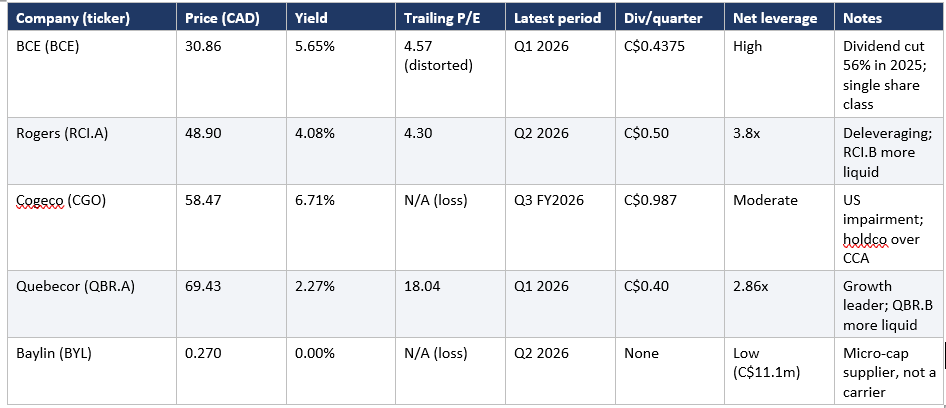
The table below summarises the five names on the metrics that matter most, using the 6 August 2026 screener snapshot for market data and the latest verified filings for fundamentals. Trailing P/E is shown as reported but should be treated with scepticism: BCE's low multiple reflects a swing out of prior-year impairments, and Cogeco's is not meaningful because a C$2.2bn US write-down produced a large accounting loss. Adjusted earnings and free cash flow are better guides for both.
Rankings by category
No single ranking captures a stock's merit, so the lists below score the five names on three lenses that matter in this market. They are analytical judgements based on the verified data, not recommendations.
Dividend safety (most to least secure)
- Quebecor — lowest payout ratio and lowest leverage, with free cash flow many times the modest dividend cost.
- Rogers — dividend consumes roughly a quarter of free cash flow; guidance points to C$4.1-4.3bn of FCF for the year.
- Cogeco — cash-covered and just raised 7%, but the US impairment and structural complexity warrant a notch of caution.
- BCE — now more sustainable after the 56% cut, yet a shrinking free-cash-flow cushion in 2026 leaves the least headroom.
- Baylin — pays no dividend; not applicable.
Balance-sheet strength (strongest to weakest)
- Baylin — only C$11.1m net debt, though on a tiny revenue base with its own solvency risks.
- Quebecor — 2.86-times leverage, the lowest of the large operators and still falling.
- Cogeco — C$4.59bn net debt against steady EBITDA; manageable but watched.
- Rogers — 3.8 times and improving, but still carrying substantial Shaw-deal debt.
- BCE — the heaviest balance sheet, being addressed through cuts, asset sales and partnerships.
Value versus growth (analytical read)
- Quebecor — priciest on trailing P/E at 18x, but the only clear subscriber-and-earnings growth story.
- Cogeco — deepest apparent value on adjusted earnings and a 6.71% yield, if the US business stabilises.
- Rogers — reasonable multiple with visible deleveraging and dependable free cash flow.
- BCE — a turnaround-and-yield play; the trailing multiple is meaningless, so judge it on 2026 guidance.
- Baylin — not valued on earnings at all; a speculative backlog-conversion bet.
The risk of comparing a micro-cap supplier with the national carriers
The single most important caution in this watchlist is not about any one company's numbers but about the act of comparison itself. Baylin Technologies sits in the same screener bucket as BCE, Rogers, Cogeco and Quebecor, yet it is a fundamentally different kind of business carrying a fundamentally different risk. The four carriers are large, cash-generative service providers with recurring subscription revenue, investment-grade or near-investment-grade credit, dividends and millions of customers whose monthly bills arrive with utility-like reliability. Baylin is a micro-cap manufacturer whose revenue depends on winning discrete contracts, whose quarterly results swing on a single acquisition, and whose 27-cent shares trade thinly enough that buying or selling can move the price.
The metrics that anchor the carrier analysis — dividend yield, payout ratio, free-cash-flow cover, net-debt-to-EBITDA, subscriber net additions and ARPU — either do not exist for Baylin or mean something entirely different. It pays no dividend, so yield is zero; it is loss-making, so its P/E is not meaningful; it has no subscribers, so churn and ARPU are irrelevant. Placing it in a league table beside BCE risks treating its analyst optimism and record backlog as comparable to a carrier's dependable cash flows, when the appropriate benchmark is other speculative small-cap suppliers. The disciplined approach is to analyse Baylin on its own terms — backlog conversion, cash runway, integration of Kaelus, customer concentration — and never to let a shared sector label imply shared risk. A screen groups by end market; it does not equalise business models.
What to monitor for the rest of August 2026
- BCE's second-quarter results on 7 August — the single biggest event on the calendar. Watch adjusted EPS, any change to the C$2,100-2,300m free-cash-flow guidance, capital-intensity trends and confirmation that the C$1.75 dividend holds.
- Quebecor's second-quarter print, expected in early August — whether Freedom Mobile keeps adding subscribers at 6%-plus and whether ARPU continues rising while rivals' falls.
- Wireless pricing signals — Rogers' ARPU dipped to C$54.25 and the whole sector is fighting on price; any sign the discounting is easing (or intensifying) shifts the earnings outlook for all four carriers.
- Regulatory developments — progress on Bell and Telus disclosing serviceable fibre locations to Rogers and Quebecor, and any further CRTC moves on wholesale fibre or roaming that alter resale economics.
- Cogeco's US segment — evidence that the impairment marks a trough rather than a prelude to further write-downs.
- Baylin's backlog conversion — early signs the record C$61.0m order book is translating into revenue and a narrower loss.
Conclusion: five ways to read one sector
The five names on this watchlist show how much variety hides beneath a single sector label. BCE is the bellwether whose dividend reset reframed what a safe Canadian telecom payout means; its 5.65% yield now rests on firmer, if less generous, ground, while a heavy fibre and AI build compresses near-term free cash flow. Rogers is the deleveraging story, converting strong cash generation into a steadily healthier balance sheet while holding its dividend. Cogeco is the contrarian high-yielder, where a frightening headline loss masks growing adjusted profit and a freshly raised distribution, provided its US business stabilises. Quebecor is the growth outlier, turning the fourth-carrier strategy and a favourable regulatory regime into market share, with the lowest leverage and the highest multiple. And Baylin is the reminder that a screen can place a fragile micro-cap supplier beside national carriers that must never be judged by the same measures.
None of this is advice to buy or sell, and a screener's rating — whether Buy or Strong Buy — is an input to research, not a guarantee. The trailing multiples that look cheapest here are the least reliable, distorted by impairments; the highest yield carries the most structural complexity; and the fastest grower trades at the richest price. What the sector rewards in 2026 is unglamorous discipline: dividends covered by cash rather than borrowing, debt maturities managed rather than rolled at ever-higher rates, capital spent where it earns a return, and subscribers won at prices that hold. Readers should verify the latest figures against primary filings, weigh each company against their own objectives, and treat the second-quarter reporting still to come this August as the next real test of every thesis above.


 Nov 27, 2026





 Please wait processing your request...