
 NZ
 UK
 US
 AU
 IND

 CA

 Share
 X (Formerly Twitter)
 Whatsapp
 Facebook
 LinkedIn
 Telegram
 Email This Article
 Copy Link
 Summarize with AI
 Chat GPT
 Perplexity

Key Takeaways
- Three metals, three stories: gold responds to macro and safe-haven flows, silver blends monetary demand with industrial and solar uptake, and copper is underpinned by electrification and a structural supply deficit.
- Canadian exchanges (TSX and TSXV) offer distinct exposure to each metal, from pre-resource explorers to early ramp-up producers.
- Several names carry near-term, often binary catalysts through late 2026, including feasibility updates, permits and final investment decisions.
- Funding profiles range from well-capitalised developers to pre-revenue explorers reliant on further raisings and potential dilution.
- All figures are current as at the research cut-off of 24 July 2026; no August 2026 outcomes are known. This article is general information only, not advice.
Introduction
Precious metals and copper are moving to different rhythms as the Canadian mining sector heads into August 2026. Gold remains the classic macro and safe-haven instrument, sensitive to rates, currencies and geopolitical stress. Silver sits at a crossroads, part monetary metal that tracks gold and part industrial input tied to solar and electronics. Copper is the metal of electrification, where grid build-out and transport demand meet a thin project pipeline and a prospective structural deficit.
This piece organises the field by metal — a precious-metals-plus-copper lens rather than a single-theme framing — using Canadian-listed juniors and developers for targeted exposure to these divergent but complementary drivers. Everything reflects verified information to 24 July 2026; August has not begun, so treat every catalyst as a possibility, not a certainty.
Commodity and Macroeconomic Overview
Gold is shaped by real interest rates, the US dollar and risk sentiment. Firming rate-cut expectations or geopolitical stress tend to attract flows; a stronger dollar or higher-for-longer rates can work the other way. For pre-revenue developers, the metal price feeds directly into project economics and financing appetite.
Silver carries a dual identity, moving with gold as a monetary metal while much of its demand is industrial, notably solar panels and electronics. That adds cyclical sensitivity to manufacturing and the energy transition, and can amplify moves either way.
Copper is the clearest structural story. Electrification, grid investment and rising power demand point to growing consumption, while new large-scale supply is slow to arrive; many frame the market around a potential long-run deficit, though copper stays cyclically exposed to industrial demand, rates and the dollar. Across all three, common threads are project financing, jurisdictional and permitting risk, and the leverage development-stage equities carry to the metal.
Gold Stocks
GoldMining Inc (TSX: GOLD: GLDG)
A clarification first: GoldMining Inc trades as GOLD on the TSX and GLDG on NYSE American. It is not Barrick, which uses GOLD on the NYSE.
GoldMining accumulates gold and gold-copper projects across the Americas — Canada, the US (Alaska), Brazil, Colombia and Peru. An advanced explorer, not a producer, it holds ~13.1 Moz AuEq M&I and 9.0 Moz inferred. Its flagship Sao Jorge (Brazil) drew a positive PEA on 11 June 2026 (after-tax NPV5% US$532M, 42.4% IRR at US$3,500 gold); a mid-year update showed cash plus securities near US$185M and no debt.
Catalysts: drill and portfolio news. Risks: pre-production execution, financing, jurisdiction and holding-company valuation. It offers diversified gold optionality, all projects pre-development.
NexGold Mining Corp (TSXV: NEXG)
NexGold, formed from the 2024 combination of NexGold (formerly Treasury Metals) and Signal Gold, is a near-term gold developer. Its most advanced asset is the fully permitted Goldboro project in Nova Scotia (~100koz/yr over 11-plus years), alongside the Goliath Gold Complex (Ontario) and earlier-stage Niblack VMS (Alaska); combined ~4.7 Moz M&I. At 31 March 2026 it held ~C$104.5M cash and short-term investments, effectively debt-free, with Appian Capital a strategic investor.
Catalysts: an updated Goldboro feasibility study and resource, both guided for Q3 2026, plus financing and a construction decision. Risks: financing, the developer-to-producer transition, Goliath permitting and resource conversion. Investors may watch its permitted flagship and growth path.
Rio2 Limited (TSX: RIO)
To avoid confusion, this is Rio2 Limited (TSX: RIO), not Rio Tinto. Rio2 has shifted in 2026 from developer toward diversified producer. Its flagship Fenix gold mine in Atacama, Chile — open-pit heap-leach — poured first gold on 23 January 2026 and is ramping toward 20,000 tpd, with commercial production targeted for Q4 2026. It also completed the producing Condestable Cu-Au-Ag mine in Peru on 30 January 2026, adding copper and cash flow; Rio2 held ~US$93.1M cash at end-Q1 2026 with operating cash flow near US$22.8M.
Catalysts: Fenix ramp against FY2026 guidance of 60,000-70,000 oz and Condestable integration. Risks are notable — Q1 showed ramp-up shortfalls, plus heap-leach recovery, integration and Chile/Peru jurisdiction. Investors may watch a multi-asset producer still proving execution.
Silver Stocks
Vizsla Silver Corp (TSX: VZLA)
Vizsla is an advanced silver developer with material gold credits, centred on the roughly 100%-owned Panuco project in Sinaloa, Mexico — essentially its sole material asset. A November 2025 feasibility study gave an after-tax NPV5% of US$1.8B and 111% IRR at US$35.50 silver (US$238.7M capex, low AISC). Recent de-risking includes EPCM/mine-design contracts (Apr 2026) and equipment supply (Jun 2026). It held ~US$431-450M cash against ~US$235M debt (mainly convertibles), fully financed to construction.
The near-term gate is the MIA environmental permit, guided mid-2026, then construction. Risks: single-asset, single-country exposure, Sinaloa security, construction execution and silver-price leverage. Investors may watch its high-return study and near-construction status.
Avino Silver & Gold Mines Ltd (TSX: ASM)
Avino is a producing polymetallic silver miner (with gold and copper) in Durango, Mexico. Its flagship Avino mine runs alongside La Preciosa (ramping toward ~500 tpd in H2 2026) plus an Oxide Tailings reprocessing project; silver was ~60% of Q1 2026 revenue. Results were strong: record Q1 2026 revenue of US$39.4M, a maiden 127 Moz AgEq reserve (April 2026) and Q2 2026 output of 534,945 AgEq oz. It held US$138.6M cash at 31 March 2026 and is debt-free.
Catalysts: Q2 earnings on 12 August 2026 and La Preciosa progress. Risks: Mexico concentration, single-district reliance, ramp execution and cost inflation. Investors may watch a cash-generative producer with an internal growth lever.
New Pacific Metals Corp (TSX: NUAG)
New Pacific is a silver developer with meaningful gold co-product, all its assets in Bolivia, a high-risk jurisdiction. Flagship Silver Sand carries a July 2024 PFS (post-tax NPV5% ~US$740M) but permitting has stalled after an illegal-mining incursion. Carangas received an updated PEA on 16 July 2026 (post-tax NPV5% US$2.65B, 35.9% IRR, initial capex US$644.5M). Pre-revenue, with about US$39.9M cash at 31 March 2026 and no debt, the large future capex implies heavy financing and dilution.
Catalysts: a Silver Sand community and resettlement agreement targeted mid-2026, and Carangas permitting and drilling. Risks are led by Bolivian jurisdiction, stalled permitting, financing and PEA-stage uncertainty. Investors may watch resource optionality against acute country risk.
Blackrock Silver Corp (TSXV: BRC)
Blackrock Silver, unaffiliated with the asset manager BlackRock Inc, is a silver-primary developer with a significant gold co-product, focused on Tonopah West in Nevada, a top-tier jurisdiction. An updated PEA on 31 March 2026 gave an after-tax NPV5% of US$437M and 28.0% IRR at US$31 silver (11.2-year life, AISC US$17.44/oz), with a 90% lift in indicated resources. Pre-revenue, it closed a C$15M Sprott-led placement in January 2026, received the first of three key permits in March 2026 and launched a fully funded 17,000m program.
Catalysts: further drill results and the second and third permits. Risks: PEA-stage status, ~US$190M development capex financing and narrow-vein technical risk; jurisdiction risk low. Investors may watch Nevada resource growth.
Sierra Madre Gold and Silver Ltd (TSXV: SM)
Sierra Madre is a small-scale silver and gold producer in a growth phase, operating entirely in Mexico. Its La Guitarra complex feeds a central mill from three underground mines, and it closed the past-producing, permitted Del Toro mine in Zacatecas on 22 June 2026, adding a redevelopment and exploration pipeline. Calendar Q1 2026 showed ~128,827 AgEq oz, revenue near US$11M, positive operating cash flow and US$13.2M cash before a June CA$57.5M raise; First Majestic emerged as a ~24.77% holder.
Catalysts: Phase 1 mill-expansion commissioning, and Del Toro integration and drilling. Risks: simultaneous expansion and restart execution, up to US$40M contingent Del Toro payments, Mexico concentration, a large shareholder overhang and small-cap liquidity. Investors may watch its production growth.
Copper Stocks
Marimaca Copper Corp (TSX: MARI)
Marimaca, formerly Coro Mining, is a copper developer operating entirely in Chile's Antofagasta Region, with emerging silver credits at its Pampa Medina discovery. Its flagship Marimaca Oxide Deposit is an open-pit heap-leach copper cathode project with an August 2025 DFS (post-tax NPV8 US$709M, 31% IRR at US$4.30/lb copper) and November 2025 environmental approval. A ~C$409M raise (Feb 2026) left US$147M cash at 31 March 2026, no debt; a US$587M debt-financing process launched in May 2026.
Catalysts for Q4 2026: sectoral permit approval, the debt package and a final investment decision, plus Pampa Medina drilling. Risks: debt-package financing and execution, permitting, single-commodity and single-country exposure, first-build construction and unresolved acid supply. Investors may watch a near-construction copper developer with exploration upside.
Faraday Copper Corp (TSX: FDY)
Faraday Copper, part of the Lundin Group, is a US-domestic copper developer with by-product molybdenum and silver, focused entirely on Arizona. Flagship Copper Creek carries a 2023 PEA (after-tax NPV7% US$713M, 15.6% IRR, capex US$798M at US$3.80/lb) and ~4.2 Blb contained copper (M&I). On 2 July 2026 Faraday signed a definitive agreement to acquire the historic San Manuel district from BHP, not yet closed. It held ~C$120.8M cash at 31 March 2026 after an C$100M placement, with no notable debt and no revenue.
Catalysts: the potential San Manuel close, expected by end-Q3 2026 subject to approvals, and Phase IV drill results. Risks: ~US$798M Copper Creek capex financing, PEA-to-construction execution, deal-completion risk, US permitting and post-re-rating valuation. Investors may watch scaled US copper exposure.
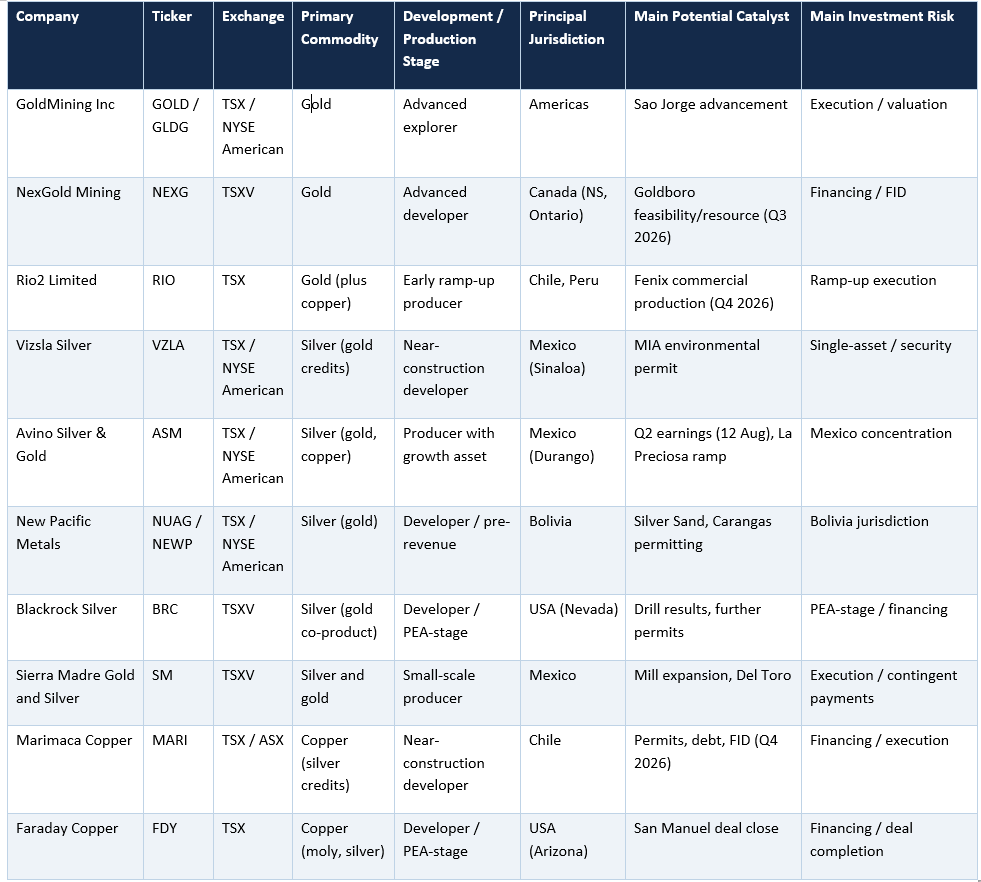
Comparison Table
Key Risks Investors Should Consider
Development and exploration equities carry pronounced, often binary, risk. Most names above are pre-revenue and depend on further capital, so financing and dilution recur; even producers such as Rio2 and Sierra Madre face execution and integration demands, and commodity-price leverage cuts both ways.
Jurisdiction matters enormously, ranging from lower-risk settings such as Nevada, Arizona, Ontario and Nova Scotia to higher-risk Bolivia and parts of Mexico, where permitting, security and community factors can delay or derail projects. PEA-stage assumptions add uncertainty, since preliminary studies often include inferred material and are not bankable. Single-asset, single-country concentration heightens these, and small-cap liquidity amplifies swings.
Conclusion
Viewed by metal, these ten Canadian-listed names offer distinct routes into gold's macro sensitivity, silver's monetary-plus-industrial character and copper's electrification-driven outlook. They range from pre-resource optionality to early-ramp production, and their appeal varies with an investor's tolerance for financing, jurisdiction and execution risk. Late 2026 carries a dense schedule of potential catalysts but also meaningful uncertainty. Prudent readers will weigh both sides and recognise that nothing here is guaranteed. Information is current as at 24 July 2026.


 Nov 27, 2026





 Please wait processing your request...