
 NZ
 UK
 US
 AU
 IND

 CA

 Share
 X (Formerly Twitter)
 Whatsapp
 Facebook
 LinkedIn
 Telegram
 Email This Article
 Copy Link
 Summarize with AI
 Chat GPT
 Perplexity

Key Takeaways
- Rising Risks, Not Red Alerts: Economic signals are yellow; recession is possible but not certain.
- AI Boom & Valuation Stretch: AI stocks are soaring, but many are priced ahead of real earnings - bubble-like traits exist.
- Consumer Stress Matters Most: Rising debt, lower savings, and increased BNPL usage signal potential slowdown.
- Credit, Yield Curves & PMIs Are Key: Real data points give the clearest picture of market health.
- Resilient Sectors: Consumer staples, healthcare, utilities, telecoms, and gold tend to hold up in slowdowns.
- Vulnerable Sectors: Autos, discretionary retail, construction, financials, energy services, and cyclical industrials react fastest to weaker demand.
- Diversify & Plan Scenarios: Adaptability and broad exposure across sectors, styles, and geographies are essential in uncertain times.
2025 Market Outlook for Canadians: Where the Risks Are & Where the Opportunities Lie
2025 is shaping up to be one of the most unpredictable - and opportunity-packed - years for Canadian investors. Some economic signals are turning yellow, AI stocks are soaring to eye-watering valuations, and consumer stress is slowly creeping up. Here’s a simple, retail-friendly guide to what experts are watching - and which sectors historically hold strong when markets get tricky.
Why 2025 Feels Uncertain: Slowing Growth Meets AI Euphoria
A few forces are driving today’s volatility:
- Global growth losing momentum
- Sticky inflation in parts of North America
- Central banks adjusting policy cautiously
- A historic wave of AI-related spending and speculation
This creates the two big questions everyone in the market is asking:
- Is a recession forming beneath the surface?
- Are AI valuations entering bubble territory?
- Credit Markets: The “First to Flash” Recession Indicator
Credit markets usually warn before stocks react.
What matters:
- Wider corporate spreads → rising risk
- Sudden spike in high-yield spreads → stress in weaker companies
- Divergence between IG and HY → early trouble ahead
Right now, spreads are tight — a sign of complacency, not safety.
- Yield Curves: Still One of the Best Predictors
Economists track the 2s/10s, 3m/10s and near-term forward curve.
Why it’s important:
- Inverted curves have preceded most recessions
- “Un-inversions” often happen right before downturns start
2025 is giving mixed curve signals — enough to keep caution alive.
- Labour Market Cooling: Cracks Form Quietly
Watch for:
- Falling job quits
- Declining temp hiring
- Fewer hours worked
- Lower job openings
Canada’s labour market is softening but not collapsing — a typical late-cycle sign.
- Consumer Stress: The Most Important Data of All
Consumers drive most economic activity. Stress here = slowdown ahead.
Key pressure points:
- Rising delinquencies (credit cards & auto loans)
- Below-trend savings rates
- Surging BNPL usage
These tend to worsen before recessions — and they’re trending upward.
- PMIs & Freight: Real Economy Signals Losing Steam
Two important indicators:
- PMIs: Manufacturing remains weak globally; services show slowing momentum.
- Freight: Lower rail tonnage, trucking softness and weaker order flow suggest softer economic activity.
These are often the “tell” before GDP numbers move.
- Corporate Earnings: Margins Under Pressure
Watch for:
- Lowered guidance
- Margin compression
- Rising inventories
- Slower growth in cyclicals (autos, energy services, industrials)
Earnings are no longer firing on all cylinders.
- Sentiment: Soft Data Turning Softer
CEO confidence, consumer surveys and small-business optimism are sliding — a reliable recession setup when combined with credit stress.
- The Buffett Indicator: A High-Level Valuation Warning
The Buffett Indicator (market cap ÷ GDP) suggests broad valuations are stretched, especially in tech-heavy markets.
Canada behaves differently because the TSX is resource and financials-heavy — but the global valuation tide still matters.
The AI Question: Innovation or Bubble?
Professionals are split, but several concerns stand out:
- Valuations Ahead of Real Earnings
Many AI companies are priced on future potential, not present profits.
- Extreme Market Concentration
A handful of mega-cap tech names drive market direction — raising fragility.
- AI Requires Enormous Capital
Data centres, chips, power, cooling, networks — all expensive, all long-payback.
- AI Startups Burning Cash
Many depend on constant funding cycles.
- AI Trading → Herd Behaviour
Algorithmic trading can amplify selloffs.
Ray Dalio calls the current trend “bubble-like,” while GMO-style value investors highlight echoes of past speculative periods.
Canadian Sectors That Historically Hold Up Better
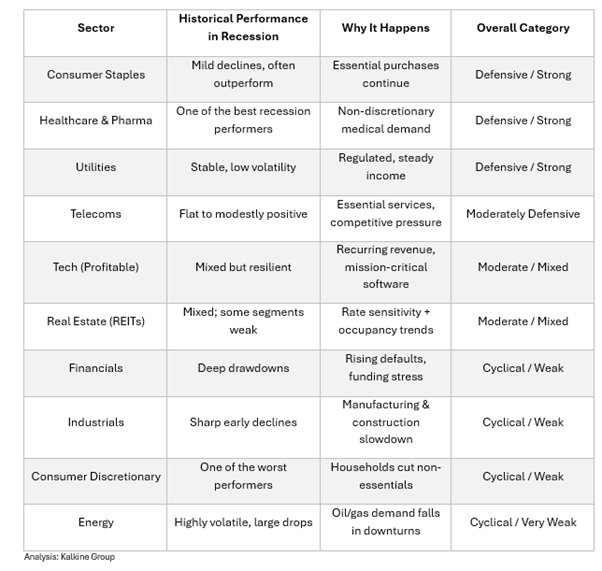
These sectors tend to show resilience when growth slows.
- Consumer Staples (Steady Demand)
- Healthcare & Pharma
- Utilities (Predictable Cash Flows)
- Telecoms (Essential Services)
- BCE (TSX: BCE)
- Rogers Communications (TSX: RCI.B)
- Telus Corporation (TSX: T)
- Gold & Precious Metals (Risk-Off Beneficiaries)
- Barrick Mining (TSX: ABX)
- Agnico Eagle Mines (TSX: AEM)
- Kinross Gold (TSX: K)
Sectors Typically Hit Harder in Slowdowns
- Autos
- Discretionary retail
- Construction & housing
- Financials (loan sensitivity)
- Energy services
- Cyclical industrials
These react fastest to weaker consumer and business demand.
The Big Picture for Canadian Retail Investors in 2025
- Indicators show risk rising — not peaking.
A recession is not guaranteed, but the setup is classic late cycle.
- AI valuations are exciting — and stretched.
Long-term potential remains huge, but hype cycles are powerful.
- Diversification is underrated.
Across sectors, styles, geographies.
- Focus on data, not drama.
Yield curves, credit spreads, PMIs, corporate earnings and consumer stress are the real signals.
- Think in Scenarios, Not Predictions.
Markets rarely follow a straight line — the winners are those who adapt, not guess.


 Nov 27, 2026





 Please wait processing your request...