
 NZ
 UK
 US
 AU
 IND

 CA

 Share
 X (Formerly Twitter)
 Whatsapp
 Facebook
 LinkedIn
 Telegram
 Email This Article
 Copy Link
 Summarize with AI
 Chat GPT
 Perplexity

Key takeaways
- The clearest fault line running through these 13 names is income versus growth. Corby Spirit and Wine, Supremex and High Liner Foods anchor the yield end of the table at roughly 4.8% to 5.7% on the 6 August screener, while Gildan, GURU and a cluster of micro-caps offer expansion but pay little or nothing.
- On valuation, Lassonde and Supremex screen cheapest among the profitable names, trading on single-digit price-to-earnings (P/E) multiples while still growing earnings; Gildan's headline P/E above 100 is an accounting artefact of its HanesBrands takeover rather than a sign the shares are expensive.
- Balance-sheet strength varies enormously. GURU carries no debt and roughly C$34m of liquidity, and AGT slashed borrowings after its March re-listing, whereas Gildan sits at 3.2x leverage and Canada Packers just posted a loss with 2.4x net debt.
- Five of the 13 are loss-making or barely profitable — Diamond Estates, Happy Belly, GURU, Cizzle Brands and AGT — which is why their P/E ratios read as not applicable; for these, revenue growth, gross margin and the cash runway matter far more than any earnings multiple.
- A screener's bullish tag is a starting point, not a verdict: the strongest income and value candidates here look quite different from the highest-growth speculations, and no single name tops every dimension.
Introduction: income and growth pull in opposite directions
Consumer non-durables — the food, drink, apparel and packaged goods that households buy and use up quickly — are the classic defensive corner of any equity market. Demand for cheese, juice, frozen fish and basic T-shirts holds up whether the economy is expanding or contracting, which tends to produce steadier cash flows than cyclical sectors and, for the mature names, dependable dividends. In August 2026, with the Bank of Canada's rate path still uncertain and the Canada-US tariff dispute unresolved, that defensiveness is back in fashion among investors rotating away from richly valued growth stories.
Yet the 13 Canadian-listed non-durables companies flagged by a market screener on 6 August 2026 are anything but uniform. They range from two roughly C$15bn heavyweights — dairy processor Saputo and apparel manufacturer Gildan — down to a C$10m micro-cap winery. Some are compounding sales at double-digit rates; others are shrinking. Some pay yields close to 6%; others pay nothing while they chase a first sustained profit. The central tension this article explores is the trade-off between income and growth: the shares that hand back the most cash today are rarely the ones growing fastest, and the fastest growers are often the least proven. Ranking them side by side makes those trade-offs explicit rather than leaving them buried in a screener's uniform buy tags.
Screening and ranking methodology
The universe is the 13 companies the screener classified as Canadian consumer non-durables on 6 August 2026, listed across the Toronto Stock Exchange (TSX), the TSX Venture Exchange (TSXV), the Canadian Securities Exchange (CSE) and Cboe Canada. Prices, market capitalisations, dividend yields and P/E ratios quoted as a snapshot come from that single screener reading and are treated as a point-in-time indication rather than an independently confirmed live quote; where a figure could not be checked against a primary source, that is flagged as per the screener as of 6 August 2026 with limited verification. Company results, guidance, dividends and deals have, wherever possible, been verified against regulatory filings on SEDAR+, investor-relations material and earnings releases.
Each company is assessed on six dimensions: revenue and earnings growth; profitability and cash generation; valuation; the dividend and its coverage; balance-sheet strength; and the principal risks. The rankings that follow group the names into four investor objectives — income, growth, value and speculation — because a stock that scores well for one aim can score poorly for another. One point on valuation recurs throughout. For a business that is loss-making or only marginally profitable, the P/E ratio is close to meaningless: dividing the share price by a negative or near-zero earnings figure produces either a nonsensical negative multiple or an astronomically high one that says nothing useful. For those names the analysis leans on sales growth, gross margin and the path to breakeven instead, and the comparison table shows their P/E as not applicable.
The Canadian backdrop: defensive staples with a trade-war twist
Two forces frame the sector in mid-2026. The first is the enduring appeal of staples as ballast: relatively inelastic demand supports steady revenue and, for the mature names, the reliable dividends that income investors prize. The second is specific to the moment. The renewed Canada-US tariff dispute cuts both ways. Fresh US duties on Canadian-manufactured goods — Supremex flagged measures taking effect on 19 August 2026 — threaten margins for firms that ship south, and High Liner has already absorbed tens of millions of dollars in tariffs on imported seafood. Against that, a wave of Canadian consumer nationalism has handed domestic brands an edge: provincial liquor boards favouring local products have lifted Corby and Diamond Estates, and the buy-local mood has spread across grocery aisles.
Currency and commodities add further texture. A softer Canadian dollar flatters the reported results of exporters and of those, like High Liner, that report in US dollars, but raises the cost of imported inputs. Volatile pork, dairy and pulse prices swing the earnings of Canada Packers, Saputo and AGT from quarter to quarter, which is precisely why some of the optically cheapest multiples here sit on the least predictable profit streams. Reading the sector well in 2026 means separating durable competitive advantage from the noise of tariffs, exchange rates and harvest cycles — and that separation is what the rankings below attempt.
The 13 names, compared
Gildan Activewear (TSX:GIL)
Gildan is the sector's growth engine and its most misread valuation. Second-quarter results on 30 July 2026 showed net sales of US$1.58bn, up 72.3% year on year as the transformational HanesBrands acquisition — closed in December 2025, after which Gildan delisted from the New York Stock Exchange — flowed through the top line. Adjusted diluted earnings rose 32% to US$1.28, and management nudged full-year guidance to revenue of US$6.0bn to US$6.2bn, an adjusted operating margin near 21.8%, adjusted EPS of US$4.65 to US$4.75 and free cash flow around US$1.0bn. It also agreed to sell HanesBrands Australia for about A$700m to trim debt.
The screener's P/E of 110.65 and reported growth of -83.19% both reflect trailing GAAP earnings depressed by deal and integration costs, not deteriorating economics; on the forward adjusted numbers the multiple is far more ordinary. The catch is the balance sheet: net debt of US$4.69bn and leverage of 3.2x sit above the company's 1.5x-2.5x target, buybacks are suspended until that ratio falls, and the 1.65% yield is modest. Catalysts include HanesBrands synergies, the Australia disposal and deleveraging; risks centre on integration slippage, US tariff exposure and the sheer size of the debt. Strong for growth, weak for income.
Saputo (TSX:SAP)
Saputo is one of the world's larger dairy processors and, at roughly C$15.6bn, the biggest company in this group by market value. The screener shows the shares at C$39.13 on a P/E of 24.04, with trailing EPS of C$1.63 and a 2.03% yield — a fuller multiple than most peers here, reflecting expectations that a multi-year cost and network-optimisation programme will lift margins from a cyclical trough. The timing is awkward for this comparison: Saputo was due to release fiscal 2027 first-quarter results after the close on 6 August 2026, with its annual meeting the following morning, so the freshest numbers were not yet public at the time of writing.
On the most recent verified picture, Saputo's investment case rests on the payoff from plant consolidation in the United States, firmer global dairy prices and cheese-market normalisation. Its scale, diversified geography and long dividend record make it a core defensive holding rather than a growth or deep-value play. Catalysts include the fiscal 2027 guidance, evidence that the efficiency programme is landing, and dairy-price recovery; risks include input-cost volatility, currency swings across its US, international and Canadian segments, and execution on the restructuring. For income it is dependable if unspectacular; for value it screens dearer than the single-digit-P/E names below.
Lassonde Industries (TSX:LAS.A)
Lassonde, the Quebec-based maker of fruit juices and speciality foods, is arguably the standout value-and-quality combination in the group. The screener puts the Class A shares at C$224.81 on a strikingly low P/E of 9.47, with trailing EPS of C$23.73, reported growth of 41.03% and a 2.17% yield. First-quarter 2026 results underlined why: although sales dipped 5.1% to C$664m on softer volumes, net income jumped 54.6% to C$36.8m as disciplined pricing, a favourable Canadian sales mix and lower orange-concentrate costs widened margins. Its US branded business, including the Apple juice range produced in North Carolina, kept gaining share.
The combination of rising profits and a single-digit earnings multiple is unusual among profitable staples and is the core of the value argument. Second-quarter 2026 figures were due around 6 August, so the snapshot may soon move. Catalysts include continued margin expansion, US brand momentum and further bolt-on acquisitions; risks include concentrate-cost inflation for apple and pineapple, exposure to US private-label competition and the thin trading liquidity typical of a founding-family-controlled Class A structure. Lassonde looks stronger for value than for headline income, though its dividend is well covered by earnings.
Corby Spirit and Wine (TSX:CSW.A)
Corby is the income-and-growth hybrid of the spirits shelf. Fiscal third-quarter 2026 results were a record: revenue rose 21% to C$58.3m, net earnings leapt 97% to C$7.9m and earnings per share reached C$0.28, powered by its Ace Beverage ready-to-drink (RTD) portfolio — up 22% against category growth near 10% — plus favourable LCBO order phasing and market-share gains in spirits. It marked a fourteenth straight quarter of outperforming a declining spirits category, and the board declared a quarterly dividend of C$0.24, having lifted the payout 4.3% earlier in the year.
The screener shows a 5.70% yield, the highest of any clearly profitable name here, on a P/E of 13.90 with 27.34% growth. That blend of a chunky, growing dividend and genuine top-line momentum is rare. The main near-term caveat is management's own guidance that the fiscal fourth quarter will be materially softer as LCBO ordering normalises, so the record run flatters the trailing figures. Catalysts include RTD expansion, the nationalist shift away from US spirits and continued share gains; risks include the LCBO phasing reversal, a structurally shrinking spirits category and reliance on a concentrated brand roster. Corby is a leading income candidate that also grows.
High Liner Foods (TSX:HLF)
High Liner, North America's largest supplier of value-added frozen seafood, is a headline name in this comparison and a study in income versus operational strain. The screener shows C$14.39, a P/E of 10.54, EPS of C$1.37, reported growth of -47.96% and a 4.76% yield. First-quarter 2026 revenue rose 24.8% to US$334.9m on a 10.6% jump in sales volume, but adjusted EBITDA fell 8.7% to US$29.3m as freight, storage and raw-material costs bit, and the company reports in US dollars, complicating comparison with Canadian-dollar peers. It absorbed US$41.3m of tariffs on imported seafood and has filed refund claims with no guaranteed outcome.
The negative growth reading captures that earnings squeeze rather than a shrinking business — volumes are climbing. Second-quarter 2026 results are scheduled for 14 August 2026, so the income thesis will shortly be tested. Management expects stronger year-on-year adjusted EBITDA in the second half as pricing and plant efficiencies take hold. Catalysts include tariff refunds, margin recovery and easing whitefish supply; risks include persistent whitefish scarcity, further tariff costs and currency translation. The near-4.8% yield is the draw, but investors are being paid to wait through a margin trough — a higher-risk income proposition than Corby or Lassonde.
Canada Packers (TSX:CPKR)
Canada Packers, the pork processor spun out of Maple Leaf Foods and listed only in October 2025, offers the group's most eye-catching — and most misleading — valuation. The screener shows a P/E of just 4.41 on EPS of C$3.88, reported growth of 42.12% and a 2.40% yield. That cheapness is largely an artefact of a short, volatile public history: on 5 August 2026 the company reported a second-quarter net loss of C$28.4m, reversing a C$23.4m profit a year earlier, as sales fell 8.8% to C$431.7m, pork cutout values softened, the yen weakened and a C$48.3m non-cash swing in biological-asset values hit the bottom line.
Adjusted EBITDA of C$34.9m stayed within the company's 8%-12% margin target, and the C$0.23 quarterly dividend (C$0.92 annualised) was maintained, but standalone public-company costs pushed SG&A up 26.7%. Net debt stands at C$432.8m and leverage at 2.4x. The trailing P/E therefore rests on earlier, stronger quarters and will look very different once the loss washes through. Catalysts include a pork-price recovery, a firmer yen and standalone-cost normalisation; risks include commodity-margin volatility, currency exposure to Japan and the biological-asset swings inherent in meat processing. Optically a value stock, in practice a cyclical the screener's low multiple flatters.
AGT Food and Ingredients (TSX:AGTF)
AGT, the Saskatchewan-based pulse and staple-foods processor, returned to the TSX in March 2026 at C$23 a share through an initial public offering and concurrent private placement backed by Fairfax Financial, which retains control. The screener shows C$17.10 — below the issue price — a market capitalisation of C$1.16bn, no meaningful P/E, EPS of -C$1.90 and reported growth of -1,152.77%, a figure distorted by one-off listing costs. First-quarter 2026 revenue fell 35% to C$560.7m on shipping delays and lower commodity prices, and the company posted a C$96.9m net loss driven chiefly by IPO-related expenses.
The more encouraging line is the balance sheet. The raising cut debt by roughly C$920m, taking net debt to adjusted EBITDA down to 0.54x from 3.35x, and adjusted EBITDA held broadly steady at C$39.1m, showing the underlying processing business still generates cash. A modest C$0.05 quarterly dividend was declared. This is a turnaround-and-value hybrid rather than a growth story. Catalysts include volume recovery once shipping normalises, deleveraging benefits and Fairfax's stewardship; risks include commodity-price swings, geopolitical disruption to Middle East and South African operations, and the overhang of trading below its IPO price. Best suited to patient, higher-risk value investors.
Supremex (TSX:SXP)
Supremex, Canada's dominant envelope maker turned packaging consolidator, is the group's quiet value-and-income candidate. Second-quarter 2026 revenue rose 8.5% to C$71.6m and adjusted EBITDA jumped 33.9% to C$7.8m, lifting the margin to 10.9%, as the packaging and speciality division grew 19% to make up almost 37% of sales while the mature envelope business added 3.2%. The company swung to a C$1.0m net profit (C$0.04 a share) from a year-earlier loss. The screener shows C$3.66, a low P/E of 7.37, EPS of C$0.50 and a 5.41% yield.
The strategic pivot from structurally declining envelopes toward packaging is doing exactly what it should — offsetting volume erosion in the legacy unit with faster-growing, higher-value work. Recent acquisitions (Goldrich Printpak and Fantasia) lifted net debt to 1.22x adjusted EBITDA from near zero at year-end, still comfortably manageable. The C$0.05 quarterly dividend underpins a yield above 5%. Catalysts include further packaging bolt-ons, margin gains and integration synergies; the clearest risk is fresh US tariffs on Canadian-made goods effective 19 August 2026, alongside envelope-volume decline and acquisition-integration execution. On a single-digit multiple with a 5%-plus yield, Supremex scores well for both value and income.
iFabric (TSX:IFA)
iFabric, a Toronto-based apparel and technical-textiles group best known for intimate apparel and its antimicrobial and moisture-management fabric technologies, is one of the higher-octane growth names. The screener shows C$4.83, a P/E of 41.67, EPS of C$0.12 and reported growth of 200.26% with no dividend — a profile of a small company scaling fast off a low earnings base, which is why the multiple looks elevated even though the business is profitable. It has reported a run of record quarters, including third-quarter 2025 revenue up 111% year on year, and guided to further growth into 2026, though the granular latest-quarter detail here carries limited independent verification.
The appeal is a differentiated technology angle in an otherwise commoditised apparel market, coupled with rapid revenue expansion. The high P/E means the shares price in continued momentum, leaving little room for disappointment. Catalysts include new licensing and distribution wins, expansion of the intelligent-fabric line and operating leverage as volumes rise; risks include lumpy order timing, tariff exposure on imported inputs, customer concentration and the sensitivity of a growth multiple to any earnings miss. iFabric belongs in the growth bucket, with a speculative tinge given its size and valuation.
GURU Organic Energy (TSX:GURU)
GURU, a Montreal-based natural energy-drink brand, is the most financially solid of the pre-profit growth names. Second-quarter fiscal 2026 revenue rose 31.6% to C$8.5m, led by a 46.8% surge in Canadian sales, while gross margin expanded 390 basis points to an impressive 63.6%. The net loss narrowed to C$1.0m and, crucially, trailing-twelve-month adjusted EBITDA turned positive at C$1.2m for a second consecutive period — evidence of genuine operating leverage. The balance sheet is pristine: C$24.3m of cash and short-term investments, no long-term debt and total liquidity of C$34.3m. The screener shows C$3.75, no meaningful P/E and 99.48% growth.
GURU's combination of high, expanding margins, a debt-free balance sheet and an emerging path to sustained profit sets it apart from the other early-stage names, which are burning cash or leaning on convertible financing. The unresolved question is US traction: American sales were essentially flat, and the domestic market alone will not support a premium growth rating indefinitely. Catalysts include new product launches, wider US distribution and disciplined pricing; risks include intense competition from global energy-drink incumbents, reliance on the Canadian market and the marketing spend required to scale. For growth investors wanting a margin of safety, GURU is among the better-balanced options here.
Happy Belly Food Group (CN:HBFG)
Happy Belly, a fast-growing multi-brand franchisor of quick-service restaurant concepts, is a speculative growth-by-acquisition play. First-quarter 2026 system-wide sales rose 80.4% to C$19.3m and operating revenue climbed 82.2% to C$6.0m, with franchise royalties and fees up 118%, as the location count reached 87 and headed toward the company's 100-plus target for the first half of the year. Adjusted EBITDA was still marginally negative at -C$0.17m, but the balance sheet is unusually clean for a roll-up, with C$6.2m of cash and under C$60,000 of secured debt. The screener shows C$1.60, no meaningful P/E and a striking -368.06% growth reading tied to a small, volatile loss base.
The model is asset-light franchising layered onto rapid acquisition, aiming to convert scale into higher-margin royalty income. The strategy is working on the top line; the open question is when the royalty stream turns the group durably profitable. Catalysts include hitting the 100-location milestone, further brand acquisitions and the operating leverage of a franchise model; risks include acquisition-integration strain, the capital demands of expansion, consumer discretionary spending on eating out and the thin liquidity of a CSE-listed micro-cap. This is a speculation on execution, not an income or value proposition.
Cizzle Brands (CN:CZZL)
Cizzle Brands, a sports-nutrition and hydration group listed on Cboe Canada (and quoted in the United States as CZZLF on the OTCQB), is the fastest-growing name in the cohort and among the most speculative. Fiscal third-quarter 2026 revenue soared 253% to C$12.6m, and the company reported its first positive quarter of adjusted EBITDA at C$0.3m, with nine-month revenue of about C$21m more than doubling year on year. Its portfolio spans the CWENCH hydration line, SPOKEN Nutrition and HappiEats performance foods. The screener shows C$0.350, no meaningful P/E, EPS of -C$0.10 and a -409.27% growth figure that reflects prior-year losses rather than current momentum.
The revenue trajectory and maiden positive EBITDA are genuinely eye-catching, but the company has leaned on convertible-note financing to fund its expansion, which introduces dilution and repayment risk that a screener's bullish tag does not capture. Catalysts include a widening retail footprint across North America, continued triple-digit revenue growth and progress toward sustained profitability; risks include cash burn, dependence on external financing, ferocious competition in sports drinks and the wide bid-offer spreads of a sub-C$1 stock. Cizzle is a high-risk, high-reward speculation best sized accordingly.
Diamond Estates Wines & Spirits (TSXV:DWS)
Diamond Estates, an Ontario winery and drinks-agency business, is the smallest name here at a C$10m market value and a classic micro-cap turnaround. Fiscal 2026 revenue rose 22% to C$29.9m, and adjusted EBITDA more than quadrupled to C$3.8m — 13% of sales, up from 3% — as its predominantly VQA winery division capitalised on Ontario retail expansion and the buy-local movement amid trade tensions. The net loss narrowed to C$1.3m from C$2.5m, and term loans were cut by C$4.6m to C$11.4m from operating cash flow. The screener shows C$0.140, no meaningful P/E, EPS of -C$0.02 and 60.79% growth.
The improving margin, falling debt and a clear domestic tailwind make this a more tangible turnaround than most penny stocks, but it remains loss-making and thinly traded. The investment case rests on the winery division continuing to convert nationalist sentiment and expanded shelf space into profitable growth. Catalysts include further VQA share gains, continued deleveraging and a first move into sustained profit; risks include the debt load relative to its size, sensitivity to provincial liquor-board policy, harvest and input costs, and negligible liquidity. Diamond Estates is a speculative value play for investors comfortable with venture-market risk.
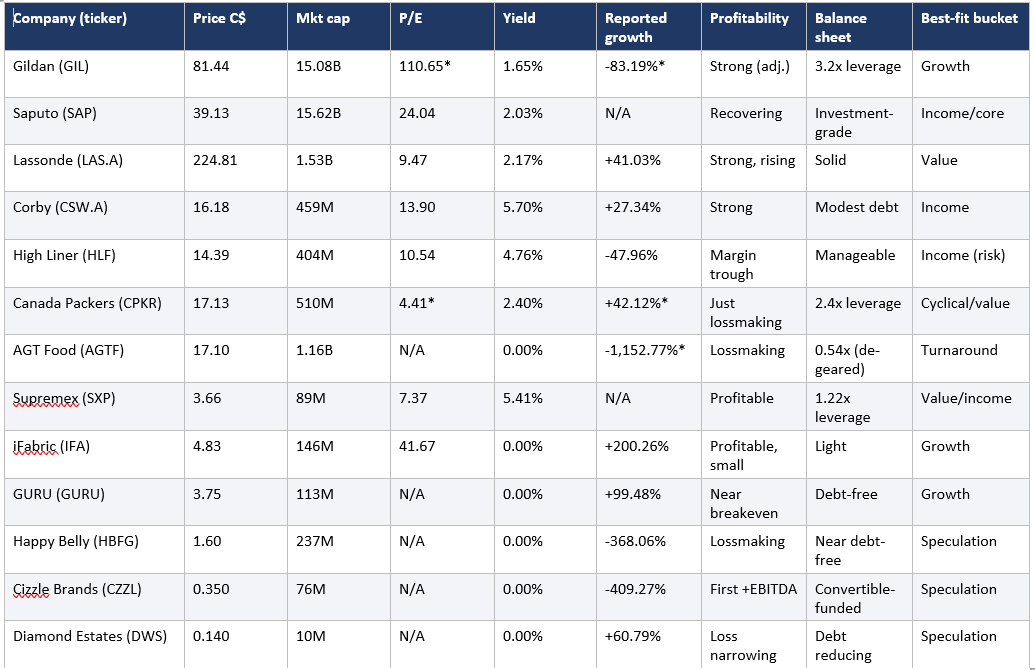
Reading the table. Entries marked with an asterisk carry a caveat explained in the assessments above: Gildan's P/E and negative growth reflect acquisition-distorted trailing GAAP earnings rather than the business's forward economics; Canada Packers' low P/E rests on stronger past quarters and predates the loss it reported on 5 August; and AGT's growth figure is warped by one-off listing costs. Where reported growth reads N/A, the screener did not supply a comparable figure. The point of the exercise is not to crown a single winner but to show that the same 13 names sort very differently depending on whether an investor wants income, growth, value or a speculative shot.
Best for income
Ranked on yield backed by earnings coverage and dividend durability, rather than headline yield alone:
- Corby Spirit and Wine (5.70%) — the highest yield among clearly profitable names, and the only one pairing a near-6% payout with double-digit revenue and earnings growth. Record fiscal third-quarter results and a recently raised dividend make the payout look well supported, though guidance for a softer fourth quarter is a near-term caveat.
- Supremex (5.41%) — a 5%-plus yield on a single-digit P/E, underpinned by a successful pivot into faster-growing packaging and a swing back to profit. The main watch item is the 19 August US tariff on Canadian-made goods.
- High Liner Foods (4.76%) — a genuine near-4.8% yield, but earned through a margin trough, tariff drag and US-dollar reporting; higher risk than the two names above, with the 14 August results a key test.
- Canada Packers (2.40%) — the dividend was maintained through a loss-making quarter, but commodity-margin volatility makes it the least predictable income stream on this list.
- Saputo (2.03%) and Lassonde (2.17%) — lower yields, but the most dependable payers, backed by scale, diversification and long distribution records; better suited to investors prioritising reliability over headline income.
Best for growth
Ranked on the quality and durability of revenue and earnings expansion, weighing margins and balance-sheet support alongside raw growth:
- Gildan Activewear — the standout for scale and forward earnings growth, with sales up 72% after the HanesBrands deal and adjusted EPS guided 32%-35% higher for 2026. High leverage is the trade-off, but no other name here combines this size, margin and cash generation.
- GURU Organic Energy — the best-balanced early-stage grower: 31.6% revenue growth, a 63.6% gross margin, positive trailing EBITDA and no debt. The unresolved US expansion caps the rating for now.
- iFabric — triple-digit historical revenue growth and a differentiated fabric-technology angle, though a P/E above 40 and small scale leave little margin for error.
- Cizzle Brands — the fastest grower of all at 253%, with a maiden positive-EBITDA quarter, but its reliance on convertible financing places it as much in the speculation bucket as in growth.
- Happy Belly Food Group — 80%-plus system-wide sales growth via franchising and acquisition, with profitability still to be proven; a growth story only for investors comfortable with micro-cap execution risk.
Best for value
Ranked on low valuation relative to demonstrated earnings and profitability — genuine value, as distinct from optically cheap cyclicals:
- Lassonde Industries — the clearest value-and-quality combination: a P/E of 9.47 despite 54.6% first-quarter earnings growth and expanding margins. Rising profits on a single-digit multiple are unusual among profitable staples.
- Supremex — a P/E of 7.37 with sharply higher EBITDA and a 5%-plus yield; cheap on earnings while actively reshaping its business mix toward growth.
- High Liner Foods — a P/E of 10.54 on trough earnings, so the multiple could look even cheaper once margins recover — provided they do; tariffs and whitefish supply are the swing factors.
- Corby Spirit and Wine — at 13.90x it is not classically cheap, but the growth and yield arguably justify the premium to the names above.
- Canada Packers — the 4.41 P/E is the lowest on the list, but it is a value trap in waiting: the multiple rests on past quarters and predates a reported loss, so it flatters rather than informs. AGT sits in similar turnaround-value territory, cheap on assets but not yet on earnings.
Best for speculation
Ranked on asymmetric upside potential set against elevated risk — for the highest-risk portion of a portfolio only:
- Cizzle Brands — explosive 253% revenue growth and a first positive-EBITDA quarter give it the most dramatic upside, but convertible-note dependence, cash burn and a sub-C$1 price make it the highest-risk name here.
- Happy Belly Food Group — a rapidly scaling, near-debt-free franchisor approaching 100 locations; the speculation is on whether scale converts into durable royalty profits.
- Diamond Estates Wines & Spirits — a tangible micro-cap turnaround with a quadrupled EBITDA margin, falling debt and a buy-local tailwind, offset by its debt load and negligible liquidity.
- iFabric — a profitable but richly valued small-cap whose fabric technology could scale meaningfully or disappoint sharply; speculative because of the price, not the balance sheet.
- AGT Food and Ingredients — a Fairfax-backed turnaround trading below its IPO price, with debt slashed but earnings still deeply negative; the most institutionally sponsored speculation on the list.
What to monitor for the rest of August 2026
Several near-term events will test the rankings above within days of publication. The calendar is unusually busy, and the results will confirm or challenge where each name sits on the income-versus-growth spectrum.
- Saputo's fiscal 2027 first-quarter results, due after the close on 6 August with its annual meeting on 7 August, will show whether the margin-recovery programme is delivering and may reset the sector's largest income name.
- Lassonde's second-quarter 2026 figures, expected around 6 August, will confirm whether the first quarter's 54.6% profit jump is a trend — central to the value case.
- High Liner's second-quarter results on 14 August are the key read on the income thesis: watch for the promised second-half EBITDA recovery and any update on tariff-refund claims.
- US tariffs on Canadian-manufactured goods, effective 19 August, directly threaten Supremex and could ripple through iFabric and other exporters; management commentary on mitigation will matter.
- Happy Belly's second-quarter update and its 100-location milestone, alongside any further acquisitions across the micro-caps, will indicate whether the growth names are converting expansion into profit.
- Follow-through from Canada Packers' loss and Corby's flagged softer quarter — both will show how much of each story was one-off timing versus a durable change in trajectory.
Conclusion
Ranked side by side, these 13 names resist a single ordering because they answer different questions. For income, Corby and Supremex stand out for pairing yields above 5% with real business momentum, while Saputo and Lassonde offer lower but sturdier payouts and High Liner a higher yield at higher risk. For growth, Gildan dominates on scale and forward earnings, with GURU the best-balanced of the smaller expanders. For value, Lassonde and Supremex screen genuinely cheap on demonstrated earnings, whereas the lowest headline multiples — Canada Packers and AGT — come freighted with cyclicality and turnaround risk. For speculation, Cizzle, Happy Belly and Diamond Estates offer asymmetric upside that only suits capital an investor can afford to lose.
None of this constitutes advice to buy or sell, and a bullish screener tag is a prompt for research, not a substitute for it — a rating is not a guarantee, and past growth does not assure future returns. The tariff picture, the rate path and commodity swings can move any of these shares sharply, and several of the figures here are a 6 August screener snapshot rather than confirmed live data. What the comparison does offer is a clearer map: it shows which of these companies are built for cash return, which for expansion, which for value and which are frankly speculative, so that readers can match a name to their own objective and risk tolerance rather than to a one-word recommendation.


 Nov 27, 2026





 Please wait processing your request...