
 NZ
 UK
 US
 AU
 IND

 CA

 Share
 X (Formerly Twitter)
 Whatsapp
 Facebook
 LinkedIn
 Telegram
 Email This Article
 Copy Link
 Summarize with AI
 Chat GPT
 Perplexity

Key takeaways
- Gildan Activewear (TSX:GIL) has roughly doubled in scale after completing its HanesBrands takeover in December 2025 and delisting from the NYSE; second-quarter sales jumped 72% and management raised full-year guidance, though a depressed trailing profit leaves the headline P/E close to meaningless for now.
- Corby Spirit and Wine (TSX:CSW.A) posted record third-quarter results, lifted by its Ace Beverage ready-to-drink acquisition and a nationalist shift away from US spirits, and again paid a chunky quarterly dividend.
- Canada Packers (TSX:CPKR) — the Maple Leaf Foods pork spin-off that listed only last October — slumped after reporting a C$28.4m quarterly net loss on 5 August, a reminder of how volatile commodity meat processing can be.
- AGT Food and Ingredients (TSX:AGTF) returned to public markets in March 2026 at C$23 a share, with Fairfax retaining majority control; the pulse processor now trades below its issue price and remains loss-making.
- Dividend income is the connective thread: Corby, Supremex, High Liner, Saputo, Lassonde and Canada Packers all pay, while several early-stage names such as Cizzle Brands, GURU and Happy Belly are still chasing their first sustained profits.
Introduction: why consumer non-durables matter this August
Consumer non-durables — the food, drink, apparel and packaged goods that households buy and use up quickly — rarely dominate headlines. Yet in the first week of August 2026 this defensive corner of the Canadian market has produced an unusually dense run of corporate news. Gildan is digesting the largest deal in its history, Corby is compounding record sales, a freshly minted meat processor has stumbled into its first quarterly loss, and a pulse-protein group thought long gone from public markets has quietly returned. For investors rotating towards steadier cash flows amid an uncertain rate path and a still-tense Canada-US trade relationship, the sector offers both income and event risk in the same breath.
This feature is deliberately news-led rather than a scored league table. It follows the live threads — earnings, guidance, dividends, mergers and spin-offs — and weaves company detail around them. A companion ranking article covers the same 13 names in scored form; here the aim is context. All share prices, market capitalisations, dividend yields and multiples described as a snapshot are drawn from a stock-screener reading taken on 6 August 2026 and should be treated as a point-in-time indication rather than an independently confirmed live quote. Company financial results, guidance, deals and dividend actions have, wherever possible, been verified against primary releases; where a figure could not be confirmed, that is stated plainly.
Screening methodology
The universe here is the 13 Canadian-listed consumer non-durables companies flagged by a market screener on 6 August 2026, spanning the Toronto Stock Exchange (TSX), the TSX Venture Exchange (TSXV), the Canadian Securities Exchange (CSE) and Cboe Canada (formerly the NEO exchange). They range from multi-billion-dollar heavyweights such as Saputo and Gildan to micro-cap venture names such as Diamond Estates. Inclusion reflects the screener's sector classification and a broadly constructive analyst tag, not an endorsement.
For each company we prioritised primary sources: regulatory filings on SEDAR+, investor-relations material, quarterly and annual reports, management discussion and analysis (MD&A) and earnings releases, supplemented by reputable financial media. We record the direction of revenue and earnings, profitability and cash generation, balance-sheet health, any dividend and its sustainability, current valuation with its date, recent announcements, plausible catalysts and the main risks. Where a business is loss-making or pre-profit, the price-to-earnings (P/E) ratio is shown as not applicable — a negative or near-zero earnings base makes the multiple mathematically unstable and analytically useless, so we lean on revenue growth, gross margin and the path to breakeven instead.
The Canadian backdrop: defensive staples with a trade-war twist
Two forces frame the sector in mid-2026. The first is the familiar appeal of consumer staples as defensive holdings: demand for cheese, juice, frozen fish and basic apparel is relatively insensitive to the economic cycle, which supports steady cash flows and, for the mature names, reliable dividends. The second is distinctly of the moment. The renewed Canada-US tariff dispute has cut both ways for these companies. On one hand, US duties on Chinese and other imported inputs have squeezed margins for apparel-adjacent firms such as iFabric and lifted costs across supply chains. On the other, a wave of Canadian consumer nationalism — provincial liquor boards pulling US-origin products from shelves, shoppers favouring domestic brands — has handed share gains to Corby and Diamond Estates in wine and spirits.
Currency adds another layer. A soft Canadian dollar flatters the reported results of exporters and of companies with large US operations, including Gildan, Saputo and Lassonde, while a weaker Japanese yen has hurt Canada Packers' pork export economics. The analysis that follows is the author's interpretation of these dynamics; the underlying financial figures are drawn from company disclosures.
The interest-rate backdrop matters too. With Canadian households still absorbing the lagged effect of earlier rate rises, trading down to private-label groceries and cheaper basics has supported volume for value-oriented players such as Lassonde in private-label juice and High Liner at the value end of frozen seafood. Lower policy rates through 2026 would ease financing costs for the more leveraged names — Corby after its Ace Beverage deal, Supremex after its packaging acquisitions, and Gildan after HanesBrands — while a firmer consumer would help the discretionary end of the group, from restaurant franchisor Happy Belly to energy-drink challenger GURU. The sector therefore blends genuine defensiveness with pockets of cyclical and event-driven sensitivity, which is what makes it worth dissecting name by name.
Gildan Activewear (TSX:GIL): a doubled business, a distorted multiple
Montreal-based Gildan is one of the world's largest vertically integrated manufacturers of basic apparel — T-shirts, fleece, socks and underwear — sold through both wholesale imprintables and retail channels. The defining event is its acquisition of HanesBrands, completed in December 2025, which roughly doubled the group's scale and prompted a delisting from the New York Stock Exchange, leaving the TSX as its primary listing. Second-quarter 2026 results, reported at the end of July, showed net sales of about US$1.58bn, up 72% year on year as HanesBrands consolidated in, with adjusted operating income of roughly US$352m and an adjusted operating margin near 22%. Management raised full-year 2026 guidance to revenue of US$6.0-6.2bn, an adjusted operating margin around 21.8%, adjusted diluted earnings per share of US$4.65-4.75 and free cash flow of about US$1.0bn.
Cash generation is a strength — operating cash flow was around US$347m in the quarter — and the company has agreed to sell HanesBrands' Australian arm for roughly A$700m (about US$490m) to accelerate debt reduction, with closing expected in the second half of 2026. Catalysts: realising the targeted US$250m of annual run-rate synergies, roughly US$220m of expected tariff refunds landing largely in the third quarter, and deleveraging after the Australia sale. Risks: integration missteps, a stretched balance sheet post-deal, and soft demand in imprintable apparel. On the 6 August screener snapshot Gildan traded at C$81.44 with a market capitalisation near C$15.1bn and a 1.65% yield; the reported P/E of about 111 and the 83% drop in trailing EPS reflect acquisition and one-off costs rather than the underlying earnings power the guidance implies, which is exactly why the trailing multiple should be discounted. It earns its place on the August watchlist as the sector's single biggest corporate-transformation story.
Corby Spirit and Wine (TSX:CSW.A): record quarter, generous payout
Corby is a leading Canadian marketer of spirits and wines, with owned brands including J.P. Wiser's whisky, Lamb's rum and Polar Ice vodka, plus a portfolio of represented international labels through its ties to Pernod Ricard. For the third quarter of fiscal 2026 (the three months to 31 March 2026), Corby reported record revenue of C$58.3m, up 21% year on year, with reported net earnings of C$7.9m — up 97% — and adjusted net earnings of C$7.6m, up 67%. Reported earnings per share were C$0.28. Over the first nine months of the year revenue reached C$200.6m, up 15%. The board declared a quarterly dividend of C$0.24 per share, payable in June 2026.
The growth engine is ready-to-drink (RTD) beverages: Corby's move to acquire a majority stake in Ace Beverage Group — maker of Cottage Springs and other RTD lines, for roughly C$148.5m as part of a deal valuing the target near C$165m — has plugged it into one of the fastest-growing drinks categories, with its RTD portfolio expanding 22% in the quarter against 10% category growth. A nationalist pull away from US-origin spirits has also lifted its domestic market share. Catalysts: continued RTD momentum, Ace integration and margin capture, and resilient LCBO ordering. Risks: acquisition debt, a maturing RTD cycle, and the commission and export lines that fell in the quarter. On 6 August the screener showed C$16.18, a market cap near C$459m and a 5.70% yield — among the richest income profiles in the group. Corby features because it pairs record operating momentum with one of the sector's most attractive, and apparently well-covered, dividends. The strategic logic is also clear: by moving from a spirits-and-wine marketer towards a broader beverage-alcohol platform that captures the RTD wave, Corby is repositioning for where Canadian drinking occasions are actually heading, and doing so while the domestic-brand tailwind is at its back.
Canada Packers (TSX:CPKR): the spin-off's first stumble
Canada Packers is the pork-processing business that Maple Leaf Foods spun off, with the shares beginning to trade on the TSX under the ticker CPKR at the start of October 2025. (Investors should note the correct symbol is CPKR, not the sometimes-assumed CPI.) As a pure-play protein processor it is exposed directly to pork cut-out prices, hog costs and export currencies. On 5 August 2026 it reported second-quarter revenue of C$431.7m, down 8.8%, and a net loss of C$28.4m, swinging from a C$23.4m profit a year earlier. Basic loss per share was C$0.95, though adjusted earnings per share were a positive C$0.34 and adjusted EBITDA of C$34.9m kept the company within its 8-12% target margin band.
Management attributed the loss largely to a C$48.3m non-cash reduction in the fair value of biological assets, softer pork cut-out prices, an unfavourable yen and the added costs of operating as a standalone company. The board approved a quarterly dividend of C$0.23 per share (C$0.92 annualised), payable at the end of September. Catalysts: normalising pork markets, standalone cost discipline, and export recovery. Risks: commodity price swings, currency, and the fair-value volatility that produced this quarter's headline loss. The screener's 6 August entry — a P/E near 4.4 on trailing EPS of C$3.88 — sits awkwardly against a freshly reported loss and appears to reflect stale or blended data; treat those particular figures with caution. What is verifiable is the roughly 10% one-day share drop that accompanied the result. Canada Packers is on the watchlist precisely because it shows how quickly a young, single-commodity spin-off can surprise to the downside.
AGT Food and Ingredients (TSX:AGTF): back on the board
AGT is a Saskatchewan-based processor and exporter of pulses — lentils, peas, chickpeas — and pulse-derived ingredients such as pea protein and pea starch, serving food manufacturers globally. Its notable feature this year is corporate rather than operational: having been taken private in 2019, AGT returned to the Toronto Stock Exchange through an initial public offering that priced at C$23 per share, began trading on 3 March 2026 and closed on 9 March. The listing raised roughly C$425m from the treasury offering plus a secondary component, with Fairfax Financial subscribing for about C$200m in a concurrent private placement and retaining majority control of around 55.8%. Proceeds were earmarked for repaying bank facilities.
AGT is loss-making at present, which is why no P/E applies; the screener's trailing EPS of about -C$1.90 and an extreme negative growth read reflect that base. The investment case rests on structural demand for plant protein, the pricing of the global pulse crop and Fairfax's long-term backing. Catalysts: deleveraging with IPO proceeds, a stronger pulse harvest, and traction in higher-margin ingredient lines. Risks: commodity and weather exposure, thin near-term profitability, a controlling shareholder whose interests may not always align with minority holders, and a share price — around C$17.10 on 6 August — that already sits well below the C$23 issue price. AGT belongs on any August watchlist as the sector's most notable re-listing, and a test of appetite for newly public agri-food names. Its performance will also be read as a signal by other private-equity-backed food and agriculture businesses weighing a Toronto listing in a window that has, so far, been cautious about new issues.
Saputo (TSX:SAP): a leaner dairy giant
Saputo is one of the world's larger dairy processors, making cheese, fluid milk, dairy ingredients and alternatives across Canada, the United States, Argentina, Australia and the United Kingdom. For fiscal 2026 (the year to 31 March 2026) it reported revenue of C$17.55bn, down 1.5%, but adjusted EBITDA rose 10.4% to C$1.66bn as a multi-year efficiency programme lifted margins; net earnings from continuing operations were C$690m and adjusted diluted EPS was C$1.82. Operating cash flow climbed to about C$1.51bn, funding both a maintained quarterly dividend of C$0.20 per share and share buybacks of roughly C$679m during the year.
The story here is margin recovery and disciplined capital return rather than top-line growth. Catalysts: the next leg of its network-optimisation savings, firmer global dairy prices, and continued buybacks. Risks: milk-price and input volatility, currency translation across five countries, and soft volumes in some segments. On 6 August the screener showed C$39.13, a market cap near C$15.6bn and a 2.03% yield, with a trailing P/E around 24. Timing matters: Saputo was scheduled to report its fiscal 2027 first-quarter results after the close on 6 August, with a conference call and annual meeting the following day — so a fresh data point was imminent as this piece went to press. Saputo makes the list as the blue-chip anchor of Canadian dairy and a barometer for the broader staples trade.
Lassonde Industries (TSX:LAS.A): the quiet juice compounder
Lassonde is North America's dominant maker of branded and private-label fruit and vegetable juices and drinks, with a substantial US footprint alongside its Quebec home base. It has been one of the sector's strongest performers, and on 6 August its shares stood at C$224.81 on the screener — up 3.71% on the day — for a market capitalisation of about C$1.53bn, a trailing P/E near 9.5 and a 2.17% yield, supported by a quarterly dividend of C$1.25 per share. The screener's trailing EPS of roughly C$23.73 and reported earnings growth above 40% capture a period in which firmer private-label pricing in the United States and disciplined cost control lifted profitability sharply.
A note of caution on timing: Lassonde was due to release its second-quarter 2026 results after the close on 6 August, with analyst consensus around C$4.30 in quarterly EPS on roughly C$525m of revenue — figures that were still forecasts, not confirmed actuals, as this feature was prepared. Catalysts: US private-label share gains, input-cost easing on fruit concentrate, and continued dividend growth. Risks: raw-material and packaging inflation, customer concentration among large grocers, and the tough comparison set by a very strong prior year. Lassonde earns its watchlist spot as a rare combination in this group — double-digit earnings growth on a single-digit multiple — with a live earnings catalyst on the very day of writing. Whether the second quarter confirms or cools that trajectory is the single most important data point for the name this month, and a miss against the roughly C$4.30 consensus could quickly compress a rating that the market has, so far, been happy to keep undemanding.
High Liner Foods (TSX:HLF): frozen seafood, steady income
Nova Scotia-based High Liner is North America's largest processor and marketer of value-added frozen seafood, supplying retail and foodservice customers on both sides of the border. Its most recent confirmed results were for the first quarter of 2026; the company had set 13 August 2026 as the release date for its second-quarter figures, so as of the 6 August snapshot the latest quarter was not yet public. On the screener the shares traded at C$14.39 for a market cap near C$404m, a trailing P/E around 10.5 and an attractive 4.76% yield, underpinned by a quarterly dividend that has been raised to C$0.18 per share.
High Liner's appeal is income plus deleveraging: management has steadily paid down debt while returning cash, and net leverage has trended lower in recent years. The screener's roughly 48% decline in trailing EPS reflects tougher year-on-year comparisons rather than a broken model. Catalysts: the 13 August result, easing input costs, and any resolution on cross-border seafood tariffs. Risks: US-Canada trade friction on a business that ships across the border daily, volatile fish-supply costs, and softening foodservice demand. High Liner is on the watchlist as a dependable dividend payer with a near-term earnings event and clear trade-policy sensitivity.
Supremex (TSX:SXP): the envelope maker pivoting to packaging
Supremex manufactures envelopes and, increasingly, packaging and specialty products across Canada and the United States. Its second-quarter 2026 results, released in late July, showed revenue up 8.5% to C$71.6m, with the packaging and specialty segment growing 19% to C$26.4m — now about 37% of the total — while the mature envelope business rose a modest 3.2% to C$45.2m. Net earnings were C$1.0m (C$0.04 per share) and adjusted EBITDA was C$7.8m at a 10.9% margin; the board declared a quarterly dividend of C$0.05 per share, payable in September. Net debt stood at C$43.9m, or a comfortable 1.22 times adjusted EBITDA.
The investment thesis is a managed transition: using cash from the structurally declining envelope business to build a growing packaging franchise. Catalysts: further packaging acquisitions, margin expansion as the mix shifts, and continued dividend coverage. Risks: the secular fall in mailed volumes, acquisition-related debt, and thin quarterly net margins. At C$3.66 on 6 August, with a market cap near C$89m, a P/E around 7.4 and a headline 5.41% yield, Supremex screens as a deep-value income name. It makes the watchlist because its packaging pivot is beginning to show in the numbers while the payout still looks supported.
GURU Organic Energy (TSX:GURU): turning the corner
GURU is a Quebec-based challenger in the organic and natural energy-drink category, sold across Canada and in parts of the United States. Its second-quarter fiscal 2026 results showed revenue up 31.6% to about C$8.5m with continued margin expansion, following a record first quarter of roughly C$8.8m and a run of EBITDA-positive quarters — evidence that a previously cash-burning growth story is edging towards sustainable profitability. The company does not pay a dividend, reinvesting instead in distribution and marketing.
Because GURU is only now approaching consistent profitability, its P/E is not meaningful; the screener's near-zero EPS and triple-digit growth read reflect that inflection. Catalysts: US distribution gains, new product formats, and the first full year of positive EBITDA. Risks: intense competition from global energy-drink majors, marketing spend that can outpace revenue, and a small-cap liquidity profile. At C$3.75 on 6 August for a market cap near C$113m, GURU is a speculative growth holding. It appears here as the clearest example in the group of an early-stage brand transitioning from cash burn to breakeven — a story worth monitoring rather than a settled winner.
iFabric (TSX:IFA): performance textiles and a brand reset
iFabric operates two arms: an Intelligent Fabrics division that makes performance and clinically tested textiles, including medical apparel, and an Intimate Apparel division transitioning away from the licensed Maidenform brand towards proprietary lines. Full-year 2025 revenue rose 20% to C$32.9m, driven by a 33% surge in Intelligent Fabrics to C$26.2m, though group gross margin slipped to 32% from 41% as US tariffs on China-sourced inventory and one-time markdowns tied to the brand exit bit into profitability. Management raised its outlook for the first quarter of 2026 to C$25-27m, and an earnings call flagged a sharp quarterly revenue jump as new programmes ramped.
Catalysts: recovery in gross margin as the supply base diversifies away from China, growth in medical and performance apparel, and traction for the in-house intimate-apparel brands. Risks: tariff exposure, margin volatility during the brand transition, and customer concentration. The screener showed C$4.83 on 6 August, a P/E near 42 on modest trailing EPS of C$0.12, and no dividend; one published analyst target sat at C$3.50, below the current price, underlining how much optimism is already embedded. iFabric is on the watchlist as a small-cap turnaround where the top line is clearly growing but the margin story is not yet resolved.
Cizzle Brands (CN:CZZL): first taste of profit
Cizzle Brands is a Toronto-based sports-nutrition and hydration company. For clarity on a name the screener left unlabelled: it trades as CZZL on Cboe Canada (the former NEO exchange), with a US OTCQB quotation under CZZLF and a Frankfurt listing. Its portfolio spans CWENCH Hydration, a sports drink now in more than 6,700 retail locations, SPOKEN Nutrition and the HappiEats food range. Fiscal third-quarter 2026 results were a milestone: revenue of C$12.6m, up 253% year on year, gross profit of C$5.4m at a 43% margin, and a first-ever positive adjusted EBITDA of about C$0.3m, against a C$2.4m loss a year earlier. Nine-month revenue reached roughly C$21.0m.
The leap partly reflects the CWENCH acquisition and a push into the United States. Catalysts: US retail expansion, the first sustained run of positive EBITDA, and new product launches. Risks: the group remains small and was still reporting net losses at the group level, competition in hydration is fierce, and rapid growth strains working capital. On 6 August the shares changed hands near C$0.35 for a market cap around C$76m, with no dividend and no meaningful P/E given its early-stage losses. Cizzle earns a watchlist place as the group's fastest-growing brand story — and its correct ticker and exchange are worth recording, since the screener supplied neither.
Happy Belly Food Group (CN:HBFG): a franchise roll-up
Happy Belly is a consolidator of emerging Canadian quick-service restaurant (QSR) brands, acquiring and franchising food concepts across the country; it trades on the CSE as HBFG and on the US OTCQB as HBFGF. The model is growth by acquisition and franchise expansion: fiscal 2025 system-wide QSR sales reached C$63.1m, up 108%, and first-quarter 2026 system-wide sales rose 80.4% to C$19.3m. The company had announced a release date for its second-quarter 2026 results, which were pending as of the 6 August snapshot.
Because Happy Belly is still investing heavily to scale, it remains loss-making at the net level, so no P/E applies and the screener's steep negative earnings-growth figure reflects that build-out phase. Catalysts: further brand acquisitions, franchise-unit openings, and the move towards positive net income from operations that management has flagged. Risks: acquisition-driven share issuance and dilution, execution risk across many small brands, and the discretionary nature of restaurant spending. At C$1.60 on 6 August for a market cap near C$237m, and with no dividend, Happy Belly is a high-beta expansion story. It appears on the watchlist as the group's most aggressive roll-up — compelling on system-wide sales momentum, unproven on bottom-line economics.
Diamond Estates Wines & Spirits (TSXV:DWS): the micro-cap wildcard
Diamond Estates is a small Ontario producer and distributor of wines and spirits, trading on the TSX Venture Exchange. For fiscal 2026 (the year to 31 March 2026) it reported revenue up 22% to C$29.9m and adjusted EBITDA of C$3.8m, a solid improvement helped by the same buy-Canadian sentiment lifting other domestic drinks makers as provincial liquor boards curtailed US-origin products. The company pays no dividend and, at C$0.14 on 6 August for a market cap around C$10m, sits firmly in speculative micro-cap territory.
The screener records a small trailing loss per share alongside strong revenue growth, which is why a P/E is not applicable. Catalysts: continued share gains from US-product displacement, its agency-representation business, and operating leverage as volumes rise. Risks: minimal liquidity, a stretched balance sheet common to venture-stage producers, and the seasonality of wine sales. Diamond Estates rounds out the watchlist as the smallest and most speculative name — a leveraged play on Canadian drinks nationalism, appropriate only for investors comfortable with venture-market volatility.
At a glance: the 13 names compared
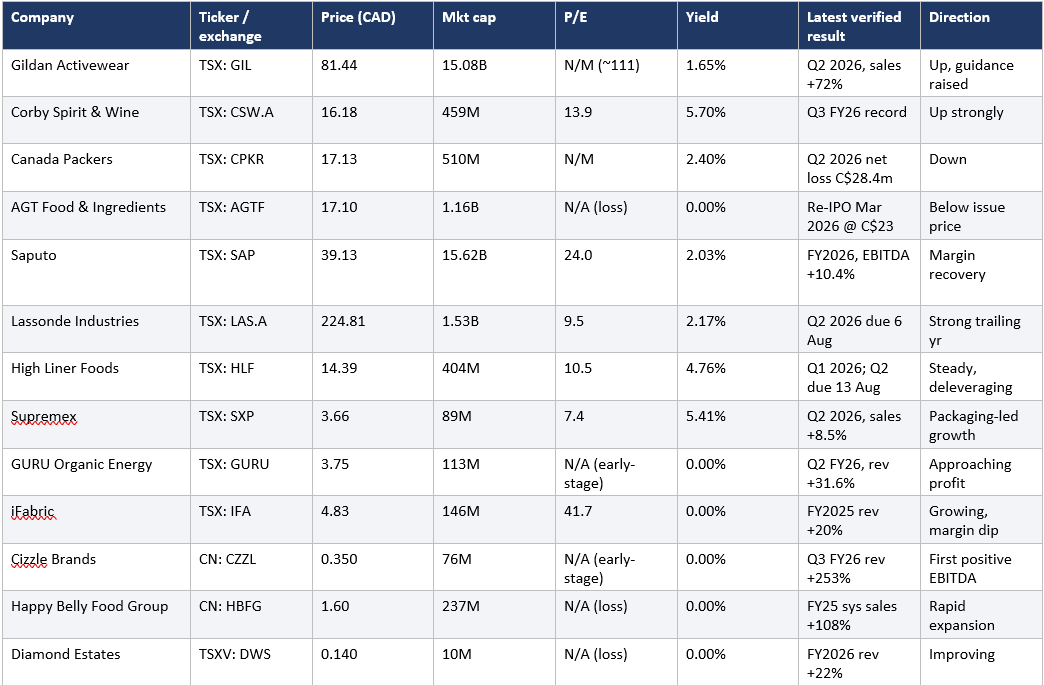
Light themes and groupings
Rather than rank these names, it is more useful to sort them by the role they might play. The income group — Corby, Supremex, High Liner, Canada Packers, Saputo and Lassonde — pays dividends yielding from roughly 1.7% to 5.7%, with Corby and Supremex offering the fattest headline yields and Saputo and Lassonde the deepest dividend histories. The transformation group — Gildan and AGT — is defined by corporate events: a transformative acquisition and delisting in Gildan's case, a return to public markets in AGT's. The early-stage growth group — Cizzle, GURU, Happy Belly and iFabric — trades on revenue momentum and the promise of profitability rather than current earnings, which is why traditional multiples do little work there. Canada Packers sits awkwardly across categories: a dividend payer that just posted a loss.
This grouping is analysis, not a recommendation. A high yield can signal either value or distress, and rapid revenue growth at a micro-cap can evaporate as quickly as it appeared. The point is that the sector currently offers unusually varied risk profiles under one banner.
Several risks cut across the whole group. Trade policy is the most obvious: tariffs raise input costs for the apparel-adjacent names and threaten cross-border volumes for High Liner and Canada Packers, even as they hand a share windfall to domestic drinks makers. Commodity inputs — milk, hogs, fruit concentrate, fish, cotton and pulses — introduce margin volatility that no amount of brand strength fully offsets. And liquidity is a real constraint at the smaller end: for Diamond Estates, Cizzle, Happy Belly and GURU, thin trading volumes can amplify price moves in both directions, so position sizing and time horizon matter as much as the underlying business case.
What to monitor for the rest of August 2026
- Saputo and Lassonde earnings, both due around the close on 6 August, will set the tone for the large-cap staples and test whether Lassonde can sustain its exceptional trailing-year profitability.
- High Liner Foods reports second-quarter results on 13 August, a read on both frozen-seafood demand and the cross-border tariff drag on its supply chain.
- Gildan's integration progress — synergy capture, the timing of the HanesBrands Australia disposal, and the roughly US$220m of expected tariff refunds — will shape whether its raised guidance holds.
- Canada Packers' recovery path after its first quarterly loss: watch pork cut-out prices, the yen, and any commentary on standalone cost normalisation.
- AGT Food's post-IPO trading, still below its C$23 issue price, and any first signs of the deleveraging its offering was meant to fund.
- Corby's Ace Beverage integration and whether RTD momentum carries into its fiscal year-end, and Cizzle's ability to build on its first positive-EBITDA quarter.
Conclusion
Canadian consumer non-durables entered August 2026 anything but sleepy. Gildan has reinvented its scale through the HanesBrands deal and now trades on a promise of synergies and deleveraging rather than its distorted trailing earnings. Corby is compounding record sales and paying investors well to wait. Saputo and Lassonde show that patient margin work and pricing discipline can still generate handsome returns in mature categories, while a clutch of smaller names — Supremex, High Liner, GURU, iFabric, Cizzle, Happy Belly and Diamond Estates — offer growth, income or turnaround angles at varying levels of risk. Canada Packers and AGT, meanwhile, are cautionary reminders that recently independent or newly re-listed companies can disappoint before they prove themselves.
None of this constitutes advice to buy or sell, and the constructive analyst tags attached to several of these names are opinions, not guarantees; a rating is not a promised return. Valuations cited here are a 6 August 2026 snapshot and will have moved. Several companies were reporting fresh numbers on the very days around publication, so any decision should rest on the latest filings and each investor's own circumstances and risk tolerance. What the sector clearly offers this month is a rich menu of events to watch — and that, more than any single price target, is why these names reward attention.


 Nov 27, 2026





 Please wait processing your request...