
 NZ
 UK
 US
 AU
 IND

 CA

 Share
 X (Formerly Twitter)
 Whatsapp
 Facebook
 LinkedIn
 Telegram
 Email This Article
 Copy Link
 Summarize with AI
 Chat GPT
 Perplexity

Key Takeaways
- The Canadian dollar (CAD) climbed to a 10-day high, trading near USD/CAD ≈ 1.4030, supported by favourable labour data, pro-growth fiscal policy, and improved global risk sentiment.
- Canada’s 2025 federal budget, with about CA$280 billion in infrastructure and productivity spending, is driving renewed confidence in domestic growth.
- Investors expect fewer rate cuts from the Bank of Canada (BoC) as the economy shows steady resilience.
- Sector implications:
- Infrastructure, construction, and engineering firms may benefit from government spending.
- Defence and manufacturing could see growth from local production and supply-chain support.
- Clean-tech and critical-minerals sectors stand to gain from new incentives.
- Financials may benefit from stable yields and higher loan demand.
- Exporters face currency headwinds, while importers and domestic industries could see cost advantages due to strength in CAD.
- The loonie’s strength reflects investor confidence in Canada’s fundamentals, but global sentiment, commodity trends, and BoC policy decisions remain key watchpoints.
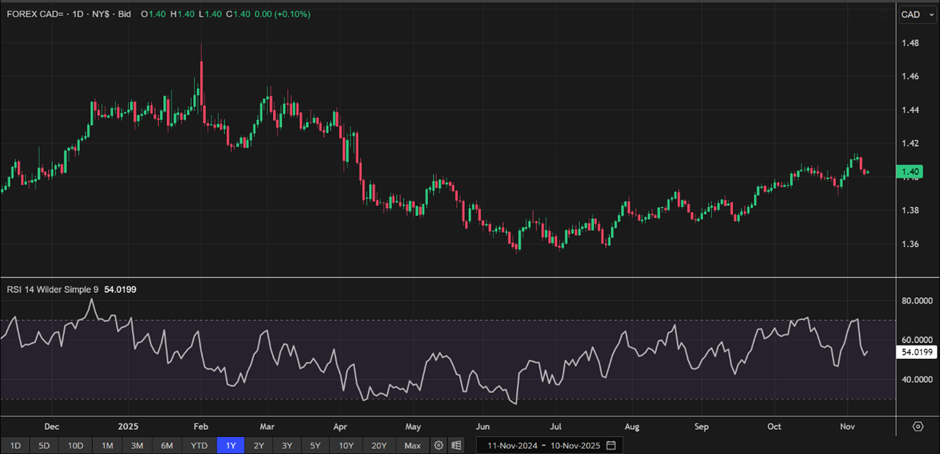
The Canadian dollar (CAD) reached a 10-day high against the U.S. dollar, trading around USD/CAD ≈ 1.4030 (or about 71.3 U.S. cents). The move reflects improved global risk sentiment, steady domestic labour data, and a federal budget focused on economic investment.
Favourable employment figures and fiscal support have increased investor confidence in Canada’s near-term outlook. Expectations for significant rate cuts from the Bank of Canada (BoC) have also eased, helping the currency find support.
Source: EODHD/Others
Factors Supporting the Canadian Dollar
- Labour Market Resilience
October employment data in Canada came in above forecasts, suggesting that the economy continues to perform better than expected. This has led investors to scale back expectations for early or aggressive BoC rate reductions.
- Pro-Growth Federal Budget 2025
The government’s latest budget outlines about CA$280 billion in spending over five years on areas such as infrastructure, housing, and productivity improvements.
This fiscal approach signals a preference for investment-led growth, which tends to support domestic demand and overall business activity.
- Global Risk Appetite
Recent improvement in global equity markets and commodities has created a risk-on environment. Commodity-linked currencies such as the CAD often benefit during such periods as investors seek exposure to growth-sensitive assets.
- Bank of Canada Policy Outlook
With stable inflation trends and a firm labour market, markets expect the BoC to maintain a cautious stance on rate adjustments. The reduced likelihood of rate cuts helps maintain interest-rate differentials that are favourable to the Canadian dollar.
Implications for the Economy and Financial Markets
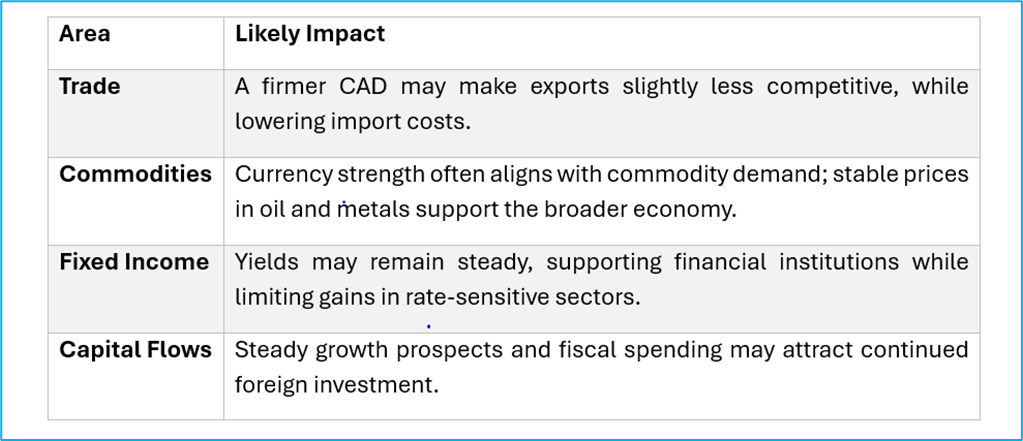
Overall, the strength in dollar reflects gradual improvement in domestic fundamentals rather than speculative flows.
Sectors and Companies That Could Benefit
- Infrastructure, Construction and Engineering
Government spending on infrastructure is expected to create opportunities for companies engaged in project management, engineering, and design services.
Notable names to look at:
- Aecon Group Inc. (TSX:ARE) - A leading Canadian construction and infrastructure company specializing in civil, industrial, and urban transportation projects across North America.
- WSP Global Inc. (TSX:WSP) - A global engineering and professional services firm delivering sustainable infrastructure, environmental, and design solutions worldwide.
- Stantec Inc (TSX:STN) - A top international engineering and architecture firm focused on infrastructure, environmental services, and community development.
- Bird Construction Inc. (TSX:BDT) - A diversified Canadian builder engaged in industrial, institutional, and infrastructure projects with a growing national footprint.
- AtkinsRéalis Group Inc. (TSX:ATRL) - A global engineering, project management, and construction solutions provider driving innovation in infrastructure and clean energy.
- Defence and Advanced Manufacturing
Policy priorities include modernizing defence capabilities and strengthening domestic manufacturing. This could benefit aerospace, technology, and materials suppliers.
Companies to watch:
- Cameco Corp. (TSX:CCO) - One of the world’s largest uranium producers, powering clean nuclear energy and supporting the global energy transition.
- CAE Inc. (TSX:CAE) - A global leader in simulation training and defence technology, serving aviation, security, and healthcare industries.
- MDA Ltd. (TSX:MDA) - A Canadian space and defence technology company pioneering satellite systems, robotics, and geo-intelligence solutions.
- Bombardier Inc. (TSX:BBD.B) - A world-class manufacturer of business jets and special mission aircraft, driving innovation in aerospace and defence.
- Clean Technology and Critical Minerals
Expanded incentives for clean energy production, carbon capture, and mineral processing may support firms involved in energy transition projects. Mining and materials companies with exposure to lithium, cobalt, and nickel could benefit.
Notable companies to watch:
- Anaergia Inc. (TSX:ANRG) - A global leader in clean energy solutions converting organic waste into renewable natural gas and sustainable fuels.
- Northland Power Inc. (TSX:NPI) - A top Canadian independent power producer focused on renewable energy, offshore wind, and sustainable infrastructure.
- Ucore Rare Metals Inc (TSXV:UCU) - A critical minerals company advancing rare earth separation technologies essential for EVs and clean energy supply chains.
- Canadian Critical Minerals Inc. (TSXV:CCMI) - A mining company developing key battery metal assets to strengthen North America’s critical minerals security.
- Canada Nickel Company Inc. (TSXV:CNC) - A fast-growing explorer unlocking next-generation nickel resources vital for the electric vehicle revolution.
- Financials and Housing
Banks and financial institutions could see steady lending activity linked to infrastructure and housing investments. Mortgage growth and corporate financing needs may support profitability even as currency strength slightly affects foreign income.
Key Players to look at:
- Royal Bank of Canada (TSX: RY) – Operates as Canada’s largest bank, offering retail banking, wealth management, and capital markets services globally.
- Toronto-Dominion Bank (TSX: TD) – Provides personal and commercial banking in Canada and the U.S., with decisive digital and retail banking operations.
- Bank of Montreal (TSX: BMO) – A full-service financial institution offering banking, investment, and capital market solutions across North America.
- Canadian Apartment Properties REIT (TSX: CAR.UN) – Owns and manages residential rental properties across Canada, generating stable income from long-term leases.
- H&R Real Estate Investment Trust (TSX: HR.UN) – A diversified REIT investing in residential, office, industrial, and retail properties in Canada and the U.S.
- Commodity and Resource Producers
The effect on commodity producers will depend on pricing trends. While a resilient CAD can weigh on export margins, investment in domestic energy and mining projects may offset near-term currency pressure.
Notable Companies:
- Barrick Gold Corp. (TSX: ABX) – Global gold producer with diversified mining assets and strong exposure to precious metals.
- Cameco Corp. (TSX: CCO) – Leading uranium supplier powering global nuclear and clean-energy demand.
- Agnico Eagle Mines Ltd. (TSX: AEM) – Major gold miner with stable production across Canada, Finland, and Mexico.
- Wheaton Precious Metals Corp. (TSX: WPM) – Premier metals streaming company offering low-risk exposure to gold and silver.
- Teck Resources Ltd. (TSX: TECK.B) – Canadian diversified miner producing copper, zinc, and coal, supporting the green-energy shift.
Areas of Caution
- Export Sensitivity: A higher CAD can affect earnings for exporters with U.S.-dollar revenue.
- Commodity Prices: Any decline in global oil or metal prices could weaken support for the currency.
- Fiscal Delivery: Delays in implementing budget initiatives may reduce expected growth benefits.
- Policy Shifts: Inflation surprises or global shocks could prompt a policy response from the BoC.
Conclusion
The recent appreciation of the Canadian dollar reflects steady economic performance, supportive fiscal measures, and constructive investor sentiment. While the outlook remains positive for infrastructure, clean energy, and domestic manufacturing, ongoing attention to global demand, commodity prices, and BoC policy direction will remain important for investors and policymakers alike.


 Nov 27, 2026





 Please wait processing your request...